 Addy
Addy  Addly
Addly  Goalify
  Monet
Monet  Reviso
Key takeaways
- A Black Friday bundle should add a product the shopper was likely to want, not a second decision that needs a huge discount to justify itself.
- Price the set from landed cost and cannibalisation, then publish one bundle per hero product. A wall of sets is a catalogue, not an offer.
- Frequently bought together from real orders beats a merchandiser's guess during BFCM, because the pairing is already proven at full price.
- Keep the bundle under the add-to-cart button. The hero product still has to be buyable in one tap on a phone.
A Black Friday bundle on Shopify is a set, a pair, or a build-your-own box offered at one clear price during the BFCM weekend. The job is to raise average order value without turning the product page into a discount warehouse. The shopper already came for a deal. The bundle should make the next unit obvious.
Black Friday 2026 falls on 27 November, with Cyber Monday on 30 November. That is a short window. Build the sets in October, price them from margin, and leave the product page with one offer a thumb can accept.
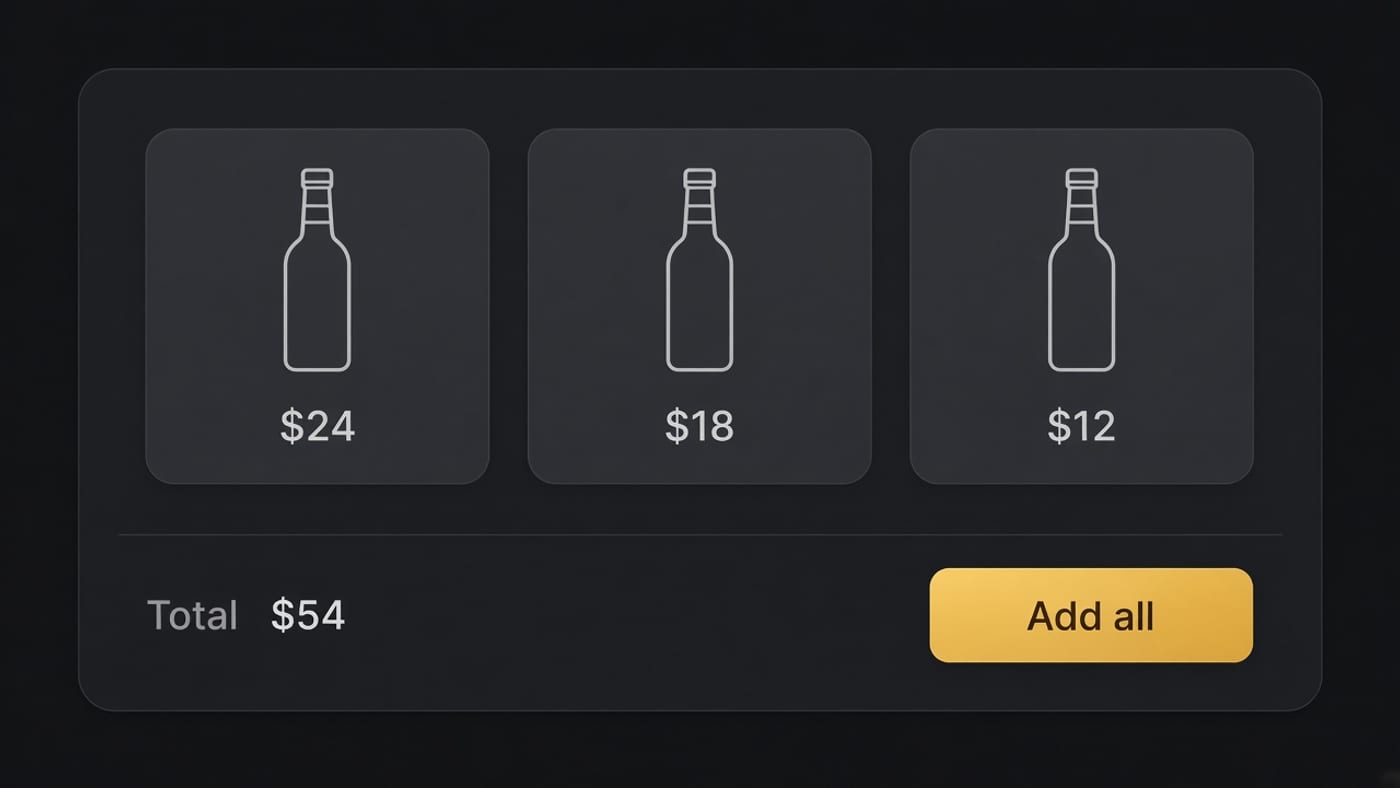
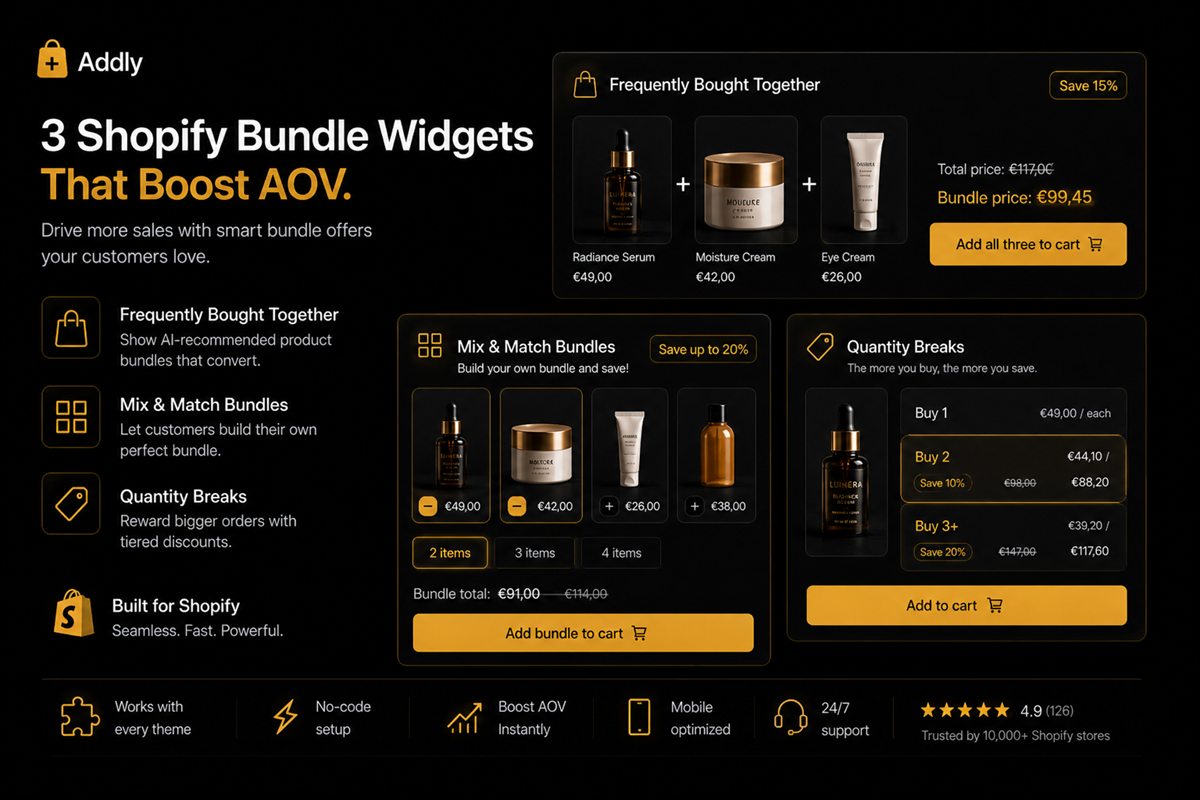
That card is the offer. Three products, each price visible, a total, and one button. If the set needs a paragraph, it is not ready.
Three details are doing the work. The products should come from orders, so the pair is already a habit at full price. Both prices are on the card, so the deal can be checked in a second. And there is one action. A bundle that asks for three separate adds is three chances to buy only the hero.
Addly is the Shopify bundles app we use for these: frequently bought together, fixed sets, mix and match, quantity breaks, add-ons and offers drawn from real orders. It is free under 15 orders a month, then $9.99, $24.99 and $49.99, with the same offer types on every plan. Install it from the Addly listing.
What a Black Friday bundle has to do
The set has to be understandable in one glance on a phone, priced so the added unit still makes money, and placed where it does not block add to cart. If any of those three fail, a bigger percent-off will not save it.
| Bundle | Best for | Discount shape | Watch-out |
|---|---|---|---|
| Fixed pair | A hero with one proven companion | 10–15% on the added item | Do not discount the hero as well |
| Mix and match | Gifts, shades, flavours | Price break at 3 and 6 units | Too many choices freeze the tap |
| Frequently bought together | Anything with order history | Small set discount, or none | Ignore category guesses |
| Add-on | A cheap completion (wrap, case, sample) | Optional, often full price | Do not make it required |
The rest of this guide is twelve shapes that fit that table. Pick two for the weekend, not twelve.
1. The proven pair
Pull the last 90 days of orders. Find the product that most often sits in the same order as the hero, priced well below it. That pair is the Black Friday bundle. A moisturiser and the serum people already add. A device and the case. Offer the pair under the button as one add.
If you do not have the report, frequently bought together on Shopify is the method. Addly can build the set from purchase history instead of a merchandiser's hunch, which matters when the weekend is too short to test ten guesses.
2. The gift box they build
Mix and match is the holiday bundle for stores with many small SKUs: shades, flavours, samples, charms. "Choose any 3" at one price. Cap the choice at one collection so the box still looks like a gift, not the whole catalogue.
Show the running total as they add. A shopper who cannot see the price until the end abandons the box and buys the single hero, which is the opposite of a Black Friday bundle.
3. The stocking trio
Three low-priced items, preselected, sold as one stocking stuffer. This is a fixed bundle, not a builder. The value is the editing. You did the choosing. Price it so one trio is an easy add next to a larger gift, and do not also run a sitewide 40% code on the same SKUs or the trio stops being a deal.
4. Hero plus the refill
Sell the device, the bottle, or the starter with the refill in the same set. The refill is the unit they will need in January. A small discount on the refill only. The hero stays at the campaign price you already planned. This protects margin better than a blanket percent off both.
5. Complete the routine
Skincare, coffee gear, hair, pet: three steps, one bundle. Name the steps in the title ("cleanse, treat, seal") so the shopper does not have to open three product pages. Keep it to three. A five-step routine is a regimen they will not assemble on a Friday night phone.
6. The add-on under the button
Gift wrap, a travel cap, a pouch, a sample of the adjacent scent. This is a product add-on, not a second bundle widget. One checkbox. Full price is fine when the add-on is obviously useful. A discount on a $6 pouch does less than simply showing it.
7. Two of the same, for a gift
"One for you, one to give" is a two-unit fixed bundle of the same hero, lightly discounted versus two singles. It is different from a quantity break, which is a ladder of 1, 2 and 3 on the product itself. Use the bundle when the story is a gift. Use the quantity break when the story is stocking up.
8. Shade or flavour flight
A set of three variants of one product: mini candles, sample perfumes, coffee bags. Mix and match if they should choose, a fixed flight if you want zero decisions. Variant-level pricing matters here. If one shade costs you more, do not let the bundle pretend every shade has the same margin.
9. The host set
For food, drink and home: the thing guests use together. Glasses plus a mixer. A throw plus the candle. Price the set under the cost of buying both at the campaign price, by a small gap, not a dramatic one. The host set fails when it includes a product nobody reorders, because then you trained a one-time basket with a permanent discount.
10. The travel edit
Minis and travel sizes in one bundle. Landed cost is low, perceived value is high, and the set does not replace the full-size hero if you keep full sizes out of the bundle. This is the same logic as a free gift with purchase, except the shopper pays, which is kinder to margin during a weekend when everyone expects something free.
11. The last-chance colourway
A holiday colour or a limited sleeve, bundled with the core product so the limited piece does not have to carry the page alone. When the limited unit sells out, hide the bundle the same day. A Black Friday bundle that shows an unavailable piece reads as a broken page, and broken pages do not convert at 9pm on 27 November.
12. The set that clears free shipping
Build one bundle whose price sits just over your free-shipping threshold. The shopper feels two wins: the set, and shipping. Do not also slash the threshold that weekend or the bundle loses its job. The threshold maths is in how to set a BFCM free shipping threshold. Goalify can show the bar. Addly presents the set.
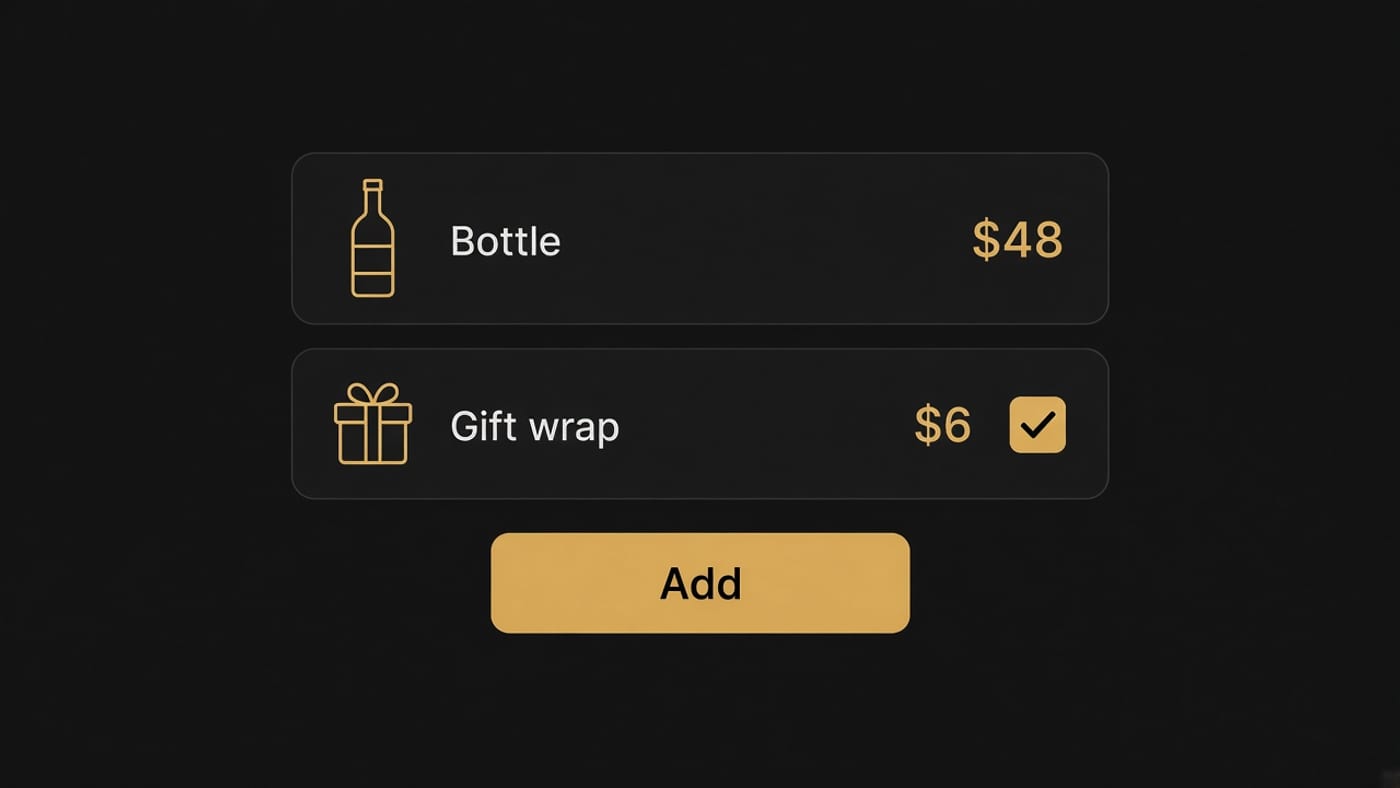
The set and the wrap are different decisions. The set is the considered extra. The wrap is a completion, and it can sit at full price. Discounting both, and then letting a sitewide code hit them again, means you no longer know which discount the order used.
A margin check before you publish a pair. Hero at a $48 campaign price, $22 landed. Companion at $18, $6 landed. Fifteen percent off the companion only costs you $2.70, against about $12 of gross profit on that added unit, and the hero stays at the price you already planned. Twenty percent off the whole $66 set gives away $13.20, including on a hero you were going to sell anyway. The louder version often makes less money. Run the same subtraction on your costs. If you cannot fill in landed cost, the bundle is not ready for the ad.
What to publish, and what to leave off
Publish one bundle on each hero, plus quantity breaks only on the consumables. Put Addy behind the set if the second unit should also appear in the cart drawer, and keep the drawer to one extra offer. The product bundles guide covers the types. The margin maths covers the discount you can afford.
If the page is already crowded, run the CRO Audit for Shopify stores on the hero URL before you add a fourth widget. A bundle under a buried add-to-cart button will not be seen.
Frequently asked questions
What is a good Black Friday bundle discount on Shopify?
Start at 10 to 15 percent off the added item, not 30 percent off the whole set. The bundle pays only when the extra margin from the added unit beats the discount given to people who would have bought both anyway. Deepen the discount only if the attach rate is too low after a few days of traffic.
Should every product have a Black Friday bundle?
No. Bundle the heroes that already have a natural pair, a refill, or a gift use. A one-off decorative item with no companion should stay a single product. Too many bundles on one product page slows the decision and trains shoppers to hunt for the biggest percent off.
Where should a Shopify bundle sit on the product page during BFCM?
Directly under the add-to-cart button, before the long description. The shopper has already chosen the hero. The bundle is a yes to one more thing, not a second storefront above the price.
Can I run quantity breaks and bundles in the same Black Friday promotion?
Yes, on different products. A consumable wants a quantity break. A kit wants a fixed bundle or a mix-and-match box. Putting both offers on the same product usually splits the click and lowers the take rate of each.
How do I know if a Black Friday bundle is cannibalising full-price sales?
Compare orders that contain both products before the promotion with orders during it. If most bundle buyers already bought the pair at full price, the discount is a gift to existing behaviour. The bundle discount maths walk-through shows the break-even.