 Addy
Addy  Addly
Addly  Goalify
  Monet
Monet  Reviso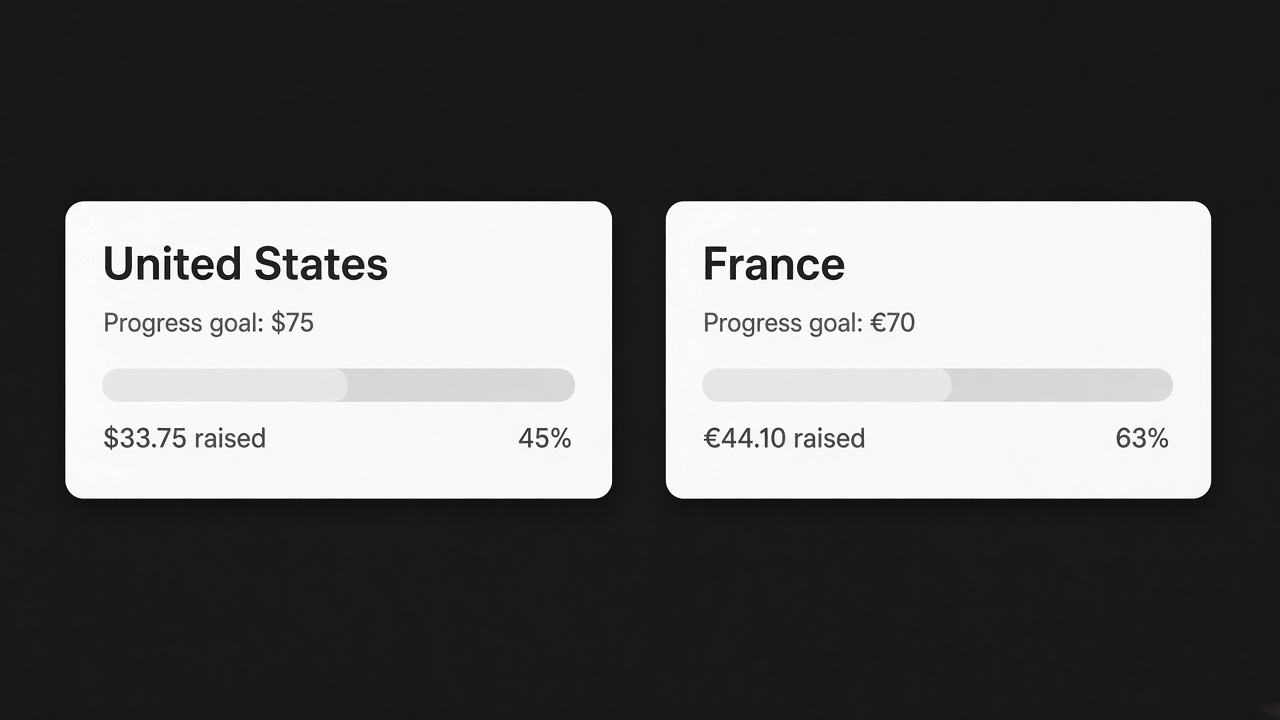
Key takeaways
- One free-shipping number for every country is how export carts stall. The label costs more, and the goal was written for home.
- The bar, the shipping discount and the currency the shopper sees have to be the same number.
- Goalify sets the threshold per country and shows it in the presentment currency.
- Start with the two countries that actually order. A matrix of forty goals on day one will be wrong in thirty-eight of them.
A $75 free-shipping threshold is a domestic sentence. The label to the next country costs a different amount, the average order is different, and a straight currency conversion is not a strategy. Showing every shopper the home number is how international carts reach checkout and bounce on the shipping price.
Set the countries that pay you
Pull the last ninety days of orders by country. Keep the two or three that are real. For each, note the average order and a typical label. The foreign threshold should sit just above that country's average, and the extra margin has to cover that country's label. The home method is in how to set free shipping over $X. Repeat it per country. Do not multiply $75 by an exchange rate and call it localised.
Round the result in the currency people think in. €70, not €68.40.
Make the discount match the bar
Shopify's free-shipping discount needs a minimum that matches the bar for that destination. If the discount is one global minimum, the bar can say €40 while checkout still wants the dollar rule. The shopper did the thing the bar asked. Checkout disagreed. That is the bug.
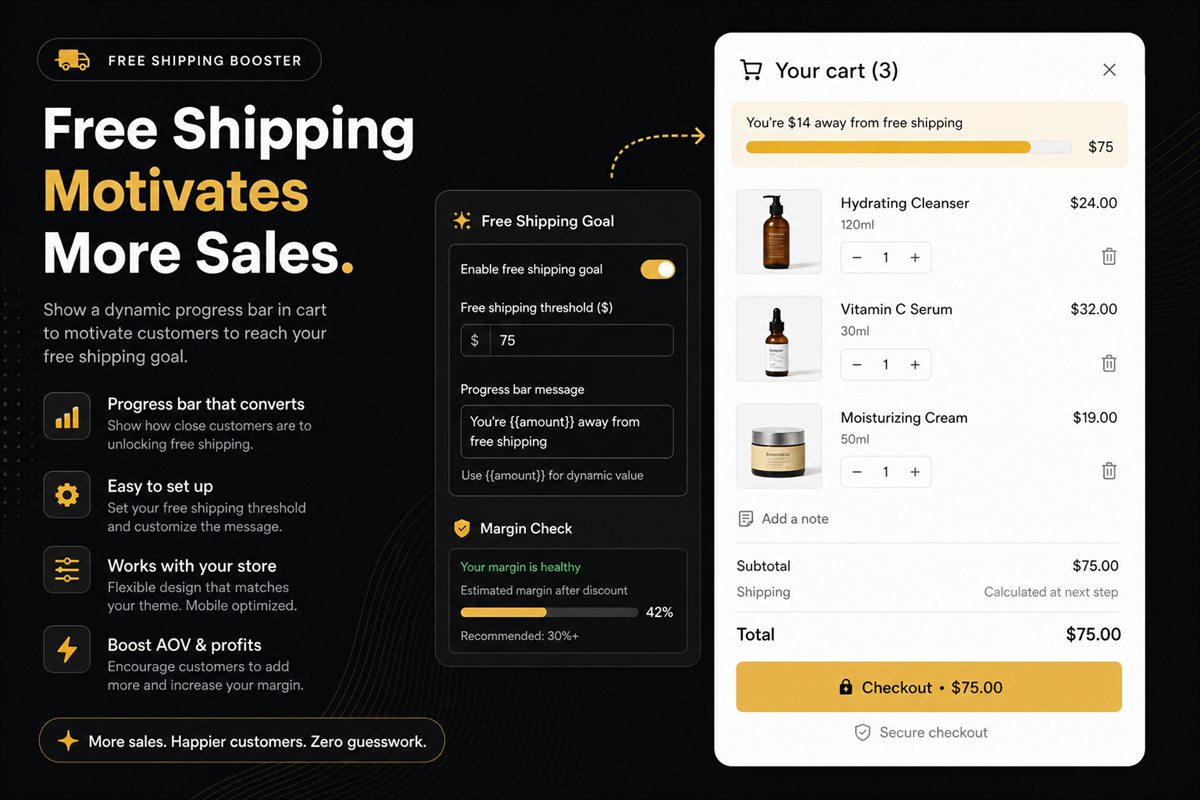
Goalify stores a threshold per country and shows the remaining amount in the shopper's presentment currency. The bar can sit on the storefront, in the cart, and on the product page. Country rules are part of the product, including on the paid plans that start at $3.99 after the free band under 10 orders. Built for Shopify.
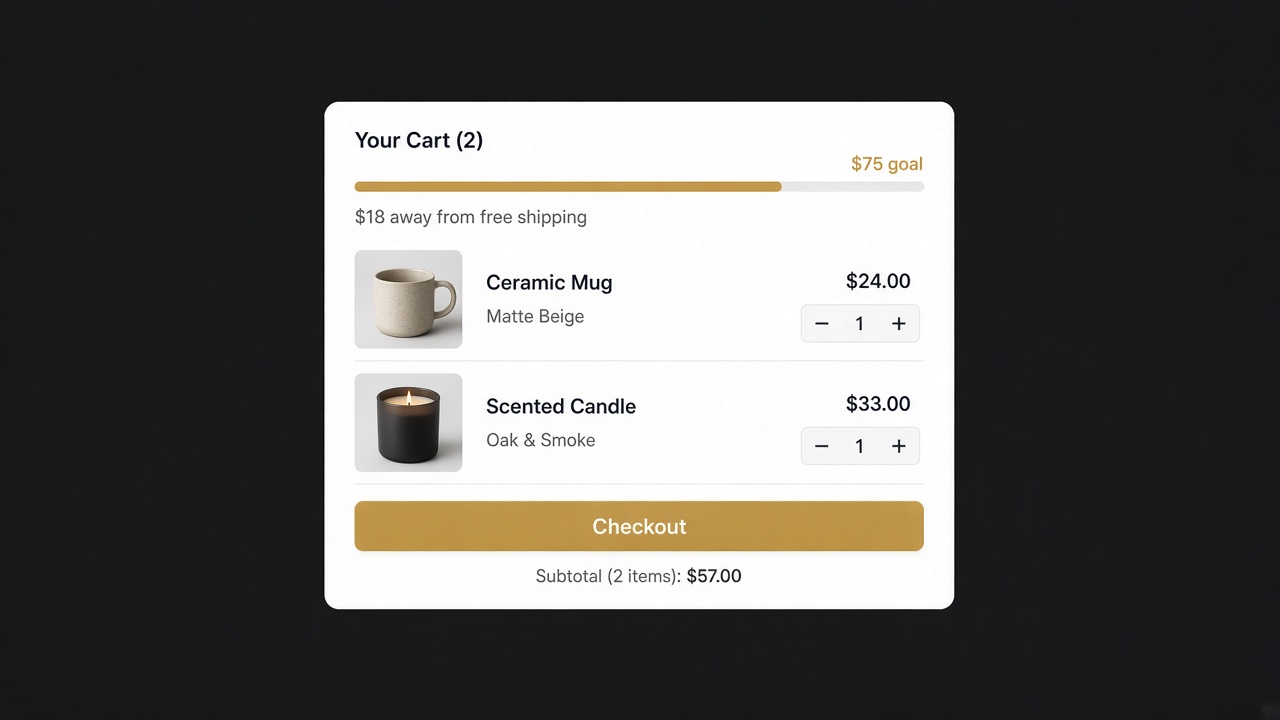
If the cart is a drawer, the same country goal should be what Addy shows. Two bars with two countries' numbers is worse than one honest bar.
What to publish first
| Country | Do this |
|---|---|
| Home | The number you already run, written as a remaining amount |
| The next country that actually orders | Its own threshold, from its labels, rounded |
| Everywhere else you ship | A simple second number, reviewed when volume shows up |
| Countries you do not ship to | No bar |
A/B test the home threshold and the export threshold separately. A winner at home is not a winner on a more expensive label. Goalify can test the threshold and the copy.
One home number, priced as if every label cost the same
A shop ships from the United States. These figures are an example you replace with your own invoices.
| Destination | Recent average order | A typical label | A threshold worth testing |
|---|---|---|---|
| United States | $54 | $6 | $75 |
| Germany | €48 | €14 | €90 |
| United Kingdom | £46 | £11 | £80 |
| A country with three orders | Too few to average | Whatever the invoice says | No special goal yet |
The US threshold sits just above $54, and the extra item has to cover a $6 label. The German threshold sits further above the average because the label is €14. A straight conversion of $75 into euros ignores that invoice. It also ignores that German prices may already be shown with tax included, so the number on the bar has to be the number the shopper thinks they are spending. If your store shows tax-inclusive prices in that market, the threshold the shopper reads should be tax-inclusive too. Place a test order and compare the bar to the amount Shopify uses for the shipping discount. Those two amounts are the whole feature.
Round in the currency people say out loud. €90, £80, $75. A threshold of €87.40 is a spreadsheet that leaked.
Markets change the currency. They do not write the goal
Shopify Markets can price a product in euros and show a European catalogue. The progress bar is still a rule you configure. If the bar has one domestic minimum, every market sees it, converted or not. Goalify stores a threshold per country and shows the remaining amount in the presentment currency. That country configuration is on the paid plans, from $3.99 after the free band under 10 orders a month. Built for Shopify. The bar can sit on the storefront, in the cart, and on the product page.
The Shopify free-shipping discount has to agree. One global minimum means the bar can say €40 while checkout still wants the dollar rule. Build the discount so the destination the shopper selected is the destination the minimum describes. Then add a product until the bar completes, and open checkout. Standard shipping should be free. Remove a unit. It should charge again.
If the cart is a drawer, Addy should show that same country goal. A header bar in euros and a drawer bar in dollars is two promises. Keep one.
What to calculate before you add a fourth country
- Orders, last ninety days, by country. Drop anyone under a volume you would trust. Three orders is an anecdote.
- Average merchandise value for the countries you kept.
- A typical label, from invoices, not from a rate-card guess you made in January.
- The margin on the item people actually add to close the gap. If that margin is smaller than the label, raise the threshold or stop offering free shipping there.
- A round number in their currency.
- One test order. Bar, then checkout, then remove a unit.
A/B tests belong on the countries with enough traffic to finish. Testing a threshold in a country that sends twenty sessions a week will not finish. Test the home number. Test the next real country. Leave the long tail on a simple second number until the orders show up. Goalify compares the threshold and the copy. A winning sentence at home can be copied. A winning number should not.
Countries you do not ship to get no goal. Hide the bar. A remaining amount you cannot fulfil becomes a ticket the moment they pay.
The home arithmetic, including where to set a single $X, is in free shipping over $X.
Install Goalify. One bar, more than one number.
What the shopper actually compares
They do not compare your domestic policy to a strategy deck. They compare the bar to the shipping line at checkout, in the currency on the screen.
Walk Germany with the example numbers. The bar says "€22 away from free shipping" on a €68 cart, because the goal is €90. They add a €24 product. The cart is €92. Checkout shows standard shipping at €0. That is a pass.
Now break it on purpose, so you know what failure looks like. Leave the Shopify discount at a converted $75 minimum, about €70, while the bar says €90. At €75 the bar still asks for more, and checkout has already made shipping free. Or the reverse: the bar completes at €70 and checkout still wants €90. Both are the same bug. The bar and the discount are describing different goals. Fix the discount to the country's number before you translate another string.
Tax changes the number they see. A €90 goal on tax-inclusive prices is a different cash amount from a €90 goal on tax-exclusive prices. Use the figure printed on the product page in that market. Place the test order while previewing as a customer in that country, not while your admin is set to the home market. An admin preview in dollars will "confirm" the domestic rule and miss the export one.
A sensible order of work
Week one, home only. The bar, the discount, and four test orders. Week two, the next country that actually pays you, with its own label and its own round number. Week three, a test of the home threshold against one alternative, if you have the orders to finish it. The long tail of countries stays on a simple second number, or on no bar if you do not ship there.
Do not launch forty country goals because the spreadsheet had forty rows. Empty rows become wrong rows. Goalify will store the ones you mean, on the paid plans, and show them in the presentment currency. The free band under 10 orders a month is there to prove the home bar. Country configuration is the reason the paid plan exists.
If Addy is the cart, the drawer should read the same remaining amount the header does. Edit the goal once. A second bar with a typed-in conversion will be stale the week rates move, and it was the wrong method even when the rate was fresh.
Frequently asked questions
Can Shopify Markets use a different free shipping threshold per country?
Markets can change currency and price. The progress bar still needs its own country rule, or every shopper sees the domestic goal. Goalify stores that rule per country.
Should the threshold be converted from the home currency?
Only as a starting guess. A straight conversion ignores the real label cost. Set the foreign number from that country's orders and shipping cost, then round it.
The bar is in euros but checkout uses the dollar minimum. What happened?
The bar converted the display and the discount did not, or the reverse. The qualifying amount and the displayed amount have to be the same rule.
Do I need a different bar design per country?
No. The same bar, a different number. Design is the last step.
What about a country I do not ship to?
Do not show them a free-shipping goal. Hide the bar, or show that you do not ship there. A goal you cannot fulfil is a complaint.
Do I convert $75 into euros and publish that?
Only as a draft number. Replace it with a threshold built from that country's orders and that country's label, then round it.
Are country thresholds on the free Goalify plan?
Country configuration is on the paid plans, from $3.99 a month after the free band under 10 orders. The free plan is the bar, the goals, and the analytics.