 Addy
 Addly
 Goalify
 Monet
 Reviso
 Rankly
Key takeaways
- Break-even ROAS is 1 divided by your gross profit margin, and a discount raises it because the price falls while your costs stay put.
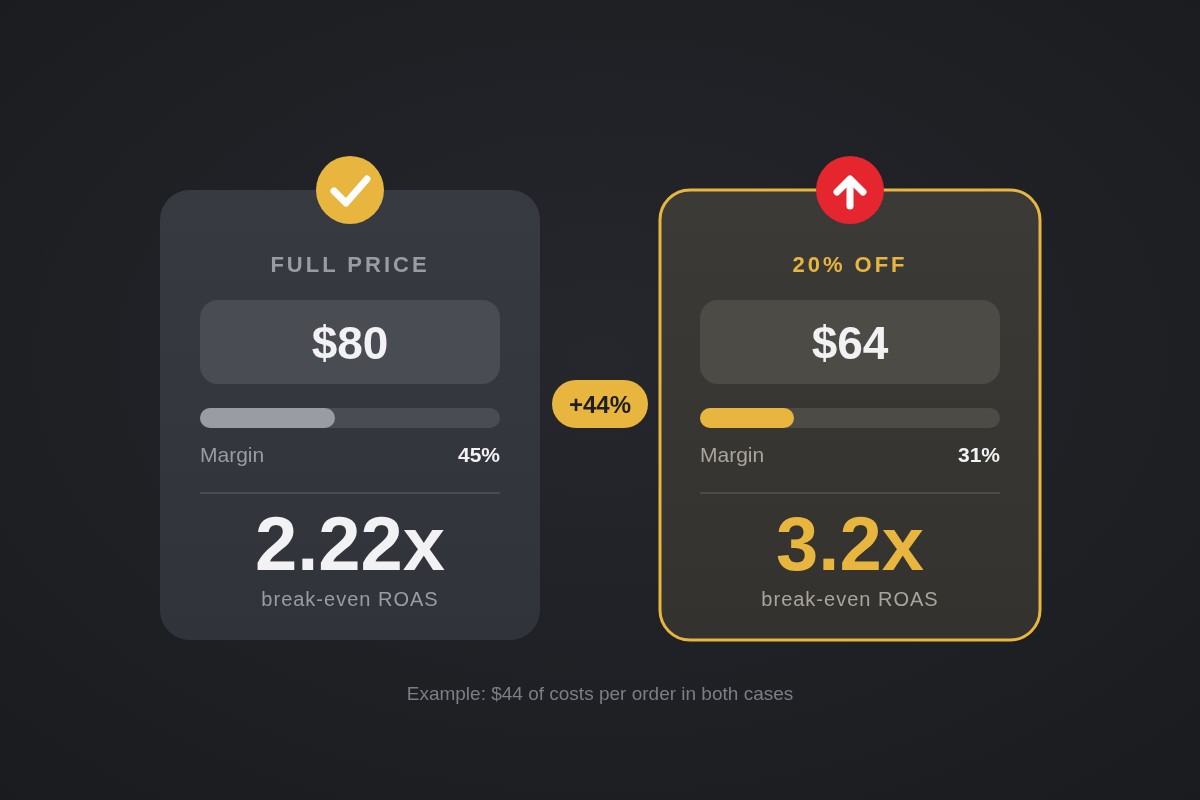
- In the example below, a 45% margin product with 20% off needs a 3.2x ROAS to break even, up from 2.22x at full price.
- The discounted margin is (margin minus discount) divided by (1 minus discount); once the discount equals your margin, no ROAS breaks even.
- At 20% off you earn $20 per order instead of $36, so you need 1.8 times the orders just to make the same profit.
- Raise your target ROAS in the ad platform on the day the sale starts, not after a week of spending against last month's number.
Your break-even ROAS goes up the moment you discount, and it goes up faster than the discount does. A product with a 45% margin breaks even at a 2.22x ROAS at full price. Put 20% off and the number becomes 3.2x. Black Friday is November 27, so you have about a week to reset your ad targets before the traffic arrives.
This post gives you the formula, a table you can read your number off, and three ways to keep the sale profitable. Every figure that is not from a linked source is an example, and the assumptions are stated.
The formula, and where discounts break it
Shopify's own guide gives the two lines: gross profit margin is (revenue minus variable costs) divided by revenue, and break-even ROAS is 1 divided by that margin. Its worked example is a $100 product with $60 of variable costs. That is a 40% margin and a break-even ROAS of 2.5.
The variable costs it lists are cost of goods sold, shipping, payment processing fees and pick-and-pack fees. Fixed costs like rent and salaries stay out.
The trap is that most merchants calculate this once, at full price, and leave it in a spreadsheet. A discount changes the revenue side only. Your product still costs what it costs, and shipping still costs what it costs.
Work the example through
Take a product that sells for $80. These are example numbers, not benchmarks.
- Cost of goods: $30
- Shipping and packaging: $8
- Payment fees: $3
- Pick and pack: $3
- Total variable costs: $44
Full price: $80 minus $44 leaves $36 profit. Margin is $36 divided by $80, which is 45%. Break-even ROAS is 1 divided by 0.45, or 2.22.
Now run a 20% sale. The price becomes $64. Your costs stay at $44 (payment fees fall by a few cents, which we ignore to stay conservative). Profit per order is $20. Margin is $20 divided by $64, or 31.25%. Break-even ROAS is 1 divided by 0.3125, which is 3.2.
Same product, same ads, and your target ROAS rose by 44%. An ad set that was comfortably profitable at 2.6x last month is now losing money on every order.
The shortcut: discounted margin in one line
You do not need to rebuild the sheet for every discount. Use this:
Discounted margin = (margin − discount) ÷ (1 − discount)
With a 45% margin and 20% off: (0.45 − 0.20) ÷ 0.80 = 0.3125. That matches the long version. It assumes your costs per order stay the same. If you ship free above a threshold or pay for a gift, add those costs to the variable-cost line first.
Two things follow. First, the formula only works while the discount is smaller than your margin. At a 45% discount on a 45% margin you earn nothing on each order before ads, so no ROAS can break even. Second, the target climbs steeply near the edge, as the table shows.
Break-even ROAS lookup table
This is the same example product, a 45% margin at full price. Find the row closest to your offer, then repeat the maths with your own margin.
| Discount | Margin after discount | Break-even ROAS | Orders needed to match full-price profit |
|---|---|---|---|
| 0% | 45.0% | 2.22x | 1.0x |
| 10% | 38.9% | 2.57x | 1.29x |
| 15% | 35.3% | 2.83x | 1.50x |
| 20% | 31.3% | 3.20x | 1.80x |
| 25% | 26.7% | 3.75x | 2.25x |
| 30% | 21.4% | 4.67x | 3.00x |
| 40% | 8.3% | 12.00x | 9.00x |
The last column is profit per order at full price divided by profit per order at the discount. At 20% off you earn $20 instead of $36 per order, so you need 1.8 times as many orders to end the day with the same profit. A sale has to bring far more than 1.8 times the traffic or conversion to be worth running at that depth.
Set the target before the sale starts
On the day the offer goes live, change two things.
- Update your target in the ad platform. If you run a ROAS or cost-cap bidding goal, replace the full-price number with the discounted one from the table. Leaving last month's target in place tells the algorithm that a break-even order is a win.
- Split reporting by offer. Keep a column for orders that used the discount and one for orders that did not. Blended ROAS hides the point where discount buyers stop paying for themselves.
Use the same variable-cost list every time. The cleanest way is one sheet with price, the four costs from Shopify's guide, and the discount percentage as the only input you change.
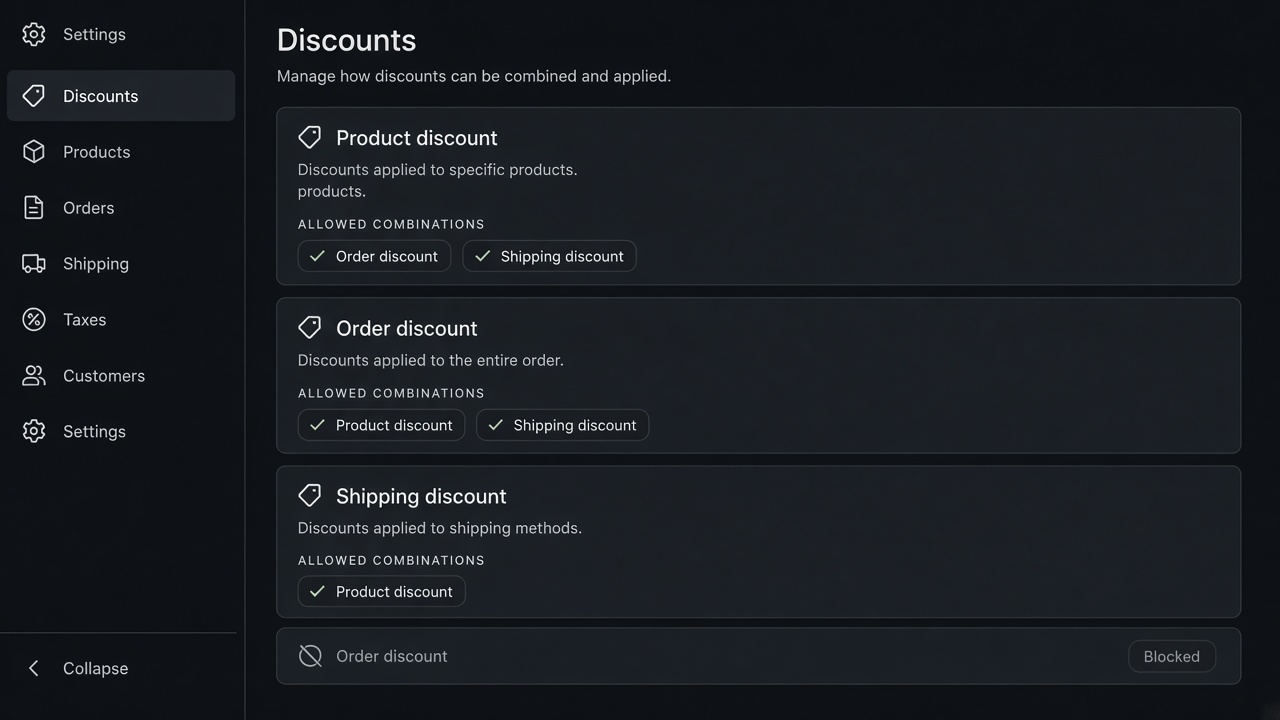
In your Shopify admin, open Discounts to see which offers are live. Shopify allows up to 25 active automatic discounts, and the types include amount off, free shipping, buy X get Y and app-based discounts. Count them before the sale so stacked offers do not take your margin lower than the table assumes. The discount stacking guide shows what combines and what does not.
Three ways to bring the ROAS target down
You cannot argue with the formula, but you can change its inputs.
1. Discount less on the hero product. A 10% to 15% price cut lifts the target by only 0.35x to 0.6x in the example. Put the deeper cut on a clearance SKU where your margin is higher or the stock is aging.
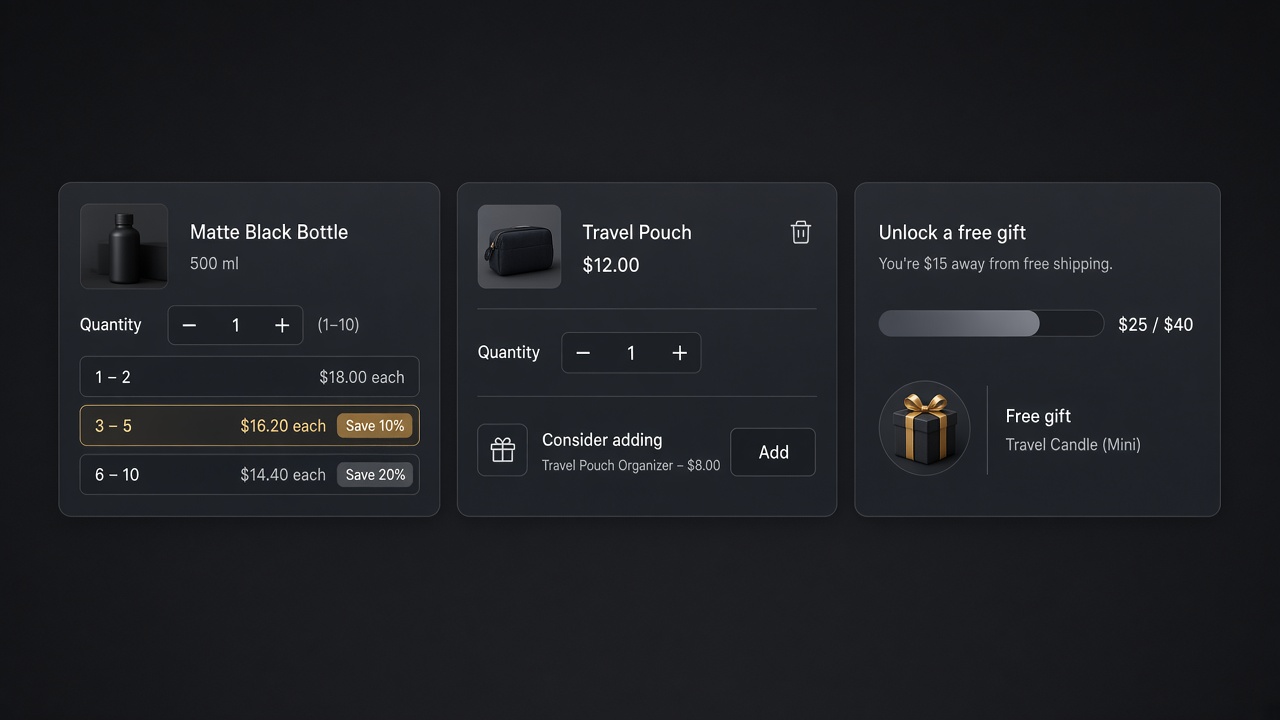
2. Make each order bigger instead of cheaper. Margin gets you the ROAS target. Profit per order gets you the cost-per-order budget. Take a "buy 2, save 15%" offer on the $80 product. Revenue is $136, costs are $88 (conservatively, no shipping saving), profit is $48 and the margin is 35.3%. That is the same 2.83x break-even ROAS as a flat 15% off, but each order earns $48 instead of $24. You can afford to pay twice as much to win the order.
Addly builds this kind of offer: bundles, frequently bought together, volume discounts, add-ons and mix-and-match, with every offer type on every plan. It is Built for Shopify, rated 4.9★ from 111 reviews, and free under 15 orders a month. Paid plans are $9.99, $24.99 and $49.99 by monthly order volume. Monet is free and adds a popup offer at add to cart or on exit intent, which suits a second item that does not fit in a bundle.
3. Protect the margin with a threshold, not a code. A single sitewide code gives the same discount to the shopper who was going to buy two items anyway. Offers that unlock at a higher cart value keep the deep price for the larger order. The free shipping threshold guide walks through setting that number.
Check this week
Do these before November 27:
- Rebuild your variable-cost list with the four costs above and write down your full-price break-even ROAS.
- Choose the discount depth, read the new target from the table, and set it in the ad platform.
- Run the CRO audit on your top product page, since a fix that lifts conversion rate lowers the ROAS you need as well.
- Review the pre-sale fix list for the page-level problems that waste paid clicks.
Write the numbers on one page so whoever approves spend during the weekend has a single number to beat.
Frequently asked questions
What is break-even ROAS?
It is the return on ad spend at which an order pays for its own product, shipping and fees and leaves nothing extra. Shopify's formula is 1 divided by gross profit margin. If your margin is 40%, break-even ROAS is 2.5, which means every $1 of ads must bring back $2.50 in revenue.
Does a discount change break-even ROAS?
Yes. The discount lowers the price but your product cost, shipping and fees mostly stay the same, so your margin shrinks and the ROAS you need goes up. A deeper discount raises the target faster than most people expect.
Which costs go into the margin for this calculation?
Shopify's guide counts cost of goods sold, shipping, payment processing fees and pick-and-pack fees as variable costs. Fixed costs such as rent and salaries are left out. Use the same list every time so your numbers stay comparable.
What if my ROAS during the sale is below break-even?
Cut the discount, pause the weakest ad sets, or raise the order value with a bundle or add-on so each order carries more profit. Do not keep spending in the hope that volume fixes it, because every extra order at a ROAS below break-even loses money.