 Addy
Addy  Addly
Addly  Goalify
  Monet
Monet  Reviso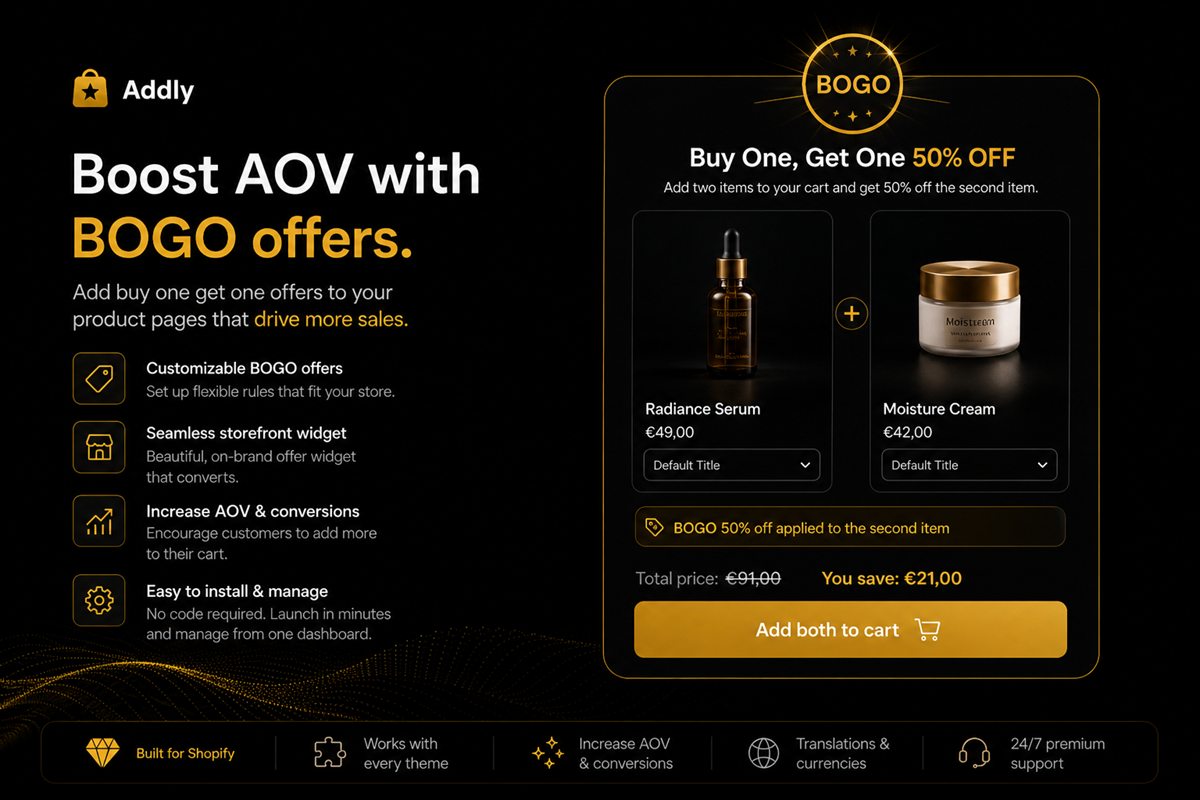
Key takeaways
- BOGO free is a fifty percent discount wearing a costume. It requires a gross margin above fifty percent just to break even on the pair.
- Buy one get one half price is the workhorse variant, needing only about a twenty-five percent effective discount while reading as a much bigger deal.
- Cross-category BOGO ("buy X get Y") is usually more profitable than same-product BOGO because it introduces a second line rather than doubling the first.
- BOGO works best where consumption scales with supply. It fails where the second unit simply delays the next purchase.
Buy one get one free is arithmetically a 50% discount on two units. It does not feel like one, which is exactly why it is used, and exactly why it is dangerous.
The perception gap is real and well documented: shoppers rate "buy one get one free" more favourably than "50% off two", despite the identical outcome. That gap is worth money. It is also worth exactly nothing if your gross margin cannot absorb the arithmetic.
The four variants and what each costs
| Variant | Effective discount on the pair | Minimum gross margin to break even |
|---|---|---|
| Buy 1 get 1 free (same item) | 50% | ~50% |
| Buy 1 get 1 half price | 25% | ~25% |
| Buy 2 get 1 free | 33% | ~33% |
| Buy X get Y free (cheaper item) | Depends on price ratio | Typically 25–35% |
"Break even" here means the gross profit on the promoted pair matches the gross profit on a single unit sold at full price. It is a floor, not a target — and it assumes zero cannibalisation, which is never true.
Why BOGO free is usually the wrong choice
At a 55% gross margin, a $40 product yields $22 of gross profit.
Give one away free and you have sold two units for $40. Your cost of goods is now $36, so your gross profit on the pair is $4 — against $22 for a single full-price sale.
That is only worthwhile if the promotion creates a large number of buyers who would otherwise have bought nothing at all. In most categories it does not. It creates buyers who would have bought one.
Run the comparison properly, per 100 promotion buyers, at a 55% margin on a $40 product:
| Scenario | Would have bought 1 | Would have bought 0 | Gross profit | Baseline (no promo) | Net |
|---|---|---|---|---|---|
| Pessimistic | 80 | 20 | $400 | $1,760 | −$1,360 |
| Realistic | 60 | 40 | $400 | $1,320 | −$920 |
| Optimistic | 30 | 70 | $400 | $660 | −$260 |
At 55% margin, BOGO free loses money even in the optimistic case. You need margin well above 60% before the arithmetic works — which is why BOGO free is common in categories like fashion accessories, cosmetics and supplements, and rare in electronics or food.
Buy one get one half price: the workhorse
The variant that works for most stores.
Effective discount on the pair is 25%, which most healthy consumer margins absorb comfortably. It still reads as a two-for-one style offer rather than as a percentage discount, so it keeps a good share of the perception advantage.
At the same $40 product with 55% margin: two units sell for $60, cost of goods $36, gross profit $24 — higher than the $22 from a single full-price sale. The promotion is profitable from the first cannibalised customer onward, which is a completely different risk profile.
Cross-category BOGO is usually better
"Buy any jacket, get a beanie free" beats "buy one jacket get one free" on nearly every dimension.
- Lower cost, because the free item is cheaper than the anchor.
- No cannibalisation of the anchor, since you are not giving away a second unit of something the customer wanted one of.
- Introduces a second product line, which has downstream value the same way a sample does.
- No price anchoring damage to your hero product.
The main design constraint is relevance. The free item must be something the customer plausibly wants, or the offer reads as clearing out dead stock — which, if that is what it is, will be obvious.
Where BOGO genuinely works
The format performs where consumption scales with supply — where having two means using two, rather than using one and storing the other.
Good fits:
- Consumables with flexible usage. Skincare, supplements, cleaning products, snacks. Having more leads to using more.
- Items that wear out or get lost. Socks, phone cables, hair ties.
- Gifting categories, where the second unit has an obvious separate recipient.
- Seasonal items with short windows, where clearing stock has its own value.
- Trial-driving cross-category offers, where the free item introduces a new line.
Poor fits:
- Durables. Nobody needs two kettles.
- Slow consumables with a fixed cycle. If a bottle lasts three months, two bottles last six, and you have discounted a sale you were going to make at full price anyway.
- High-consideration purchases where the decision is about which, not how many.
- Low-margin categories, for the arithmetic above.
Operational details
Which item is free? The cheaper one. State it explicitly in the offer terms; customers who expect the more expensive one to be free will feel misled, and support will spend their week on it.
Mixed variants. Can they combine a small and a large? Usually yes, and usually the lower-priced variant is the free one. Decide it and enforce it in the rules.
Stacking. BOGO plus a site-wide code plus a free shipping threshold produces an effective discount well beyond what you modelled. Either exclude BOGO items from code stacking or raise the free shipping threshold for orders containing one.
Returns. If a customer returns the paid item and keeps the free one, what is the refund? The standard answer is to refund the paid amount minus the value of the retained free item. Write the rule down before it happens.
Inventory. BOGO consumes stock at twice the rate of a normal promotion. A BOGO that sells out in a day is a marketing cost with no revenue attached.
Presentation
- Show the saving as currency, not percentage. "Save $40" is the point of BOGO. Converting it to a percentage discards the reason you chose the format.
- Show the second item as a $0.00 line in the cart, so the customer can see it landed.
- Auto-add where you can. Requiring the customer to manually add the second item to qualify loses a share of the take rate to confusion.
- State the terms in one line. "Add 2 items, cheapest is free. Discount applied at checkout."
- Give it an end date. An indefinite BOGO becomes the price. The perception advantage evaporates once it is permanent.
Measuring it
- Units per order on promoted products, versus baseline.
- Effective discount rate — total discount ÷ promoted revenue, including any stacking.
- Gross profit per order during the promotion versus the comparable period before.
- Post-promotion dip. The critical one. Track sales of the promoted product for the four weeks after the promotion ends. A deep trough means you pulled demand forward rather than creating it, and the promotion's true cost includes that trough.
- New customer share of promotion buyers. If it is high, the promotion is doing acquisition work and deserves to be judged partly on lifetime value rather than on first-order margin.
Frequently asked questions
Is BOGO the same as a fifty percent discount?
Buy one get one free is arithmetically identical to fifty percent off two units, but it does not read that way to shoppers, who consistently rate it as a better deal. That perception gap is the entire reason to use the format, and it is also why it is easy to run at a loss without noticing.
What margin do I need to run BOGO free?
Above fifty percent gross margin just to break even on the pair, and realistically above sixty percent to make it worthwhile once shipping and returns are included. Below that threshold, use buy one get one half price or a percentage discount instead.
Does BOGO work better than a percentage discount?
It depends on the category. BOGO performs well where a second unit is genuinely useful - consumables, socks, seasonal items, gifting. It performs poorly where the second unit simply postpones the next purchase, because you have discounted a sale you would have made anyway at full price.
Should the free item be the cheaper or the more expensive one?
The cheaper one, almost always. "Get the lower-priced item free" is standard, it protects margin, and shoppers expect it. Discounting the more expensive item makes the offer significantly more costly with only a marginal increase in appeal.
Can BOGO cannibalise full-price sales?
Yes, and this is the main hidden cost. Customers who would have bought one unit at full price now buy two at an effective discount. If your baseline repeat-purchase cycle is short, you may simply be pulling forward a sale you were going to make anyway.