 Addy
Addy  Addly
Addly  Goalify
  Monet
Monet  Reviso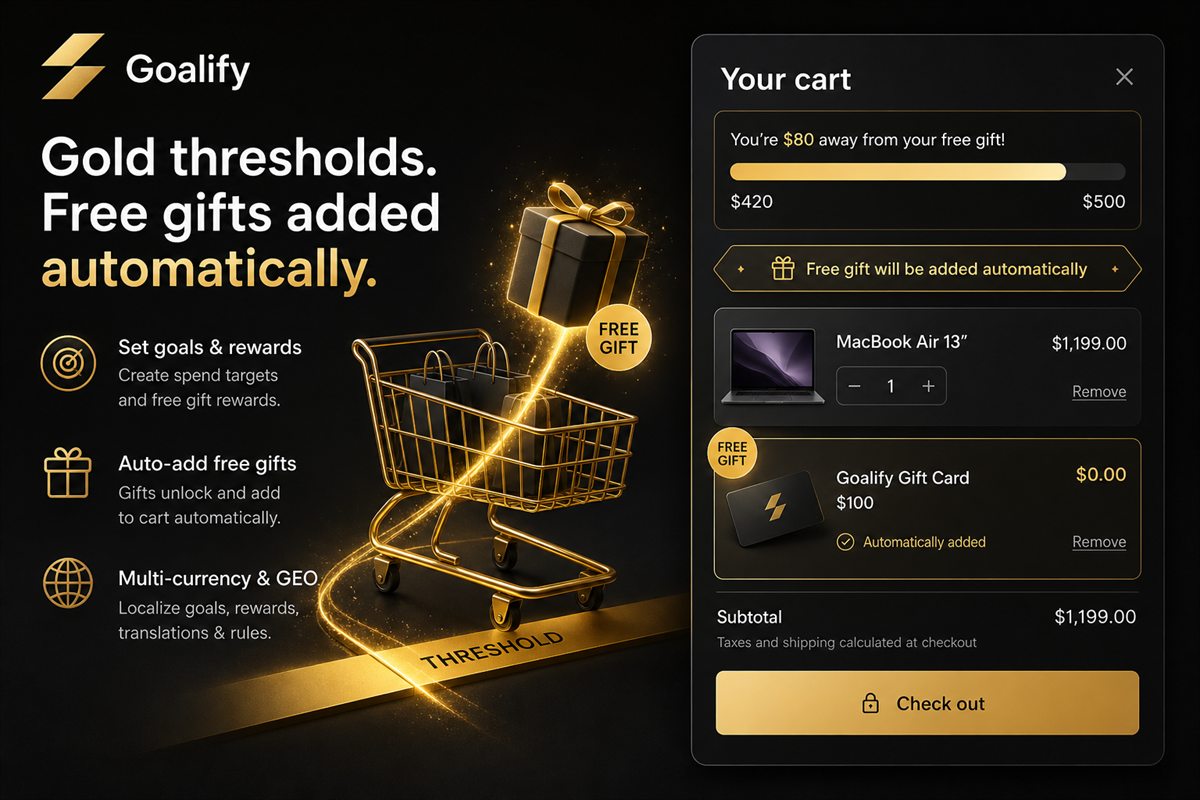
Key takeaways
- The gift must have high perceived value and low landed cost. Those are two separate variables and most stores optimise only the second.
- A gift threshold works best above your free shipping threshold, as the second rung of a ladder rather than a competing offer.
- Sample and travel sizes are the strongest GWP category because they carry real value, cost little and seed a future full-size purchase.
- Gift stockouts are the main operational risk. A promised gift that cannot be fulfilled costs more goodwill than the gift was ever worth.
A free gift with purchase is one of the more powerful average-order-value mechanics available, and one of the easiest to run at a loss without noticing.
The reason is that the cost side is visible — you know what the gift costs — while the value side is not. A gift with a $2 landed cost that nobody wants produces nothing. A gift with a $6 landed cost that customers genuinely value can move a meaningful share of your order distribution.
The whole exercise is picking the second kind.
Perceived value and landed cost are different variables
Most stores optimise only for cost, which is how you end up giving away branded stickers.
The number that matters is the ratio:
Gift efficiency = perceived value to the customer ÷ landed cost to you
Landed cost includes the unit cost, the additional pick-and-pack time, and any change to shipping weight or box size. A gift that pushes a parcel into the next weight bracket is far more expensive than its unit cost suggests.
Perceived value is what the customer believes they got. It is heavily influenced by whether the item has a visible price elsewhere on your site — which is why "worth $18" is credible for a product you actually sell and meaningless for a promotional item that has never had a price.
| Gift type | Perceived value | Landed cost | Efficiency |
|---|---|---|---|
| Travel/sample size of your bestseller | High | Low | Excellent |
| Full-size product you also sell | Very high | High | Poor — and cannibalising |
| Exclusive item not sold separately | Medium–high | Low–medium | Good |
| End-of-line stock | Medium | Very low (sunk) | Excellent |
| Branded merchandise | Low | Medium | Poor |
| Digital guide or content | Low–medium | Near zero | Situational |
| Consumable accessory | Medium | Low | Good |
Why sample and travel sizes win
They score well on every axis at once.
- Perceived value is anchored to a product with a known price. Customers understand what a 30ml version of a 200ml product is worth.
- Landed cost is genuinely low, often a fraction of the full-size margin.
- They do not cannibalise, because a sample is not a substitute for the full size — it is an advertisement for it.
- They seed future purchases. A customer who tries a new product from your range because it arrived free has been introduced to a second line at zero acquisition cost.
That last effect is the one that makes samples pay for themselves twice, and it is why beauty and supplements categories have used the mechanic for decades.
Avoid full-size giveaways of active products
Giving away the full-size version of something you actively sell creates two problems.
Direct cannibalisation. Customers who would have bought it now get it free. That is not a promotion, that is a discount with extra logistics.
Price anchoring damage. A product routinely given away develops a perceived value close to zero. Once customers learn that item X comes free above $120, buying item X at full price starts to feel like a mistake.
The exception is deliberate: giving away a product you are discontinuing or overstocked on. There the sunk cost is real and the anchoring damage does not matter because you are exiting the line anyway.
Threshold placement
A gift threshold works best as the second rung of a ladder, not as a standalone offer.
A typical structure derived from an order value distribution:
- Free shipping at the 60th–75th percentile — the entry goal, reached by many.
- Free gift at roughly the 85th percentile — the stretch goal, reached by fewer.
That shape works because the second goal appears at the moment the first is met, which is exactly when a shopper would otherwise stop adding. It also means the gift is only given to genuinely larger orders, where the margin comfortably absorbs it.
Setting the gift threshold below free shipping inverts the logic — the cheaper reward sits above the more valuable one — and setting them at the same value wastes one of them.
Letting the customer choose
A choice of two or three gifts consistently outperforms a single fixed gift.
The reasons are straightforward: choice raises perceived value, it increases the chance that at least one option appeals, and it produces genuinely useful preference data about your catalogue.
Keep it to three. Beyond that you add decision cost, multiply your inventory exposure across several SKUs, and make the picker interface something that needs designing rather than something that fits in the cart.
The operational traps
This is where free gift promotions actually fail.
Stockouts
The most common and the most damaging. The gift is not a product the customer bought, so a stockout feels like a broken promise rather than a supply issue.
Requirements:
- Reserve stock specifically for the promotion, separate from sellable inventory.
- Suppress the offer automatically the moment stock hits your reserve floor.
- Handle in-flight carts explicitly. A gift that silently disappears between cart and confirmation is worse than one that was never offered.
Returns
If a customer returns enough of the order to fall below the gift threshold, what happens to the gift? Most policies do not say, which means the default is that the customer keeps it.
Usually that is the right answer — chasing a $4 sample is not worth the support interaction — but decide it deliberately and write it down, because at scale it is a real cost line.
Shipping weight and packaging
A gift that changes the parcel dimensions or pushes it into the next weight bracket can cost more in freight than in goods. Check the actual packed configuration before launching, not the unit cost in a spreadsheet.
Multiple gifts in one order
Does a $400 order get one gift or three? Almost always one. Make sure the rule is enforced in the cart logic rather than assumed.
Copy that works
The gift needs framing, not just listing.
- Name the item and its value. "Free 30ml travel size (worth $18)" beats "free gift" substantially, because "free gift" could be anything and the shopper assumes the worst.
- Show it. A product image in the progress bar or cart converts better than text alone.
- State the gap. "Add $23 more for a free travel size" — same pattern as the shipping bar.
- Make the earned state obvious. When it is unlocked, show it in the cart as a line item at $0.00 so the customer can see they have it.
Measuring it
- Take rate — orders above the gift threshold as a share of all orders, before and after launch.
- Incremental orders crossing the threshold, not just the total above it. Some were always going to be there.
- Gift cost as a percentage of revenue. The direct cost.
- Gross profit per order above the threshold versus below it. The verdict.
- Repeat purchase rate of the gifted product's full-size version. This is the sampling payoff, and it usually takes a full purchase cycle to appear — often 60 to 120 days.
That last one is why sample-based gifts are frequently undervalued in a monthly report. The revenue shows up a quarter later and in a different line item, so the promotion looks more expensive than it was.
Frequently asked questions
What makes a good free gift with purchase?
High perceived value relative to landed cost, genuine relevance to what the customer is already buying, and small physical size so it does not disrupt packing or shipping weight. Travel and sample sizes of your own products usually score best on all three.
What threshold should a free gift be set at?
Above your free shipping threshold, so the two form a ladder rather than competing. A common structure is free shipping at the sixtieth to seventy-fifth percentile of order values and a gift somewhere around the eighty-fifth, which gives shoppers who clear the first goal a reason to keep going.
Should customers choose their gift?
A choice of two or three increases perceived value and take rate, and gives you useful preference data. More than three adds decision cost without adding much appeal, and it multiplies your inventory exposure.
Does a free gift cannibalise sales of that product?
It can, which is why full-size versions of products you actively sell are usually a poor choice. Sample sizes, travel sizes, exclusive items and end-of-line stock avoid the problem because there is no full-price version competing with the giveaway.
What happens if the gift runs out of stock?
The offer must be suppressed the instant stock hits your reserve level, and any cart already showing the gift needs a clear message rather than a silent removal. A promised gift that fails to arrive generates more damage than the promotion generated value.