 Addy
Addy  Addly
Addly  Goalify
  Monet
Monet  Reviso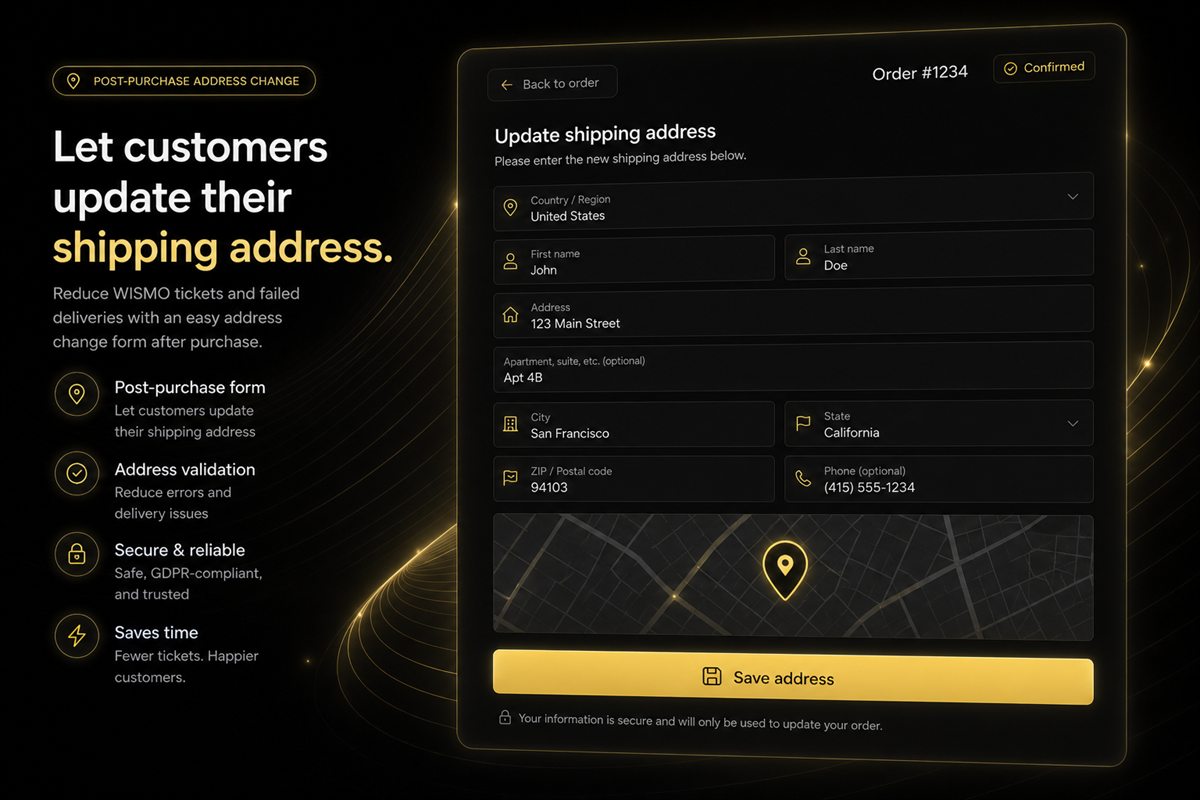
Key takeaways
- Address changes are the highest-volume post-purchase support request in most stores and among the cheapest to automate.
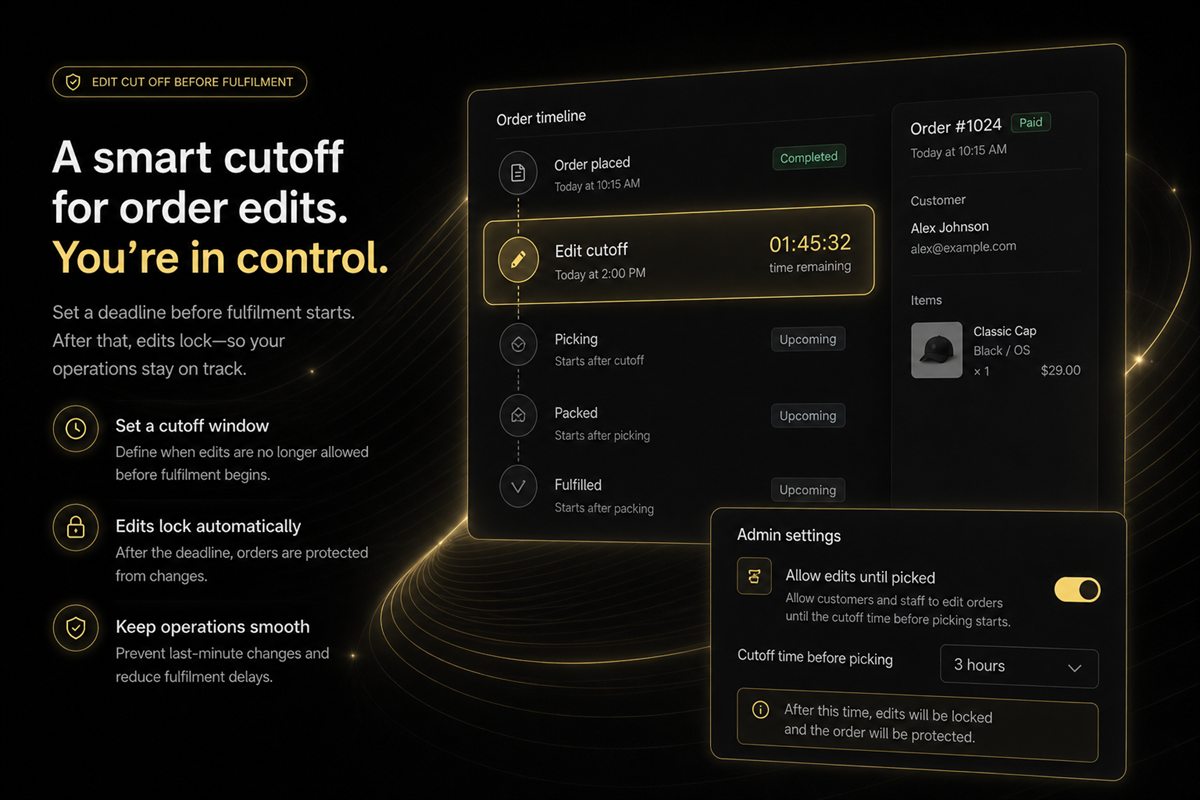
- The window must close at fulfilment. After a label is printed the same request becomes a carrier intercept and costs an order of magnitude more.
- Validate the new address and check whether it changes shipping zone, rate or duty treatment before accepting it.
- A failed delivery costs the outbound shipping, the return leg, restocking and often the whole order. Nearly all of that is avoidable in the window before dispatch.
Ask any ecommerce support team what they answer most often after "where is my order" and the answer will be some version of "I put the wrong address".
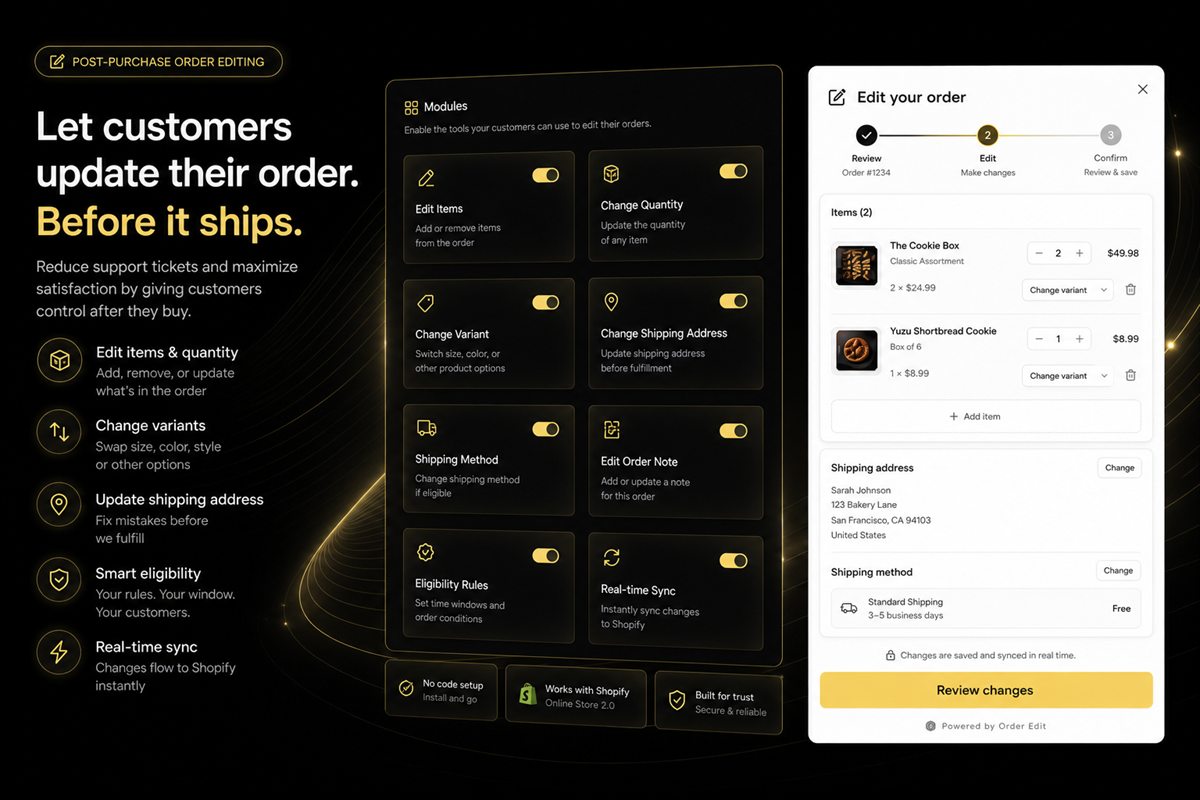
It is the most common post-purchase request, it is almost entirely mechanical, and in most stores it is handled by a person reading an email, opening the admin, checking the fulfilment status and typing an address into a form. Six to eight minutes of skilled labour for something that is, technically, a database update.
Why it happens so often
Address errors are not carelessness. They are structural.
- Autofill inserts a stale address. The browser remembers where someone lived two years ago.
- The customer is buying a gift and enters their own address by reflex.
- They moved recently and typed the old one from muscle memory.
- A unit or apartment number is missing, which is the single most common cause of a failed delivery.
- They meant to ship to work and did not switch.
- Express checkout used a saved address they had forgotten about.
None of these are preventable at checkout, because in every case the customer believed the address was right at the time. The error is discovered afterwards, when the confirmation email arrives and they actually read it.
Which means the confirmation email is the moment of highest detection — and it is also, conveniently, before you have printed anything.
What a failed delivery actually costs
Worth quantifying, because it is the number that justifies building this.
A parcel sent to a wrong or incomplete address will typically:
- Attempt delivery and fail.
- Sit at a depot, then return to sender — a second shipping leg, often charged at a premium.
- Arrive back and need inspecting and restocking.
- Trigger a refund or a reship, plus the support conversation around it.
So the direct cost is roughly outbound shipping plus return shipping plus restocking labour. On top of that, a meaningful share of customers who experience a failed delivery simply do not reorder — so a portion of the time you also lose the order and the customer.
Set against that: the cost of letting the customer fix their own address in the four hours before you print a label is essentially zero.
The rules you need
Self-service address editing is safe, but not unconditionally. Five rules cover almost everything.
1. Close the window at fulfilment
Non-negotiable. Once a label exists, the destination is fixed. Changing it means a carrier intercept, which is slow, frequently chargeable, sometimes impossible, and never a good customer experience.
The interface should reflect the order state rather than relying on a policy. When the order is fulfilled, the address edit option is not there.
2. Validate the new address
Run the replacement through the same validation as checkout. An unvalidated correction can easily be worse than the original error — someone fixing a typo can introduce a different one.
Where you have address autocomplete at checkout, use it here too.
3. Handle zone changes explicitly
If the new address falls in a different shipping zone, three options:
- Recalculate and collect the difference. Correct, and adds friction.
- Restrict to the same zone. Simplest, and covers the majority of genuine corrections since most are a typo in the same city.
- Absorb the difference. Fine at low volume, an unmanaged cost line at scale.
For international orders this matters more than the shipping cost, because a country change alters duty treatment, tax and sometimes whether you can legally ship the product at all. Cross-border address changes should generally be blocked and routed to support.
4. Add fraud controls
There is a known pattern: place an order with a verified billing address to pass fraud screening, then redirect the parcel elsewhere after the fact.
Reasonable mitigations without punishing legitimate customers:
- Restrict changes to the same country.
- Block changes above an order value threshold, and route them to manual review.
- Require an authenticated session rather than accepting a link from an email alone.
- Log every change with a timestamp and IP address.
- Flag any order where the address changes more than once.
5. Notify everyone involved
An address change must propagate. The customer gets a confirmation showing the new address in full. Your fulfilment system gets the update before picking. If a 3PL or warehouse management system is involved, confirm that the change reaches it — a change that updates Shopify but not the WMS is worse than no change at all, because now two systems disagree and the wrong one is holding the parcel.
Where to put it
Three surfaces, all worth having.
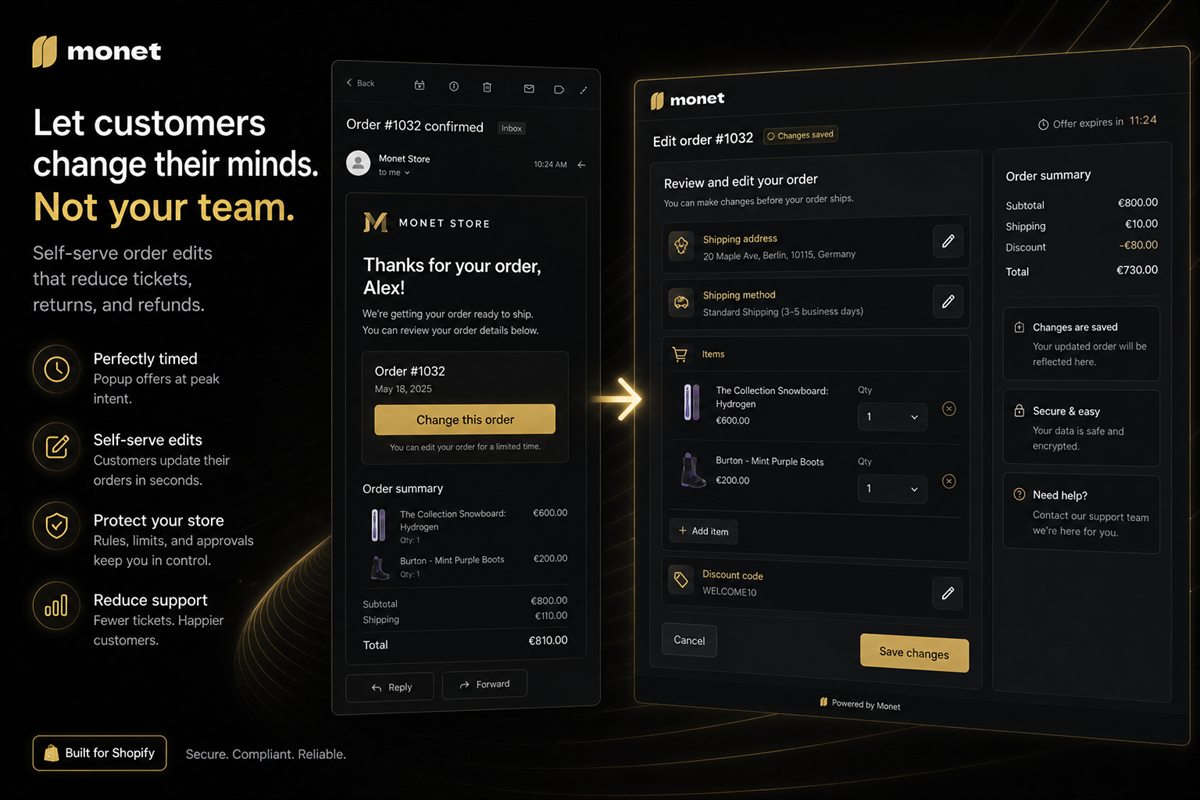
The order confirmation email. The highest-value placement by a wide margin, because it coincides with the moment of detection. A visible "Need to change your address?" link, not buried in the footer.
The customer account order page. Where people look when they think about their order later.
The order status page. Shopify's post-purchase page is where customers land from tracking links, and it is a natural home for edit actions.
The upside beyond cost saving
A customer on your address-edit screen is a customer who has just come back to your site, deliberately, with their order in mind, before it has shipped.
Two things follow from that:
Adding an item costs you nothing in fulfilment. The parcel has not been packed. An extra item goes in the same box, on the same label, with the same handling. The marginal fulfilment cost of an add-on at this moment is close to zero, which is not true anywhere else in the journey.
The friction is already cleared. They are authenticated, their payment method is on file, and the shipping decision is made. An additional purchase is fewer clicks here than on any storefront page.
Keep the offer secondary — the customer came to fix an address and the address field must be the first thing they see — but the slot below it is one of the highest-converting placements you own.
Rollout
- Same-country address changes only, before fulfilment, validated. This alone handles the majority of requests.
- Add the link to the confirmation email, which is where the detection happens.
- Verify the fulfilment integration propagates updates. Test with a real order.
- Add fraud rules — value threshold, authentication requirement, change logging.
- Add the recommendation block below the address form.
- Then consider zone-change handling with rate recalculation, if the restriction is generating support volume.
Measuring it
- Address-change support tickets per 100 orders, before and after. The primary metric, and it should move within two weeks.
- Self-service address change rate — changes made ÷ orders eligible.
- Failed delivery rate. The slower, more valuable metric.
- Return-to-sender volume and cost.
- Revenue from items added during an address edit. The upside.
- Fraud rate on orders with a changed address, compared with baseline. The guardrail — if it rises, tighten the rules.
Frequently asked questions
Can a customer change their shipping address on a Shopify order?
Not through any native self-service interface. A merchant can edit the shipping address from the Shopify admin, but the customer has no built-in way to do it themselves, which is why this request dominates post-purchase support queues.
How late can a shipping address be changed?
Safely, up to the moment the order is fulfilled and a label is generated. After that the address on the label is fixed and changing the destination requires a carrier intercept, which is slow, often chargeable, and not always successful.
What if the new address is in a different shipping zone?
Either recalculate and collect the difference, or restrict the change to addresses within the same zone. Silently absorbing a zone change works at low volume and becomes an unmanaged cost at scale, particularly on international orders where duty treatment also changes.
Is allowing address changes a fraud risk?
There is a known pattern where a fraudulent order is placed with a verified billing address and then redirected. Mitigate it with rules - restrict changes to the same country, block changes on high-value orders, and require the account to be logged in rather than accepting a link alone.
How much does a failed delivery actually cost?
The outbound shipping, the return leg, the restocking labour, and frequently the entire order because a meaningful share of customers do not reorder after a failed delivery. Against that, the cost of letting the customer correct their own address before dispatch is close to zero.