 Addy
Addy  Addly
Addly  Goalify
  Monet
Monet  Reviso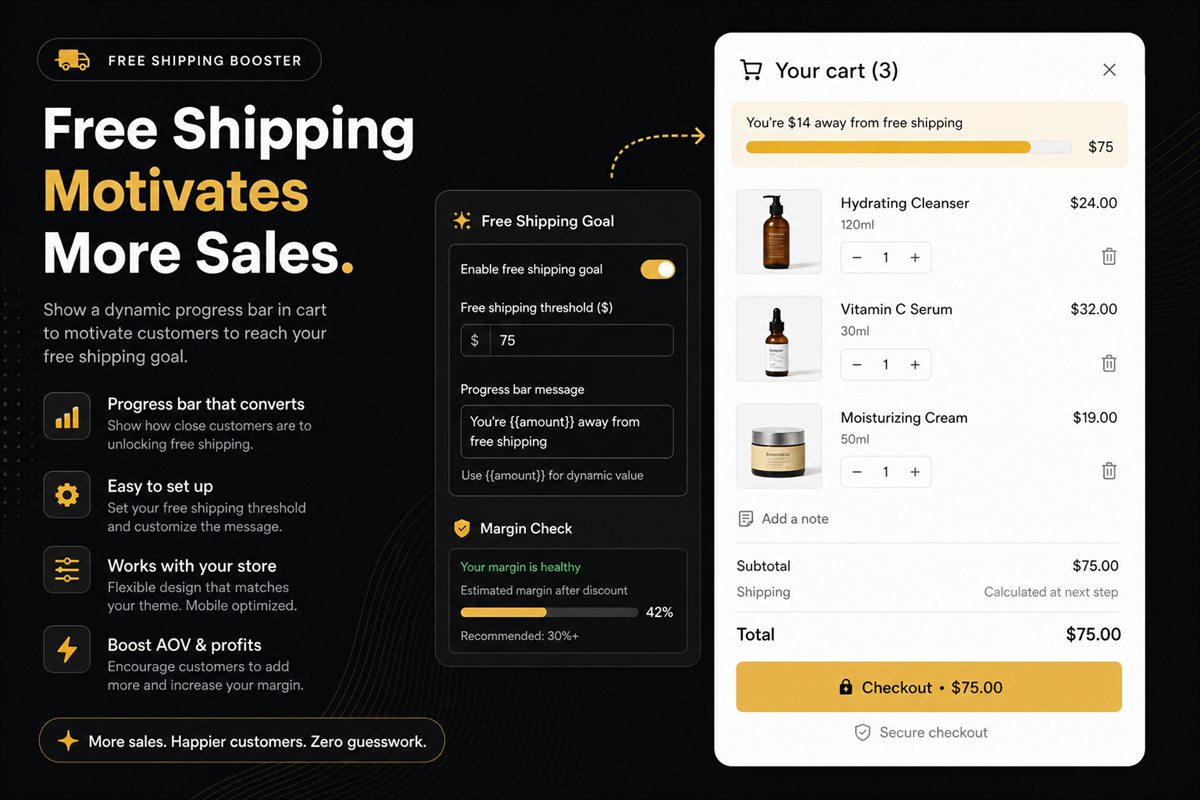
Key takeaways
- Set the threshold from your order value distribution, not your average. The average is already cleared by half your orders and changes nobody's behaviour.
- The 60th to 75th percentile is the working band. Below it you subsidise existing behaviour, above it the goal reads as unreachable.
- Run the margin check - gross profit on the incremental spend must exceed your average shipping cost, or the threshold loses money on every order it moves.
- One global threshold is wrong in most markets, because both sides of the margin equation change at the border.
The free shipping threshold is the most common average-order-value tactic in ecommerce and one of the most commonly mis-set. Most stores pick a round number that feels close to their average order value, publish it, and never revisit it.
That approach has a specific failure mode: a threshold set at or below your average order value is cleared by roughly half your orders without anyone changing behaviour. You have not created incremental revenue. You have given away shipping on half your orders.
Here is the method that avoids that.
Free shipping is a goal, not a discount
The mechanism is worth understanding because it explains why the number matters so much.
A shipping fee is a cost the shopper weighs against convenience. A free shipping threshold is a target they can hit. Those are different psychological objects. The first invites a comparison; the second invites an action.
The effect is well documented and reliably reproducible: shoppers who are shown a specific remaining amount to reach free shipping add items at a materially higher rate than shoppers shown the same policy stated as a rule. It works even when the fee being avoided is small, because the shopper is no longer evaluating $6.90 against convenience — they are completing a task.
That reframing only happens if the target is reachable but not already met. Which is entirely a function of where you set it.
Step 1: Get the distribution, not the average
Export the last 90 days of orders and their values. Sort them. Then find the percentiles.
A typical store might look like this:
| Percentile | Order value |
|---|---|
| 25th | $28 |
| 50th (median) | $46 |
| 60th | $54 |
| 70th | $63 |
| 75th | $71 |
| 90th | $104 |
| Average | $58 |
Notice that the average ($58) sits between the 60th and 70th percentile — which is normal, because order value distributions have a long right tail that drags the mean above the median.
Setting the threshold at $58 means roughly 38% of orders already clear it. Those customers get free shipping for doing what they were already doing.
Step 2: Pick from the 60th–75th band
Your candidate threshold sits between the 60th and 75th percentile. In the table above, that is $54 to $71.
The reasoning:
- Below the 60th — too many orders already clear it. High subsidy, low behaviour change.
- Above the 75th — the gap between a typical basket and the threshold is large enough that shoppers disengage from the goal entirely. An unreachable target is not a target.
- Inside the band — a meaningful group of shoppers sits close but not there. Those are the orders you can move.
Within the band, lean lower if your margin is thin or your category is price-sensitive, and higher if your margin is healthy and your products have natural complements.
Step 3: Run the margin check
This is the step that gets skipped, and it is the one that determines whether the threshold makes money.
Gross profit on the incremental spend must exceed your average shipping cost.
Say you choose $65 with a median order value of $46. The average shopper you move up spends an extra $19. At a 55% gross margin, that is $10.45 of additional gross profit. If your average shipping cost is $7.20, you net $3.25 per moved order.
If your average shipping cost were $12, the same threshold loses $1.55 on every order it moves. You would need a threshold of at least $46 + ($12 ÷ 0.55) ≈ $68 just to break even, and higher to make anything.
Step 4: Round it
$68.42 is not a goal, it is an output. $70 is a goal.
Round numbers work better because they are easier to hold in mind and easier to calculate against. "I need $14 more" is a manageable thought. "I need $12.42 more" is arithmetic.
Round up rather than down when you have the margin room. The gap in behaviour between $65 and $70 is small; the gap in your economics is not.
Step 5: Split it by market
One global threshold is wrong in most markets, because both sides of the margin equation change at the border.
Your shipping cost to a neighbouring country is not your domestic cost. Your order value distribution in a market where you are unknown is not the distribution in your home market. A threshold derived from domestic data and converted at the spot rate encodes neither.
Do the whole exercise per market for your top three or four, and use a sensible default elsewhere. And set each one as a round number in the local currency rather than converting — €70, not €68.42.
Step 6: Make it visible
A threshold nobody can see their progress against is just a policy on a page.
The progress bar is what turns it into a goal, and the specific thing that makes it work is showing the remaining amount rather than the target:
- "Free shipping over $70" — a rule. It is about you.
- "You're $14 away from free shipping" — a task. It is about them.
The second consistently outperforms the first. Show it in the cart drawer first, the cart page second, and consider the product page third.
Common mistakes
Setting it at the average. Covered above, and it is the most common error by a distance.
Never revisiting it. Carrier rates change. Your catalogue prices change. Your order mix changes with every campaign. A threshold set eighteen months ago is a threshold set for a different business.
One threshold across wildly different products. If you sell both $15 accessories and $400 machines, a single threshold is meaningless for one of them. Consider a collection-scoped threshold.
Excluding half the catalogue without saying so. A threshold that quietly does not apply to bulky items generates more support tickets than revenue. If there are exclusions, state them in the same sentence as the offer.
Not stacking a second goal. A shopper who lands at $71 on a $70 threshold has no further reason to add anything. A second tier — an order discount or a free gift at a higher value — keeps the mechanic working across the upper half of your distribution.
Measuring whether it worked
Do not use average order value on its own — a threshold mechanically raises AOV whether or not it made money.
Track:
- Share of orders above the threshold, before and after. This is the behaviour change.
- Median order value, which is less distorted by outliers than the mean.
- Shipping cost as a percentage of revenue. The direct cost of the policy.
- Gross profit per order. The verdict.
- Cart-to-checkout rate. The guardrail. A threshold that is too high can suppress conversion among shoppers who conclude they will never reach it.
Give it four weeks minimum. Compare against the same period rather than the previous month if your category has any seasonality at all.
Frequently asked questions
What should my free shipping threshold be?
Somewhere between the 60th and 75th percentile of your order value distribution over the last ninety days, subject to a margin check. There is no universal number because it depends entirely on the shape of your distribution and your fulfilment cost, both of which are specific to your store.
Is free shipping actually worth offering?
For most consumer categories, yes, because shipping cost is the most commonly cited reason for cart abandonment and a threshold converts that objection into a goal. It stops being worth it when your shipping cost is high relative to your order value and margin, which is common for heavy or bulky goods.
Should the threshold be a round number?
Yes. Round numbers work better as goals because they are easier to hold in mind and easier to calculate against. A threshold produced by currency conversion, such as sixty-eight euros, reads as arbitrary. Round it.
How often should I review the threshold?
Quarterly at minimum, and immediately after any carrier rate change or significant catalogue price change. Both sides of the calculation drift, and a threshold set eighteen months ago is almost certainly no longer optimal.
Does a free shipping threshold work without a progress bar?
Much less well. A threshold nobody can see their progress against is just a policy. The bar is what converts it into an active goal, because it shows the shopper a personal, incomplete task with a specific remaining amount.