 Addy
Addy  Addly
Addly  Goalify
  Monet
Monet  Reviso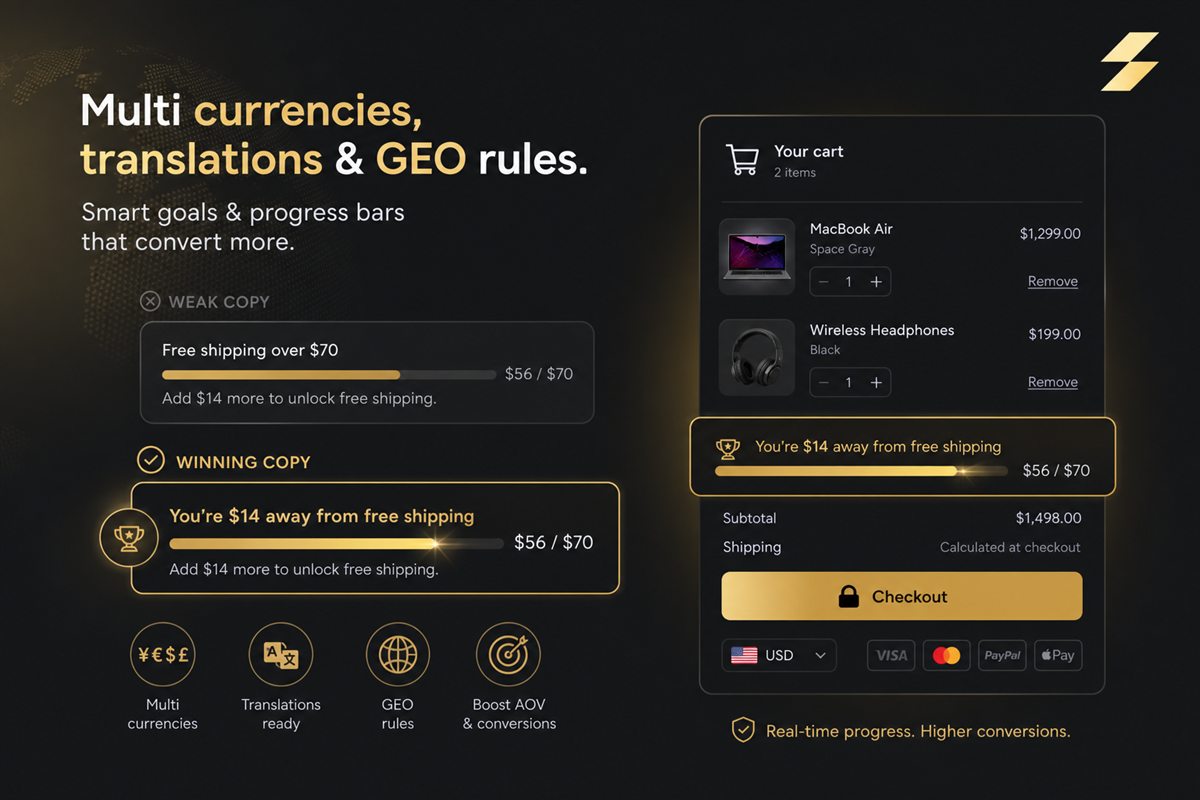
Key takeaways
- Remaining amount beats target amount. "You're $14 away" is a task; "Free shipping over $70" is a policy.
- Once the goal is met, change the line. A bar that still talks about the threshold after it is unlocked feels broken.
- Do not mix currency, percentage and gift copy in one sentence. One number, one outcome.
- Translate the line per market. A US remaining-amount line pasted into a EUR store looks lazy and often rounds wrong.
- Match the cart's currency and rounding to the cent. A bar that disagrees with the checkout by even a few cents loses trust.
The best free shipping bar copy tells the shopper how much is left, in their currency, to the cent: "You're $14 away from free shipping." Stating the rule — "Free shipping over $70" — describes your policy and leaves the shopper to do the maths. Write three lines (far from goal, in progress, unlocked), use one number, and translate the structure for every market you sell in.
What is free shipping bar copy?
Free shipping bar copy is the text inside a cart progress bar that tells the shopper where they stand against a shipping threshold. It has three jobs: state the goal when the cart is empty, state the remaining amount while the shopper is short of it, and confirm the reward once they reach it. Most stores write one sentence and leave it on screen for all three situations, which is why most bars read like a policy page.
Why the remaining amount beats the rule
A free shipping threshold is a rule. A progress bar is a task. Shoppers complete tasks. They do not memorise rules.
That is why "Free shipping over $70" is weak copy even when the maths is perfect. It describes your policy. "You're $14 away from free shipping" describes their next move. The first sentence asks the shopper to check their subtotal, subtract, and decide. The second has done all of that for them and left only the decision.
The three states
Write three lines, not one:
- Empty cart / far from goal. "Free shipping at $70 — add $70 to get it." (Only here is the target useful, because remaining ≈ target.)
- In progress. "You're $14 away from free shipping."
- Unlocked. "Free shipping unlocked on this order."
If you have a second goal, the unlocked state becomes the setup for it: "Free shipping unlocked. $6 away from a free gift." How to sequence two goals without turning the bar into a to-do list is covered in stacked cart goals.
How to write the copy for your Shopify store
- Confirm the real threshold. Open Settings → Shipping and delivery and read the price condition on your free shipping rate for each zone. The bar must quote the same number checkout will apply.
- Draft the three states in your primary market's currency, using the remaining amount for state two.
- Add the second-goal line if you run a gift or wrap goal, so the unlocked state has somewhere to go.
- Match currency and rounding. Use the cart's subtotal after discount codes and the same decimal handling Shopify uses. If the cart shows €11.40, the bar shows €11.40.
- Reuse the same lines everywhere the bar appears — cart drawer, cart page, product page preview. One copy deck, one calculator.
- Test four carts: empty, one cent below the threshold, exactly on it, and well above it. Each should show a different, correct sentence.
One number
Do not write "You're 18% away" or "Add 2 more items". Percentages hide the actual spend; item counts break as soon as prices differ. Money remaining is the only number that matches the checkout the shopper is about to see.
Match the currency and the rounding of the cart. If Shopify shows €11.40, the bar cannot show €12.
Weak lines and their fixes
| Weak line | Why it fails | Stronger line |
|---|---|---|
| Free shipping over $70 | States the rule, not the task | You're $14 away from free shipping |
| You're 80% there | Hides the spend | You're $14 away from free shipping |
| Add 2 more items for free shipping | Breaks when prices differ | You're $14 away from free shipping |
| Free shipping! (at $56 subtotal) | False unlock | You're $14 away from free shipping |
| Free shipping over $70 (at $82 subtotal) | Still talking about the rule after it is met | Free shipping unlocked on this order |
The right-hand column is almost the same sentence five times. That is the point. The copy does not need variety; it needs to be true for the cart in front of the shopper.
Markets
Every market needs its own threshold and its own sentence. Translating "You're $14 away" into a language that does not use that construction, or leaving the dollar sign on a kroner store, is how bars start to look like apps.
If you cannot staff translations, keep the structure and swap the currency. Structure travels. Slang does not. Per-market thresholds and copy are part of a wider job — see Shopify Markets cart personalisation for the rest of it.
What not to say
- "Spend more to save on shipping" — lecture.
- "Hurry, almost there!" without a number — noise.
- "Free shipping" when they still have $40 to go — a false unlock.
- "Free shipping on orders over $70*" with an asterisk — if there are exclusions, the bar should not count excluded items, rather than footnote them.
Common mistakes
- One sentence for all three states.
- A remaining amount that ignores discount codes, so it disagrees with the cart.
- Rounding up to a whole number when the cart shows cents.
- A brand voice so loud the number is the smallest thing on the bar.
- Different sentences in the drawer and on the product page. Placement is a separate decision, covered in where to put a free shipping progress bar, but the copy must be identical across every placement.
How to measure a copy change
Copy changes are cheap to test and slow to judge. Compare, over the same length of time before and after: the share of carts that end above the threshold, average order value for carts that saw the bar, and the number of support contacts that mention shipping cost. If your bar app or theme supports it, run the rule version against the remaining-amount version as a split test and let the threshold-crossing rate decide.
The bar has one job: tell them how much is left. Do that job in the fewest honest words.
Frequently asked questions
Should the bar show the target or the remaining amount?
Remaining amount, always, until the goal is met. After that, show a confirmation ("Free shipping unlocked") plus the next goal if you have one. The target is only useful on an empty cart, where the remaining amount and the target are the same number.
How precise should the remaining amount be?
To the cent in the shopper's currency, using the same rounding as the cart. A bar that says "$12 away" when the cart says $11.40 left is a small lie with a large cost, because shoppers compare the two numbers.
Can I add humour to free shipping bar copy?
A little, if it is on-brand and the number stays first. Humour that hides the remaining amount is decoration, and decoration gets skipped. Test the plain version first so you know what the joke costs.
Where does the bar go if copy is this important?
Top of the cart, and optionally a slim bar on the product page that uses the same remaining-amount logic. Different copy in two places is how you get two numbers, and two numbers is how you get zero trust.
What should a free shipping bar say when the cart is empty?
Show the target, because the remaining amount equals the target: "Free shipping at $70 — add $70 to get it." This is the only state where the rule and the task are the same sentence. Once anything is in the cart, switch to the remaining amount.
Should free shipping bar copy include urgency or a deadline?
Only if the deadline is real, such as a weekend promotion with an end date. Generic urgency ("Hurry, almost there!") without a number adds noise and trains shoppers to ignore the bar. The remaining amount is already the motivating element.