
 Addy
Addy  Addly
Addly  Goalify
  Monet
Monet  Reviso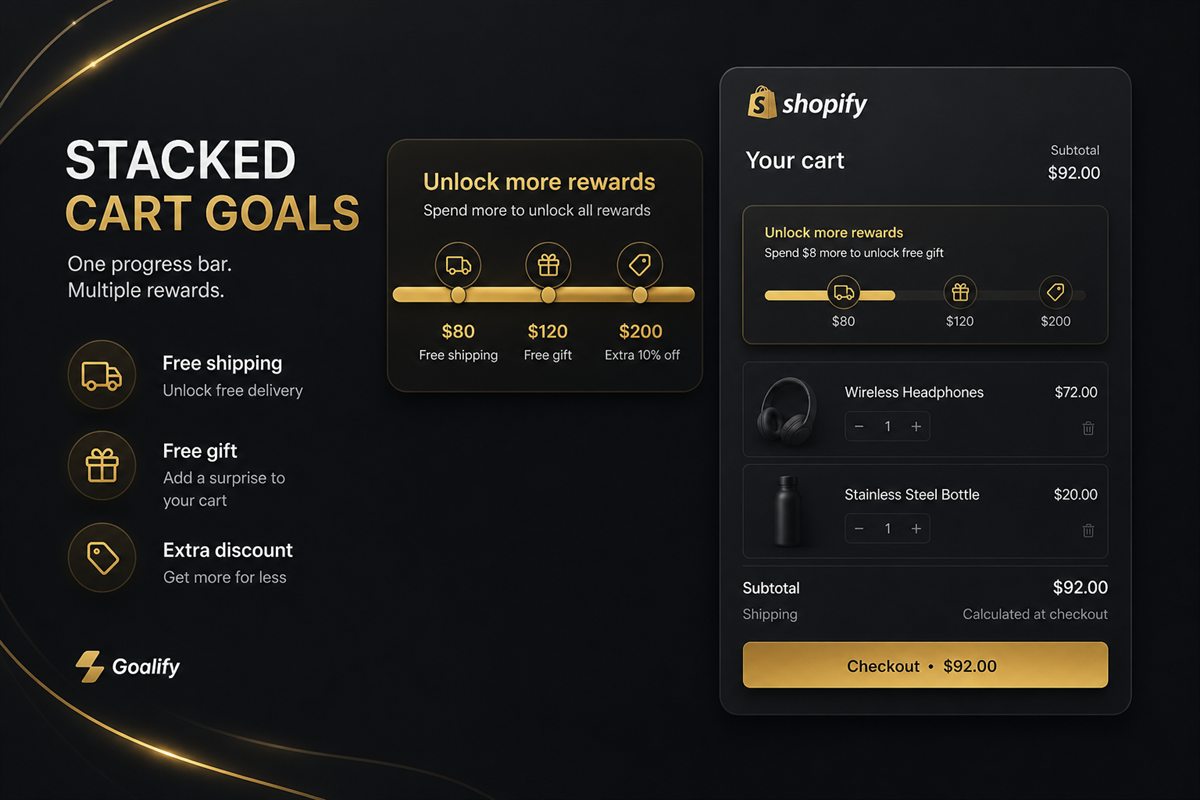
Key takeaways
- A single threshold only influences shoppers near that one point. Everyone above it has no remaining reason to add anything.
- Three tiers placed at rising percentiles of your order distribution cover most of the curve without becoming a puzzle.
- Each reward must cost less than the gross profit on the incremental spend required to unlock it. Model every tier separately.
- Reveal the next tier at the moment the previous one is met. Showing all three at once makes the top one the reference point and the bottom one feel trivial.
A free shipping threshold at $70 does one job: it influences shoppers whose basket lands somewhere between about $45 and $70.
Everybody below that range is too far away for the goal to feel reachable. Everybody above it has already won and has no remaining reason to add anything. You have installed a mechanic that operates on a slice of your order distribution and does nothing to the rest of it.
Stacked goals fix that by giving every part of the curve a next step.
What a single threshold leaves behind
Take a store with this distribution:
| Percentile | Order value |
|---|---|
| 25th | $28 |
| 50th | $46 |
| 65th | $58 |
| 75th | $71 |
| 85th | $92 |
| 95th | $138 |
With a single $70 threshold:
- Orders below roughly $40 — the gap is too large to feel achievable. No effect.
- Orders between $40 and $70 — the target zone. This is where the mechanic works.
- Orders above $70 — goal already met. No further incentive.
That is meaningful influence over maybe a third of orders, and no influence at all over the top quartile, which is where your best customers are.
The three-tier shape
The fix is a ladder, with each rung placed higher in the distribution:
- Tier 1 — Free shipping at $58 (65th percentile). The entry goal, reached by a large share of shoppers.
- Tier 2 — 10% off the order at $92 (85th percentile). The stretch goal.
- Tier 3 — Free gift at $138 (95th percentile). The aspiration.
Now every basket has a next step. A shopper at $50 is chasing free shipping. A shopper at $62 has just won and immediately sees a new target thirty dollars away. A shopper at $100 is looking at the gift.
The reason this works is the same reason the single bar works — the goal-gradient effect — applied repeatedly instead of once.
Reveal, do not display
The most important implementation detail, and the one most often got wrong.
Do not show all three tiers at once. Showing "$58 free shipping · $92 for 10% off · $138 for a gift" to a shopper with $20 in their cart anchors them on $138. The first tier stops reading as an achievement and starts reading as the least of three things they will not get.
Show the active goal, then reveal the next. One goal at a time, prominent and specific. When it is met, celebrate the crossing and immediately surface the next one.
That sequencing produces a repeating loop of near-completion, which is exactly the state the mechanic depends on.
Choosing rewards for each rung
The rewards should escalate in perceived value and change in kind, not just in size.
Tier 1 — Free shipping. Almost always the right first reward, because it removes a cost the shopper already resents rather than adding a benefit they did not ask for. It also has the cleanest margin story.
Tier 2 — An order discount or a free gift. A percentage discount is simple and universally understood. A gift usually has better economics, because a $6 landed cost can carry $18 of perceived value while a 10% discount on a $92 order costs a flat $9.20.
Tier 3 — Something with high perceived value and controlled cost. An exclusive item, expedited shipping, an extended warranty, early access. Avoid deep percentage discounts here — on a large order, a percentage becomes expensive fast.
The margin check, per tier
This is where stacked goals go wrong. Each tier is set by intuition, the total is checked afterwards, and by then the ladder is live.
Every tier must independently satisfy:
Gross profit on the incremental spend required to reach this tier > cost of this tier's reward
Worked through, at 55% gross margin:
| Tier | Threshold | Reached from | Incremental spend | Gross profit on it | Reward cost | Net |
|---|---|---|---|---|---|---|
| 1 — Free shipping | $58 | $46 median | $12 | $6.60 | $7.20 shipping | −$0.60 |
| 2 — 10% off | $92 | $58 | $34 | $18.70 | $9.20 | +$9.50 |
| 3 — Free gift | $138 | $92 | $46 | $25.30 | $6.00 landed | +$19.30 |
Tier 1 is marginally negative as configured — which is common, and tolerable, because free shipping also improves conversion rate in a way the other tiers do not. But it is worth knowing rather than discovering. Raising tier 1 to $62 would fix it.
Note the shape: tiers become more profitable as you climb, because the incremental spend grows faster than the reward cost does. That is the property you want. A ladder where the top tier is the least profitable is upside down.
Copy for a ladder
Each state needs its own line, and the transitions matter as much as the states.
- Below tier 1: "You're $12 away from free shipping"
- At tier 1: "Free shipping unlocked. Add $34 more for 10% off"
- At tier 2: "10% off applied. Add $46 more for a free travel size"
- At tier 3: "You've unlocked everything. Nice work."
Three principles: name the reward just earned before pointing at the next one; always give the remaining amount as a number; and give the final state a genuine end rather than an open-ended prompt, because a ladder with no top feels manipulative.
When not to stack
Stacked goals are not universally right.
- Low average order value with narrow distribution. If almost every order is between $20 and $35, there is no room for three tiers. One threshold is correct.
- Thin margins. Three rewards need three margin checks to pass. If tier 1 is already borderline, adding two more is not the fix.
- Limited catalogue. If there is nothing sensible for a shopper to add between $58 and $92, tier 2 is an unreachable goal regardless of where you set it.
- Complex existing promotions. A ladder on top of a BOGO on top of a site-wide code produces an effective discount nobody has modelled and a cart nobody can read.
Measuring a ladder
Per tier, not in aggregate:
- Share of orders reaching each tier, before and after. The behaviour change.
- Distance-at-checkout distribution for orders that did not cross each tier. If a cluster sits just below a threshold, that threshold is slightly too high.
- Gross profit per order in each band between tiers.
- Total reward cost as a percentage of revenue.
- Cart-to-checkout rate. The guardrail — a cart cluttered with three competing goals can suppress conversion.
The distance-at-checkout chart is the most actionable and the least used. If you find a pile of orders finishing at $54 against a $58 tier one, moving that threshold to $52 will convert most of them, and the arithmetic on that change is trivially favourable.
Frequently asked questions
How many cart goal tiers should I run?
Three is the practical maximum for most stores. Two works and leaves value on the table above the second threshold. Four or more turns the cart into a puzzle, and the incremental revenue from the top tier rarely justifies the added complexity and inventory exposure.
Should all the tiers be visible at once?
No. Show the current goal prominently and reveal the next one when the current is met. Displaying all three simultaneously anchors the shopper on the largest number, which makes the first tier feel like a consolation prize rather than an achievement.
What rewards work best at each tier?
Free shipping at the first tier because it removes a cost the shopper already resents. An order discount or a free gift at the second. Something with high perceived value and controlled cost at the third, such as an exclusive item or expedited shipping.
Where should each threshold sit?
At rising percentiles of your order value distribution. A common shape is the sixty-fifth percentile for tier one, the eighty-fifth for tier two and the ninety-fifth for tier three, adjusted so each reward passes its own margin check.
Do stacked goals hurt margin?
They do if the rewards are not individually modelled. Each tier must satisfy the same test - the gross profit on the incremental spend required to reach it must exceed the cost of the reward. Stacked goals fail when stores set tiers by intuition and only check the total afterwards.