 Addy
Addy  Addly
Addly  Goalify
  Monet
Monet  Reviso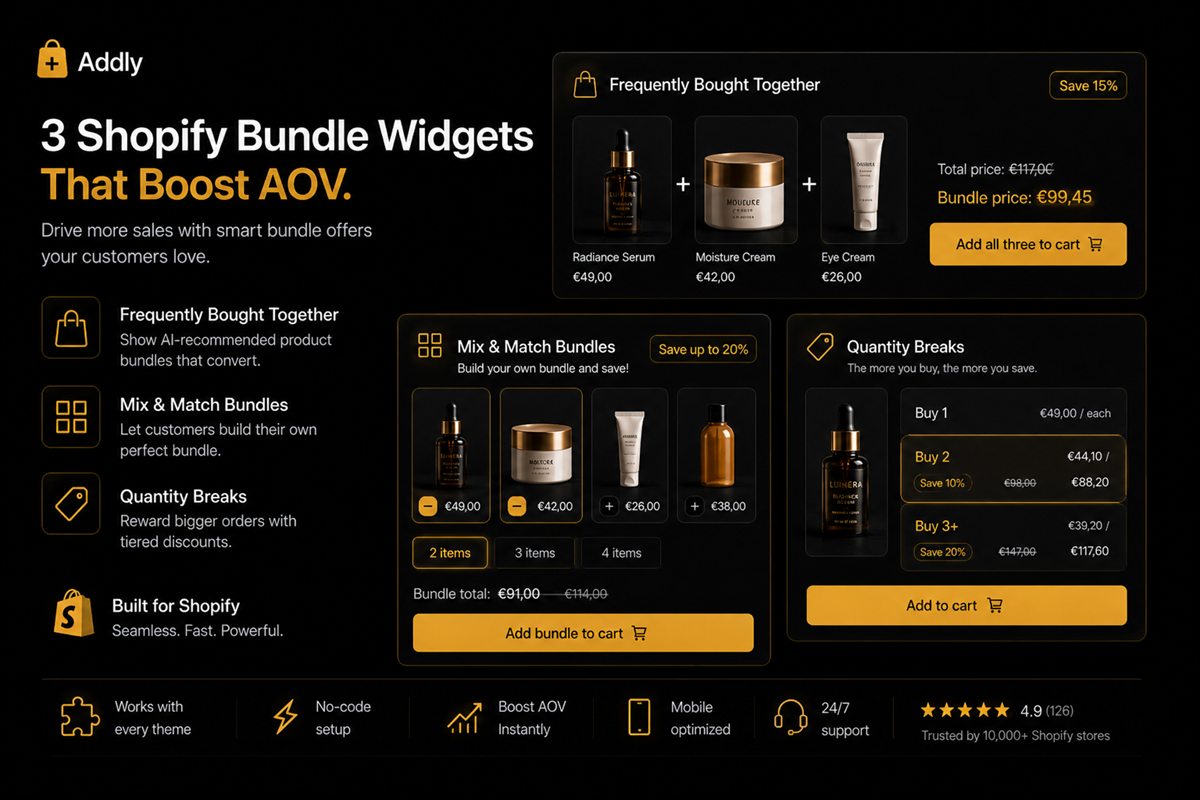
Key takeaways
- Bundles fail on maths far more often than on design. Model the cannibalisation rate before you set the discount depth.
- Match the bundle type to the buying question. "Which one" needs a curated set, "how many" needs a quantity break, "what else" needs a cross-sell.
- A bundle that only sells to customers who would have bought everything anyway is a discount, not a bundle.
- Show the saving in both currency and percentage. Shoppers anchor on whichever number is larger and you should let them.
Most bundle advice starts with layout. Grid or slider, two columns or three, badge in the corner or across the image.
None of that is why bundles succeed or fail. Bundles succeed or fail on two things: whether the combination answers a question the customer is actually asking, and whether the maths underneath is profitable. Everything else is decoration on top of those two decisions.
Match the bundle to the question
Every shopper looking at a product page is asking one of three questions. The bundle type that works is the one that answers the question they are asking.
| Their question | Bundle type | Why it fits |
|---|---|---|
| "Which one should I get?" | Curated fixed bundle | You have made the decision for them |
| "How many should I get?" | Quantity break | Reframes the choice from whether to how many |
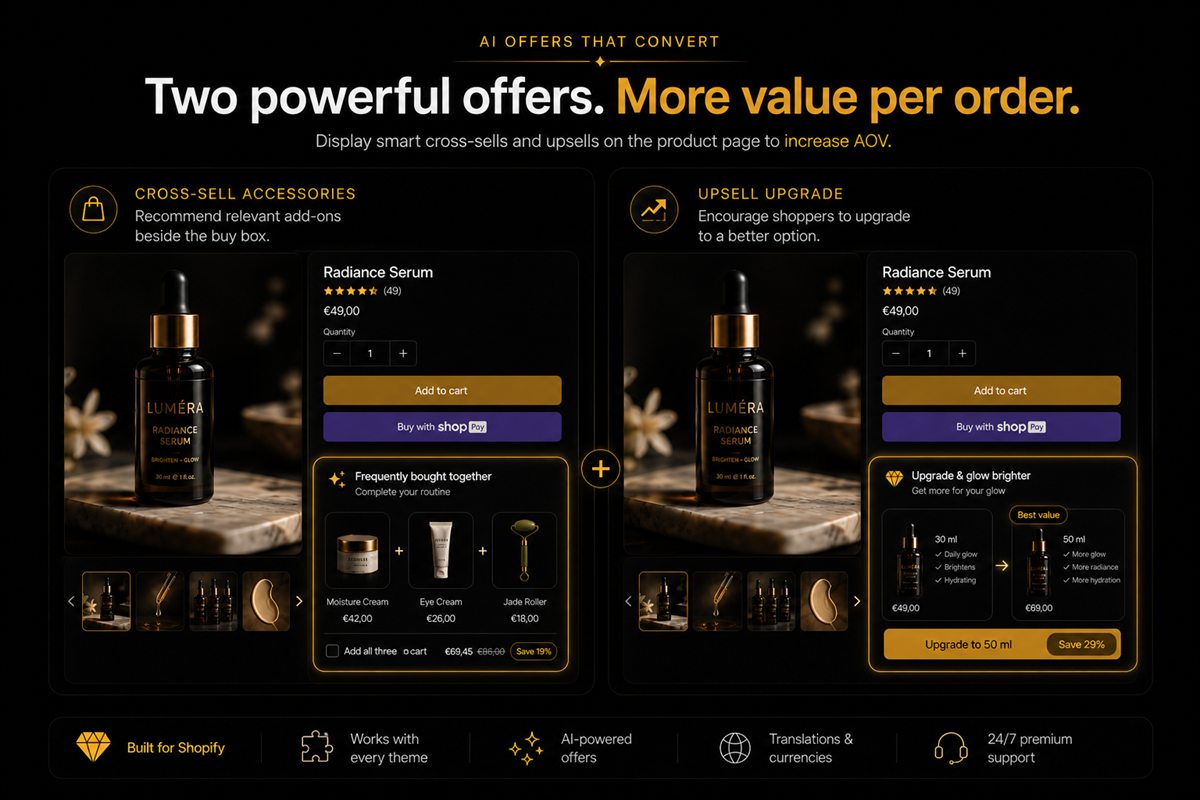
| "What else do I need?" | Cross-sell / frequently bought together | Completes a set they already understand |
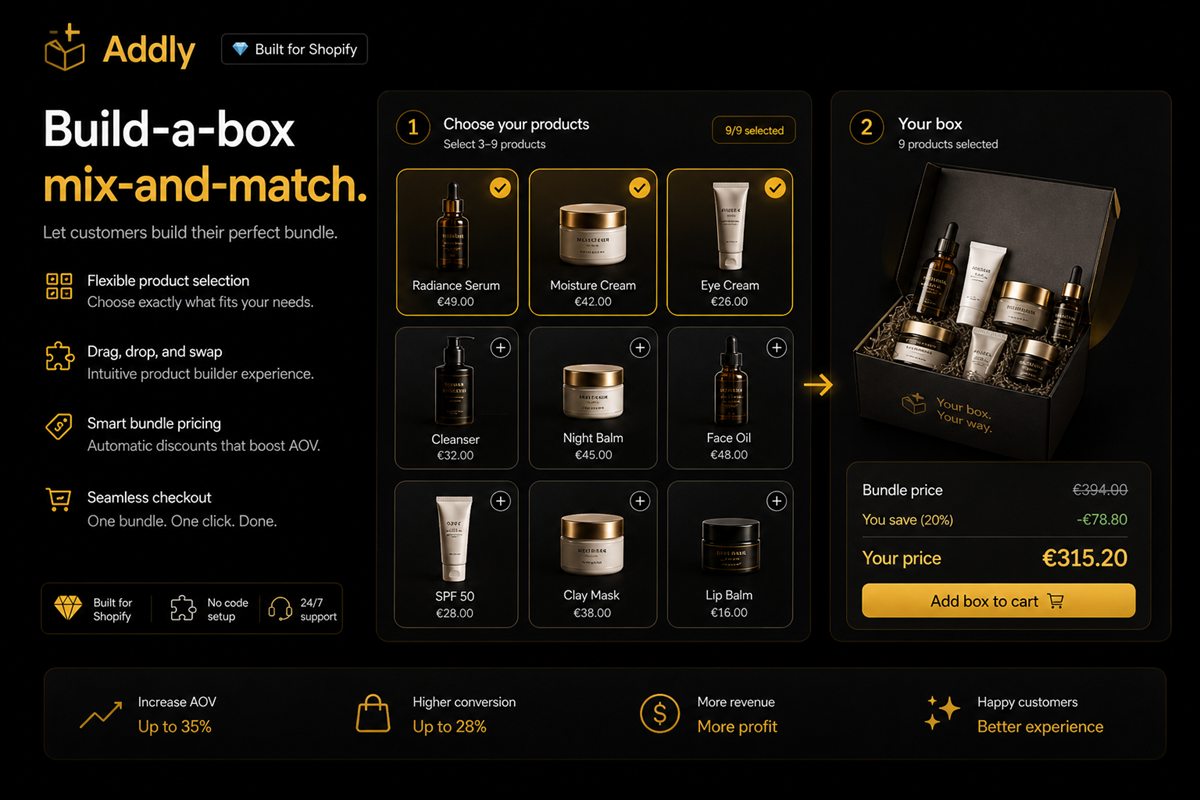
| "Can I make this mine?" | Mix-and-match, build-a-box | Control is the value, discount is secondary |
| "Is this worth trying?" | Sample pack | Reduces the risk of an unfamiliar category |
Selling a build-a-box to someone asking "which one should I get?" gives them more decisions when they wanted fewer. Selling a curated set to someone who wants control feels restrictive. The mismatch, not the offer, is usually what kills the take rate.
The eight types that work on Shopify
Fixed bundle
A defined set at a defined price. Highest margin control, lowest flexibility. Best when your expertise is the value — a starter kit, a routine, a complete setup.
The failure mode is including one item nobody wants. A fixed bundle is only as attractive as its weakest component, because the shopper mentally subtracts the item they will not use from the value.
Quantity break
Buy 2 save 10%, buy 3 save 15%. The simplest bundle to run and often the most profitable, because it requires no pairing logic and no new product decisions.
Works on consumables, replenishables, and anything where the real question is how many. Does not work on considered single purchases.
Mix-and-match
Pick any three from this collection, get a discount. Combines choice with a reason to buy more, and it works particularly well when your catalogue has genuine variety within a category — flavours, scents, colours.
Build-a-box
A structured version of mix-and-match with slots: pick one base, two add-ons, one extra. The structure is what makes it work; unlimited choice produces abandonment, constrained choice produces engagement.
Multipack
The same product in a larger unit. Effectively a quantity break presented as a product. Useful when the multipack has its own logic — a case, a family size, a travel set.
Gift box
Seasonal, curated, and presentation-led. The discount matters much less here than the packaging and the framing, because the buyer is not the user.
Sample pack
Low price, low risk, high information value. A paid product trial that improves AOV rather than costing acquisition budget. Excellent for categories where the customer cannot judge fit before trying.
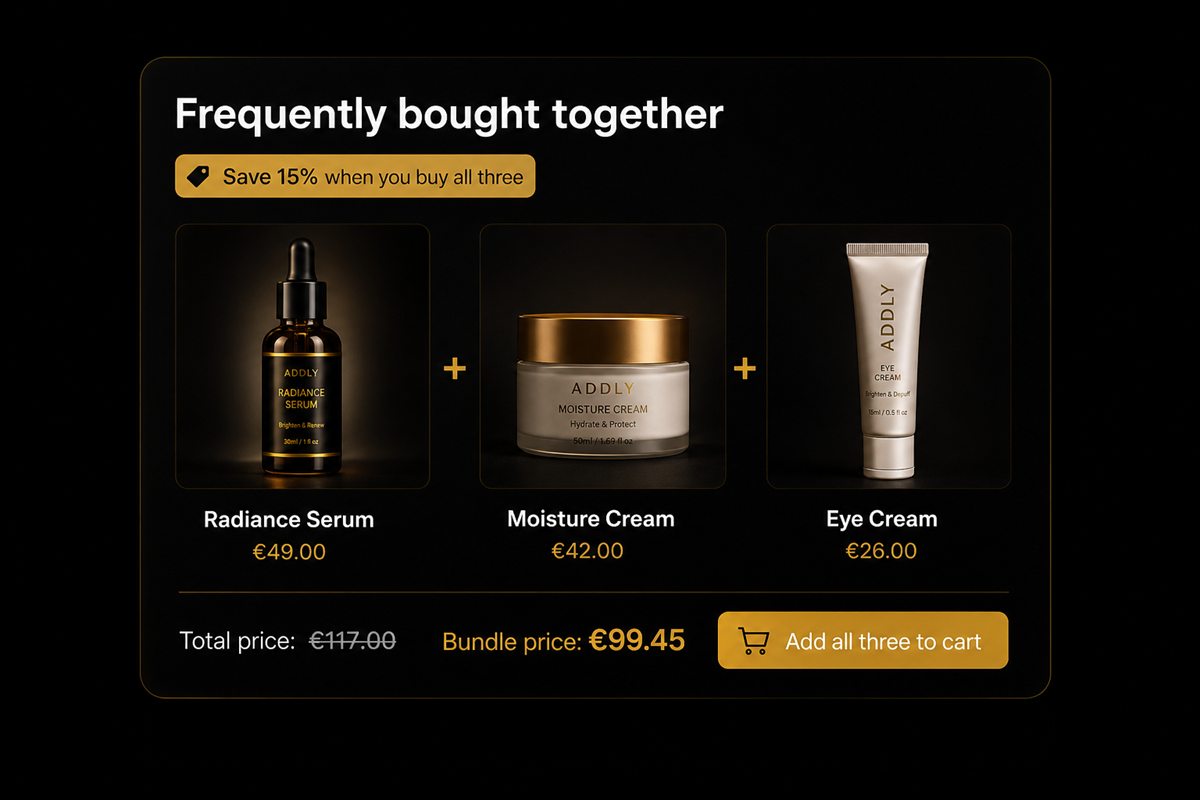
Frequently bought together
Not strictly a bundle — a data-driven cross-sell presented as one. The most reliably converting of the lot when the pairs come from real order history rather than category tags.
The maths that decides profitability
Here is the calculation almost nobody runs before launching a bundle.
A bundle is profitable when the gross profit from incremental units exceeds the discount given to cannibalised units.
Concretely. You sell product A at $40 with a 55% margin ($22 gross profit) and product B at $25 with a 55% margin ($13.75). You bundle them at 15% off, so the pair sells for $55.25 instead of $65, giving away $9.75.
Of 100 people who buy the bundle:
- Some number would have bought both anyway. Every one of these costs you $9.75.
- Some number would have bought only A. Each of these gains you B's gross profit minus the discount: $13.75 − $9.75 = $4.
- Some number would have bought nothing. Each gains you the full bundle profit: $35.75 − $9.75 = $26.
| Split | Cannibalised | A-only upgraders | New buyers | Net effect per 100 |
|---|---|---|---|---|
| Pessimistic | 60 | 35 | 5 | −$585 + $140 + $130 = −$315 |
| Realistic | 30 | 55 | 15 | −$292 + $220 + $390 = +$318 |
| Optimistic | 15 | 60 | 25 | −$146 + $240 + $650 = +$744 |
The same bundle, the same discount, three completely different outcomes — driven entirely by cannibalisation rate.
Setting the discount
Three principles, in order of importance.
Deep enough to be visible, shallow enough not to be the reason. If your bundle only moves at 30% off, the combination is not solving a problem and you are just running a sale with extra steps.
Never below your incremental margin floor. The discount must leave more gross profit than you would have made selling the anchor item alone. This is the hard constraint.
Show the saving both ways. "$9.75 off" and "Save 15%" are the same fact, but shoppers anchor on whichever number is larger. On a $65 bundle, the percentage looks better. On a $400 bundle, the currency amount does. Show both and let them pick.
Dynamic bundles, not bundle SKUs
Two ways to build a bundle on Shopify, and only one of them is maintainable.
As a separate product. You create a new SKU, set a price, and manage its inventory. This immediately breaks: stock levels for the component products no longer reflect reality, reporting double-counts, and a customer who buys the bundle and returns one item creates a mess.
As a dynamic offer. The real products go in the cart and a discount applies at cart or checkout level. Inventory stays truthful, reporting works, partial returns are trivial, and you can change the bundle composition without creating a new SKU.
Use dynamic bundles unless you are physically packing and shipping a distinct product, in which case it genuinely is a separate SKU.
Placement
Product page for curated bundles and quantity breaks. The shopper is still deciding, which is when a better option can change the outcome.
Cart for accessories and completion offers. The decision is made, so additive offers cost nothing.
Both is usually worse than either. Running the same offer on the product page and in the cart tends to lower the take rate of both, because the second showing reads as pressure rather than as a suggestion.
Measuring bundle performance
Per bundle, not in aggregate:
- Take rate — bundle purchases ÷ views of the offer. Tells you about relevance.
- Incremental units — units sold in bundles minus your pre-bundle baseline attach rate. Tells you whether it created anything.
- Effective discount rate — total discount given ÷ total bundle revenue. Tells you what it actually cost, which is usually higher than the headline number once stacking is included.
- Gross profit per bundle order compared with your non-bundle average. The only number that decides whether to keep it.
Retire bundles that fail the last one, even when the take rate looks flattering. A popular bundle that loses money loses money faster the more popular it becomes.
Frequently asked questions
What is the best type of bundle for a Shopify store?
It depends on the question your customer is asking. If they know what they want and are deciding how many, use quantity breaks. If they are unsure what goes together, use a curated fixed bundle. If they want control, use mix-and-match or build-a-box. If they have already chosen and just need accessories, use a cross-sell rather than a bundle.
How much should I discount a bundle?
Enough to be visible, not enough to be the reason. A discount in the ten to twenty percent range is usually sufficient to make a bundle feel like a deal without becoming the primary driver. If your bundle only sells at thirty percent off, the bundle is not solving a problem and the discount is doing all the work.
Do bundles hurt margin?
They hurt margin whenever they are bought by customers who would have purchased every item anyway. That is cannibalisation, and it is the real cost of a bundle. A bundle is profitable when the incremental units it creates outweigh the discount given to customers who needed no persuasion.
Should bundles be separate products or dynamic offers?
Dynamic offers in almost all cases. Creating a bundle as a separate SKU duplicates inventory management, breaks stock tracking on the component items and makes reporting harder. Dynamic bundles apply a discount to the real products at cart level and keep your inventory truthful.
Where should bundle offers appear?
The product page for curated and quantity offers, because that is where the shopper is still deciding. The cart for accessories and completion offers, because the decision is already made. Running the same offer in both places usually reduces the take rate of both.