 Addy
Addy  Addly
Addly  Goalify
  Monet
Monet  Reviso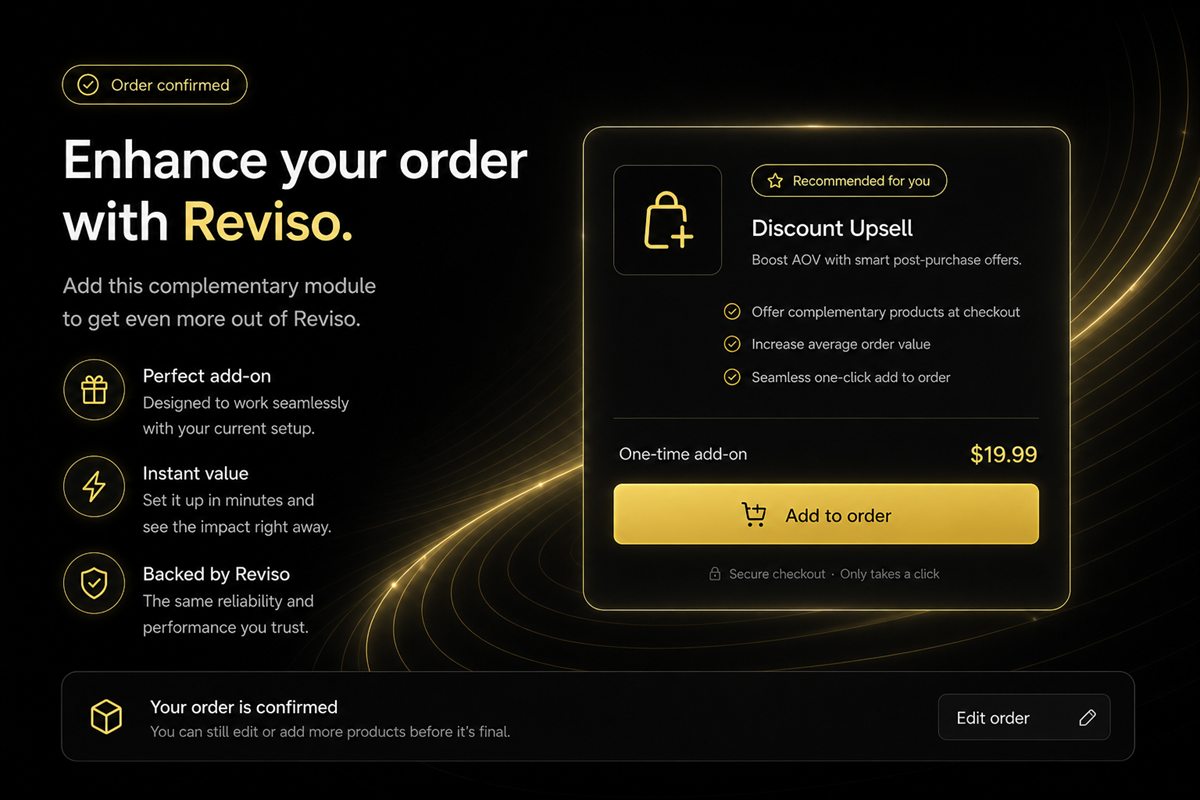
Key takeaways
- Post-purchase offers carry zero conversion-rate risk, because the order is already banked before the offer appears.
- The pre-dispatch window is the strongest of the three surfaces, since an added item ships in the same box at no extra fulfilment cost.
- Relevance beats discount depth. An accessory to the thing they just bought outperforms a bigger discount on something unrelated.
- Anything that delays the order confirmation or obscures the tracking information will cost more in support than it earns in revenue.
Every upsell before checkout is a trade. You are asking for attention at a moment when attention is the scarce resource, and every additional element on the path to payment carries some risk of losing the order entirely.
After checkout that trade disappears. The money is banked. The offer can fail completely and you are no worse off than if you had never made it.
This is not a small structural advantage. It is the reason post-purchase deserves more attention than it usually gets, and it applies to three distinct surfaces with quite different properties.
The three surfaces
1. The thank-you page
Highest traffic — every single customer passes through it. Attention is genuinely high for the first few seconds because people want to confirm the order went through.
Strengths: universal reach, high initial attention, natural place for a one-click add.
Weaknesses: the customer's primary goal is confirmation, and the window is short. Many leave within seconds of seeing the order number.
What works: a single, obviously-related offer with a one-click accept. Order details visible first, offer second.
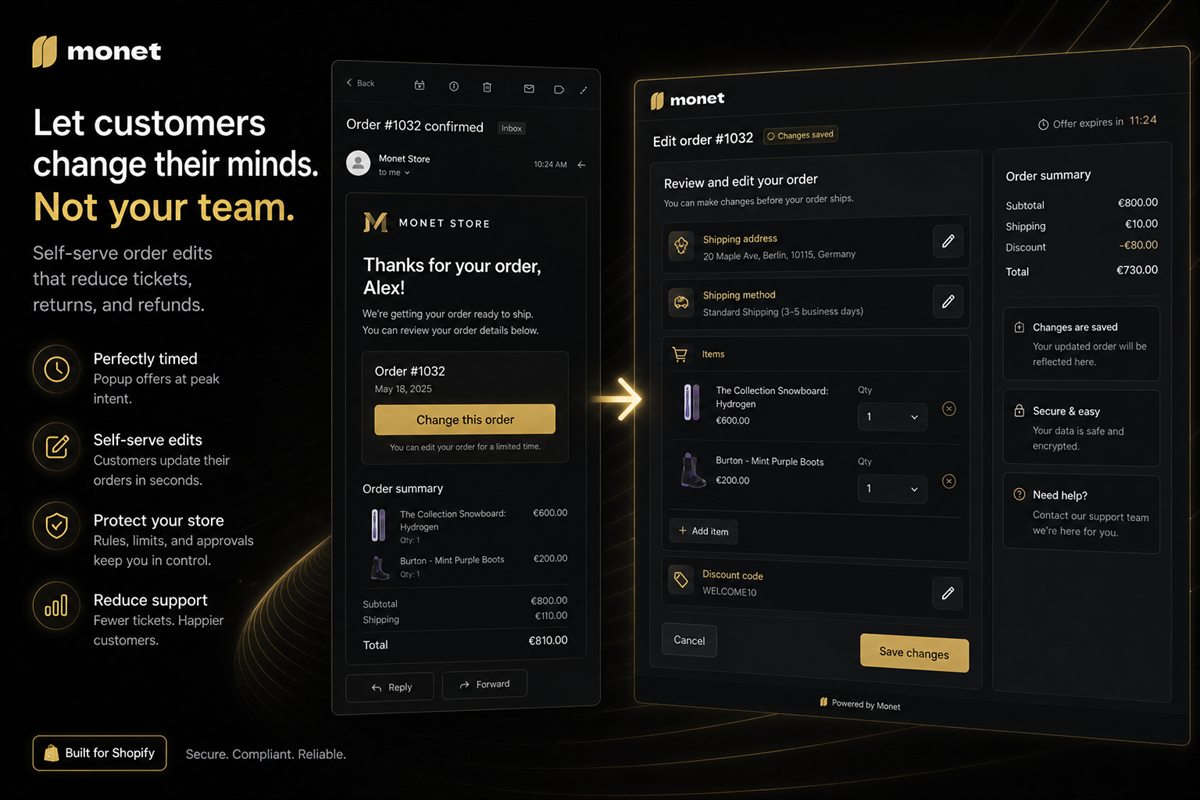
2. The order confirmation email
Reaches everyone, gets opened at extremely high rates — confirmation emails are among the most-read messages any store sends.
Strengths: near-universal open rate, arrives at the moment people are re-engaging with the purchase, easy to include an edit link alongside.
Weaknesses: an email cannot complete a transaction. Every offer here is a click away from the site, and email clients mangle complex layouts.
What works: a simple "forgot something? add to your order before it ships" link, and a low number of visually simple recommendations.
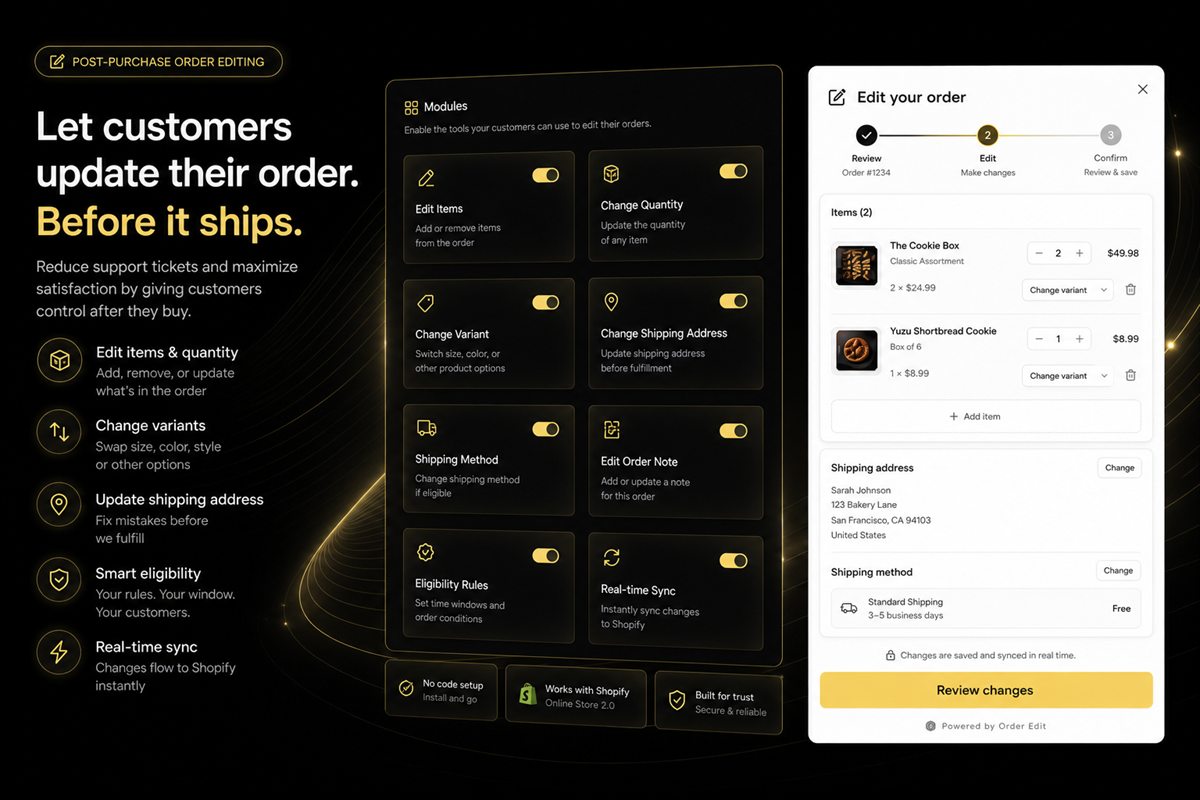
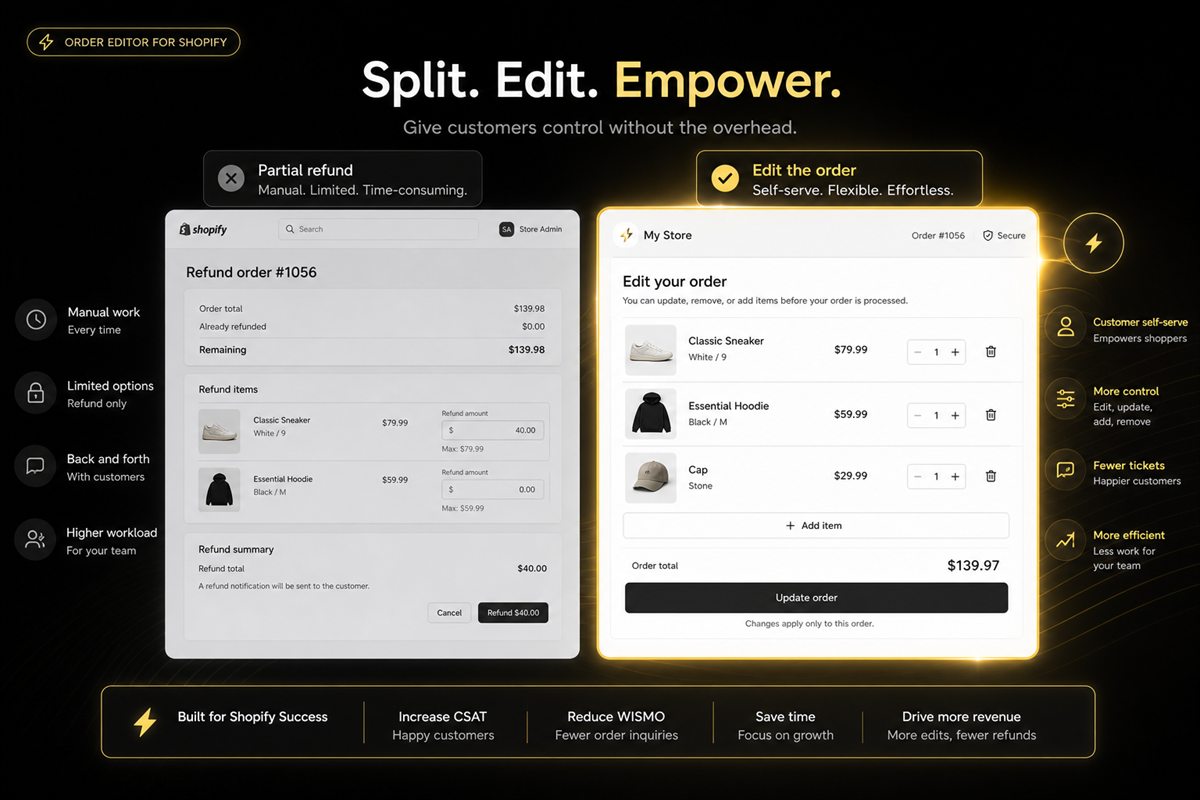
3. The order edit screen, before dispatch
The strongest surface, and the one most stores do not have.
Strengths:
- The customer arrived deliberately. Nobody is being interrupted.
- The order has not shipped, so an added item goes in the same box on the same label. The marginal fulfilment cost is essentially zero.
- Payment details are already on file.
- They are, by definition, thinking about the order right now.
Weaknesses: only reaches customers who come back to manage their order, which is a subset.
What works: contextual recommendations below the primary task, framed as convenience rather than promotion.
What to offer
Ranked by how reliably it works.
1. Accessories for what they just bought. The phone case, the extra filter, the matching strap. The relevance is self-evident and the customer does not have to think.
2. Quantity top-ups on consumables. "Add a second one and save." No new decision — they have already decided they want this thing.
3. Items they viewed and did not buy. You know what they considered. The friction that stopped them the first time is now largely gone.
4. Free shipping top-up. Only if they are below a threshold and now adding items anyway. Works well on the edit screen, poorly on the thank-you page.
5. Subscription conversion. For consumables, the post-purchase moment is a natural place to offer recurring delivery — they have just demonstrated the need.
6. Warranty or protection. Higher-margin, and genuinely useful on considered purchases.
Note the ordering. Discounted unrelated products do not appear, because they do not work. Relevance is doing the heavy lifting on every one of these.
What to avoid
Delaying the confirmation. If the customer cannot see their order number until they have dismissed an offer, you have made the single most important post-purchase job harder in exchange for a small conversion rate on the offer. The support cost exceeds the revenue.
Sequences. Two offers is the practical ceiling, and the second should be an upgrade of the first rather than a new pitch. Three or more converts the confirmation into a funnel, and customers notice.
Countdown timers on the confirmation page. Manufacturing urgency immediately after taking someone's money reads as manipulative in a way it does not pre-purchase.
Offers that require re-entering payment details. If the customer has to type a card number again, the offer will not convert. Use the stored payment method through Shopify's post-purchase capabilities.
Discounts that undercut the order just placed. Offering a code that would have made their completed order cheaper produces a support ticket, not a second sale.
Sizing the incentive
A useful frame: on a pre-dispatch add-on, your incremental cost is the cost of goods and nothing else. No additional shipping, no additional handling, no additional payment processing beyond the marginal fee.
That means you can afford a deeper incentive than you could on the same item sold standalone — but usually should not, because the data consistently shows relevance outperforming depth on this surface.
A reasonable default is a small incentive, in the range of five to ten percent, framed as a convenience of adding to an existing order rather than as a discount. The offer is doing its work through relevance and zero-friction checkout, not through price.
The cannibalisation question
A fair objection: are you selling something the customer would have bought at full price later?
Sometimes, yes. The mitigation is the same as anywhere else — check whether total revenue per customer over a period rises, not just whether the offer converts.
Two things work in your favour here specifically:
- The alternative for many of these items is that the customer buys the accessory elsewhere, or not at all. Accessory attachment rates on separate visits are low.
- Consolidating two purchases into one shipment saves you a full fulfilment cycle, which often covers the incentive by itself.
Measure it properly, but the balance on this surface is unusually favourable.
Rollout
- A single accessory recommendation on the thank-you page, below the order details, with one-click add.
- An "add to your order" link in the confirmation email, pointing at the edit screen.
- Recommendations on the edit screen, below the primary edit form.
- Viewed-not-purchased items as a second recommendation source once the first is working.
- Subscription or replenishment offers for the consumable subset of the catalogue.
Do not start with a multi-step post-purchase funnel. Start with one relevant item on one surface and read the numbers.
Measuring it
- Attach rate per surface — offers accepted ÷ offers shown. Expect the edit screen to lead comfortably.
- Incremental revenue per order, which is the number that matters more than attach rate.
- Total revenue per customer over 60 days, versus a holdout. This is the cannibalisation check.
- Support contacts about the confirmation or tracking. The guardrail. If this rises, the offer has crowded out the information.
- Fulfilment exceptions. Items added late must reach the warehouse before picking. If they do not, this shows up as short-shipped parcels.
- Refund rate on added items, compared with the same items sold normally. A materially higher rate suggests the offer is persuading rather than helping.
Frequently asked questions
What is a post-purchase upsell?
An offer shown after the customer has completed checkout - on the thank-you page, in the order confirmation, or on an order management screen before dispatch. The defining characteristic is that the original order is already secured, so the offer cannot reduce conversion rate.
Do post-purchase upsells hurt conversion rate?
No, and that is the central argument for them. The transaction has completed before the offer is displayed. The only risk is to customer experience, and that is a design problem rather than a structural one.
Which post-purchase surface performs best?
The pre-dispatch order edit screen, because the added item ships in the same parcel at no additional fulfilment cost and the customer arrived deliberately rather than being interrupted. The thank-you page has the highest traffic; the edit screen has the highest intent.
Should post-purchase offers be discounted?
A modest incentive helps, but relevance matters far more than depth. An accessory that obviously belongs with the item just purchased will outperform a heavily discounted unrelated product, and it protects your margin.
How many post-purchase offers should I show?
One, or at most two if the second is a direct upgrade of the first. Sequences of three or more read as a funnel rather than a service, and the incremental revenue does not cover the damage to the confirmation experience.