 Addy
Addy  Addly
Addly  Goalify
  Monet
Monet  Reviso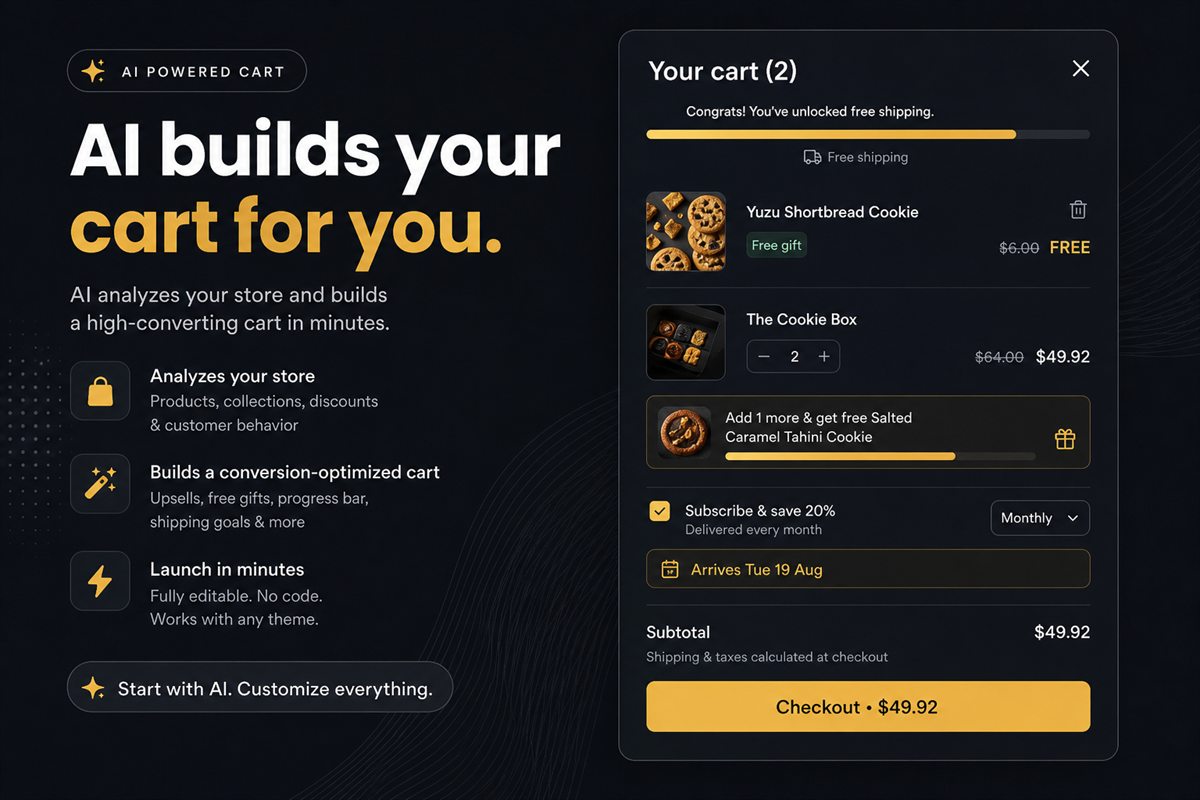
Key takeaways
- Shoppers do not want a shipping speed, they want a date. "Arrives Tuesday 26 August" answers the question; "2-4 business days" makes them do arithmetic.
- Delivery uncertainty is one of the most common reasons a committed shopper leaves the cart to go and check a policy page, and most of them do not come back.
- An honest wide range outperforms a precise range you miss. Missed dates convert into support tickets, refund requests and reviews.
- The date belongs in three places, in this order of value - the cart, the product page, and the order confirmation.
Ask a shopper what they want to know before they check out and delivery timing will be in the first three answers. Look at what most Shopify stores show them and you will find either a shipping speed, a policy link, or nothing at all.
That gap is unusual in ecommerce, because closing it is cheap, technically straightforward and produces a measurable effect on both conversion and support load. It just does not look like a growth lever, so it stays on the backlog behind things that do.
Why a date beats a speed
"Ships in 1–2 business days, delivery 3–5 business days" is a sentence that asks the reader to do work.
To turn it into an answer they need to know: what time your cut-off is, whether today counts, whether Saturday counts, whether the two ranges are additive, and what your carrier does over a public holiday. Most people will not do that calculation. They will approximate it, get it wrong, and either accept a vague sense of "about a week" or go and look for a clearer answer somewhere else.
"Arrives Tuesday 26 August" removes all of it. There is no arithmetic, no assumption and no ambiguity. It is also, importantly, a commitment, which is a different psychological object from an estimate — and commitments are what shoppers use to decide.
The gap widens on mobile, where the shopper is more likely to be doing something else at the same time and much less likely to sit and work out what "3–5 business days from Thursday" means.
What uncertainty costs you
The mechanism is specific and worth naming, because it explains where the value comes from.
A shopper in your cart who is unsure about delivery has three options. Guess and continue. Leave the cart to find your shipping policy. Or abandon.
The middle option is the expensive one, and it is the most common. It requires navigating away from the cart, finding a policy page written for legal completeness rather than for answering this question, parsing a table, and then finding their way back. Every step in that sequence is a place to lose them, and the policy page is a particularly good place to lose them because it usually does not answer the question either.
Putting the date in the cart removes the reason to leave.
Calculating a date you can honour
The estimate is the sum of four components. Getting it right is mostly about not forgetting any of them.
- Order cut-off. Orders after your daily cut-off do not start processing until the next working day. This is the component most often omitted, and it is why so many estimates are systematically one day optimistic.
- Processing time. From paid to handed to the carrier. Be honest about this. If your warehouse takes two days during peak, the peak estimate is two days.
- Transit time. Per carrier, per service level, per destination lane. Not one global number.
- Non-working days. Weekends, and the public holidays of both the origin and destination country.
Then apply a confidence policy. You have two reasonable choices:
- A range — "26–30 August". Honest, easy to hit, slightly less persuasive.
- A single date at a high percentile — the date you hit 90% of the time, not the date you hit on a good week. Persuasive, and safe if you actually use the percentile rather than the median.
What you must not do is show the best-case date. A promise you keep two thirds of the time is worse than no promise at all, because the third of customers you miss are now customers with a specific grievance rather than a vague disappointment.
Where to show it
Three surfaces, in descending order of value.
The cart
Highest value, because this is where uncertainty converts directly into abandonment. The shopper has committed to the products and is now evaluating the transaction as a whole, and delivery timing is the largest remaining unknown.
Place it near the subtotal, in the same visual group as the shipping line. It should read as part of the transaction summary, not as a marketing message.
The product page
Second, and it does a different job. In the cart the date removes an objection; on the product page it influences the add-to-cart decision itself, particularly for gift purchases and anything with a deadline. "Order within 4 hours for delivery Tuesday" is the strongest legitimate form of urgency available to an ecommerce store, because it is simply true.
The order confirmation
Third, and mostly a support-cost play rather than a revenue one. Repeating the date after purchase reinforces the expectation and removes the reason for the customer to write in on day three.
Localisation is not optional here
Of everything in a cart, the delivery estimate is the element that varies most by destination — and therefore the element most damaged by showing one global value.
Three rules:
- Compute per destination lane. Domestic transit time shown to an international shopper is not an estimate, it is a false claim.
- Use the destination's calendar. Public holidays at the destination affect final-mile delivery. So do the origin country's holidays for dispatch.
- Format the date unambiguously.
08/09is 8 September in most of Europe and 9 August in the US. Spell the month.
If you cannot compute a defensible estimate for a market, show nothing there. An absent estimate is neutral. A wrong one is a liability.
The honest limits
Delivery dates are not a magic lever and it is worth being clear about where they do not help.
- If your delivery is genuinely slow, showing the date will reduce conversion on those orders. That is the estimate working correctly — you are filtering out customers who would have been disappointed and become refund requests. It is a short-term loss and a long-term gain, but it is a real short-term loss.
- If your fulfilment is unpredictable, an estimate makes the unpredictability visible and quantifiable, which will generate complaints you were previously absorbing invisibly. Fix fulfilment first.
- If you dropship from multiple origins, a single order can have several arrival dates. Showing one date for a multi-origin order is worse than showing per-item dates, even though per-item dates look messier.
What to measure
- Cart-to-checkout rate, before and after. This is where the effect should show up first.
- Add-to-cart rate on product pages that gained the estimate.
- "Where is my order" ticket volume as a share of orders. Expect a meaningful decline.
- On-time delivery rate against the shown estimate. This is the guardrail. If it drops below your target percentile, widen the estimate rather than hoping.
- Refund and cancellation rate for late orders specifically.
The last two are what keep this honest. An estimate engine is only as valuable as the promise it makes is reliable, and the only way to know that is to score yourself against the date you displayed rather than the date you hoped for.
Frequently asked questions
Should I show a delivery date or a shipping speed?
A date. "2-4 business days" requires the shopper to know your cut-off time, your processing time and which days count as business days, and to do that arithmetic in their head. "Arrives Tuesday 26 August" answers the question they actually have. Every study of this comparison finds the date wins, and it wins by more on mobile.
What if I cannot predict delivery reliably?
Show a range wide enough to be honest, or show nothing for that lane. A range like "26-30 August" is far better than a single date you miss a third of the time. The cost of an unmet promise is much higher than the benefit of a tighter one.
Does an estimated delivery date reduce support tickets?
Substantially, yes. "Where is my order" is the single most common support contact in ecommerce, and a large share of it is generated before the expected window has even passed, by customers who never had a clear expectation set in the first place.
Where should the delivery estimate appear?
The cart has the highest value because that is where uncertainty causes abandonment. The product page is second because it influences the add-to-cart decision. The order confirmation is third and mostly reduces support load rather than driving revenue.
Do delivery dates need to change per country?
Yes, and this is the most common way stores get it wrong. A domestic transit time shown to an international shopper is not an estimate, it is a false claim. If you cannot compute the estimate for a market, do not show one there.