 Addy
Addy  Addly
Addly  Goalify
  Monet
Monet  Reviso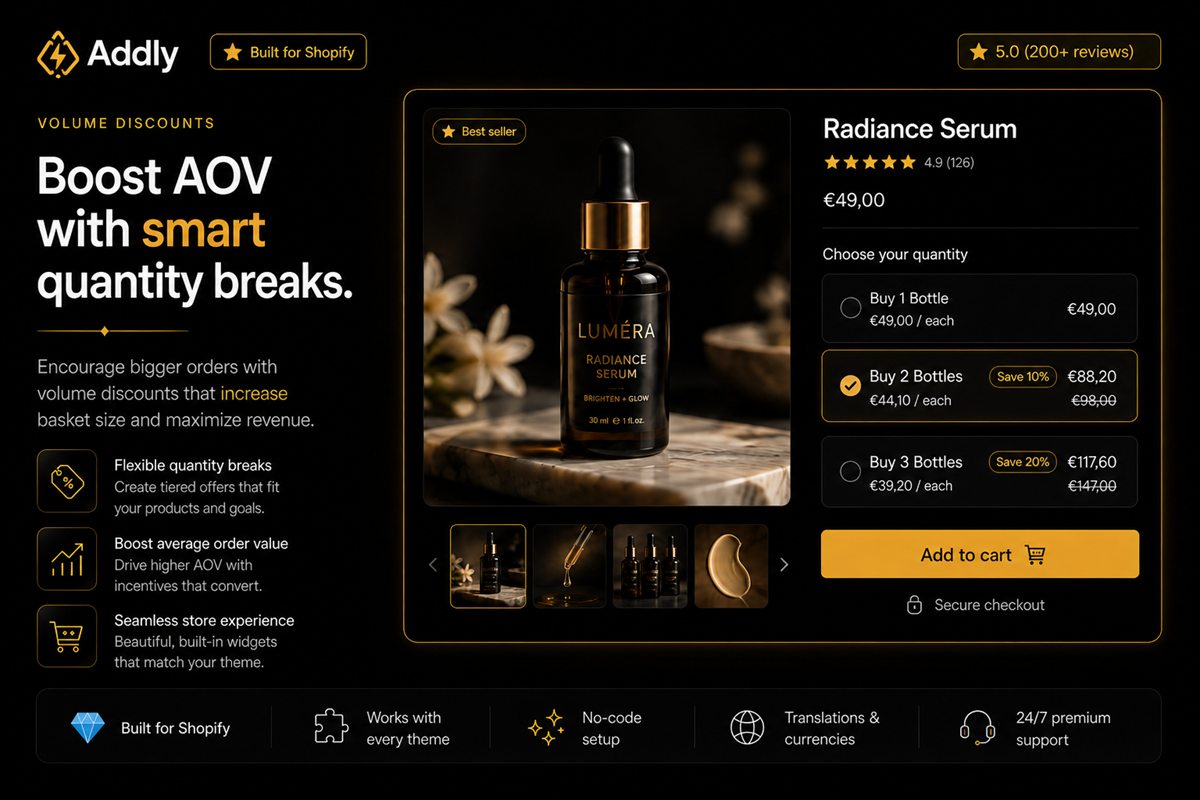
Key takeaways
- Three tiers is the sweet spot. Two leaves value on the table, four or more spreads attention and lowers the take rate of the tier you actually want.
- Anchor the middle tier. Most stores should design the whole ladder around the tier they want the majority to pick, then build the others to make it look correct.
- Discount depth should rise less than proportionally with quantity. A linear ladder gives away margin at the top for no additional behaviour change.
- Variant-level targeting turns a blunt pricing instrument into an inventory tool - discount the sizes you are overstocked on, not the ones that sell themselves.
Quantity breaks look like the easiest offer in ecommerce. Pick a discount, pick a quantity, publish.
They are also one of the easiest ways to quietly lose money, because the customers most likely to take a quantity break are the ones who were already going to buy that quantity. You can run a tier ladder for a year, watch your average order value rise, and end up with less gross profit than you started with.
The fix is not complicated, but it does require doing the arithmetic before rather than after.
The two things a tier ladder does
Every quantity discount does two things simultaneously, and they pull in opposite directions.
- It creates incremental units. Some customers buy three who would have bought one. This is the reason to run it.
- It subsidises existing behaviour. Some customers who were always buying three now pay less for three. This is the cost.
The whole design problem is maximising the first while minimising the second. Everything below follows from that.
Start by measuring your baseline
Before setting any tier, pull your current units-per-order distribution for the product in question. You need to know what share of customers already buy 1, 2, 3, 4+ units without any encouragement.
That distribution tells you two things:
- Where the natural break is. If 70% of orders are a single unit and 20% are two, your first tier belongs at two — that is where the marginal customer already sits.
- Your cannibalisation floor. If 12% of customers already buy three units unprompted, then a three-unit tier is subsidising at least 12% of buyers from day one.
Setting a tier below your existing modal quantity is the classic mistake. If most people already buy two, a "buy 2 save 10%" tier changes nobody's behaviour and costs you 10% of a large share of your revenue.
Three tiers, and why not four
Two tiers is a binary — buy one, or take the deal. It leaves the entire upper half of the demand curve untouched.
Four or more tiers spreads attention. Every additional option lowers the salience of the others, and the tier you actually wanted people to pick loses share to indecision. There is also a practical limit to how much information a shopper will read in a pricing table on a phone.
Three works because it produces a shape people recognise instantly: an entry point, an obvious middle, and a ceiling that makes the middle look reasonable.
Design the middle tier first
This is the part most stores do backwards. They start with tier one and work up.
Start instead with the tier you want most people to choose. That is your target — usually one unit above your current modal quantity, at a discount your margin can absorb comfortably. Design that tier to be genuinely attractive.
Then build the other two around it:
- Tier 1 is the entry point. Small discount, low commitment. Its job is to establish that a ladder exists.
- Tier 3 is the anchor. It should offer a visibly better rate, at a quantity most customers will not choose. Its job is to make tier 2 look like the sensible option rather than the greedy one.
Why the ladder should flatten
A linear ladder — 10%, 20%, 30% — feels fair and is expensive.
The reason is that the behaviour change you are buying gets smaller as you go up. Convincing a one-unit buyer to take two is a real change and worth paying for. Convincing a four-unit buyer to take five is a marginal change, and the customers buying four were probably going to buy five occasionally anyway.
A flattening ladder pays the most where the behaviour change is largest, and progressively less where you are mostly subsidising existing demand.
The margin floor
The hard constraint. For any tier:
Gross profit at the discounted price × quantity must exceed gross profit at full price × the quantity that customer would otherwise have bought.
On the $30 product above with 55% margin ($16.50 gross profit per unit):
| Tier | Revenue | Gross profit | Beats 1 unit? | Beats 2 units? |
|---|---|---|---|---|
| 1 unit | $30.00 | $16.50 | — | — |
| 2 @ 10% off | $54.00 | $27.00 | Yes | — |
| 3 @ 16% off | $75.60 | $35.10 | Yes | Yes |
| 5 @ 20% off | $120.00 | $52.50 | Yes | Yes |
| 5 @ 40% off | $90.00 | $22.50 | Yes | No |
That last row is the trap. A 40% discount at five units still looks profitable against a single-unit baseline, but it makes you less money than the customer who would have bought two at full price. If a meaningful share of your five-unit buyers came from the two-unit group, the tier is a loss.
Variant-level targeting
The most underused feature in quantity discounting, and the one that turns it from a pricing instrument into an inventory tool.
A product-wide discount treats every variant the same, which is almost never what you want. You are rarely overstocked on everything.
Scoping tiers to specific variants lets you:
- Clear the sizes that always end the season in the warehouse, without discounting the ones that sell out.
- Push the colourway that arrived in the wrong quantity.
- Protect a variant with a supply constraint from being discounted at all.
- Run a deeper ladder on last season's colours while this season's stay at full price.
This is a much more precise tool than a markdown, and it is invisible to customers who are not looking at the variant you are clearing.
Presentation
The maths decides profitability; the presentation decides take rate. A few things reliably help:
- Show per-unit price at every tier. "$25.20 each" makes the comparison concrete in a way "16% off" does not.
- Show total saving in currency. For low-priced items the percentage looks better; for expensive ones the currency amount does. Show both.
- Pre-select the target tier. Defaults matter enormously. If tier 2 is where you want people, select it by default rather than starting at one.
- Label the target, not the top. "Most popular" on the middle tier. Putting "best value" on the top tier pushes people to a tier you make less money on.
- Keep the table short. Four rows maximum, readable on a phone without horizontal scroll.
Measuring the right thing
Average order value will go up. That is not evidence of anything — a discount ladder mechanically raises AOV by construction.
The numbers that matter:
- Units per order, compared against your pre-launch baseline distribution.
- Effective discount rate — total discount ÷ total revenue on that product.
- Gross profit per order for the product, before and after.
- Tier distribution — what share of buyers landed on each tier. If almost everyone takes tier 3, your ladder is too generous. If almost nobody does, it is too steep.
Give it at least four weeks at moderate volume, and compare against the same period rather than the previous month if your category is seasonal.
Frequently asked questions
What is the difference between quantity breaks and volume discounts?
In practice the terms are used interchangeably. Where a distinction is drawn, quantity breaks usually means discrete tiers on a single product (buy 2 save 10 percent) while volume discounts can also mean a sliding scale across a collection or an entire order. The pricing logic and the margin risk are the same in both cases.
How many discount tiers should I offer?
Three. Two tiers is a binary choice that leaves the upper range untouched, and four or more spreads attention so thinly that the take rate of your target tier falls. Three gives you a clear entry point, a designed target and an aspirational ceiling.
Should the discount increase proportionally with quantity?
No. Discount depth should increase, but at a decreasing rate. Ten percent at two units, sixteen at three, twenty at five is a healthy shape. A linear ladder gives away margin at the top to customers whose behaviour you were not going to change anyway.
Do quantity breaks work on non-consumable products?
Rarely on the same product, because nobody needs two of a considered single purchase. They can work across variants, where the customer is buying different colours or sizes of the same item, and they work well on anything gifted in multiples.
Can I run quantity breaks on specific variants only?
Yes, and it is one of the more useful applications. Scoping a discount to particular variants lets you clear overstocked sizes or colours without discounting the ones that already sell at full price, which is far more precise than a product-wide markdown.