 Addy
Addy  Addly
Addly  Goalify
  Monet
Monet  Reviso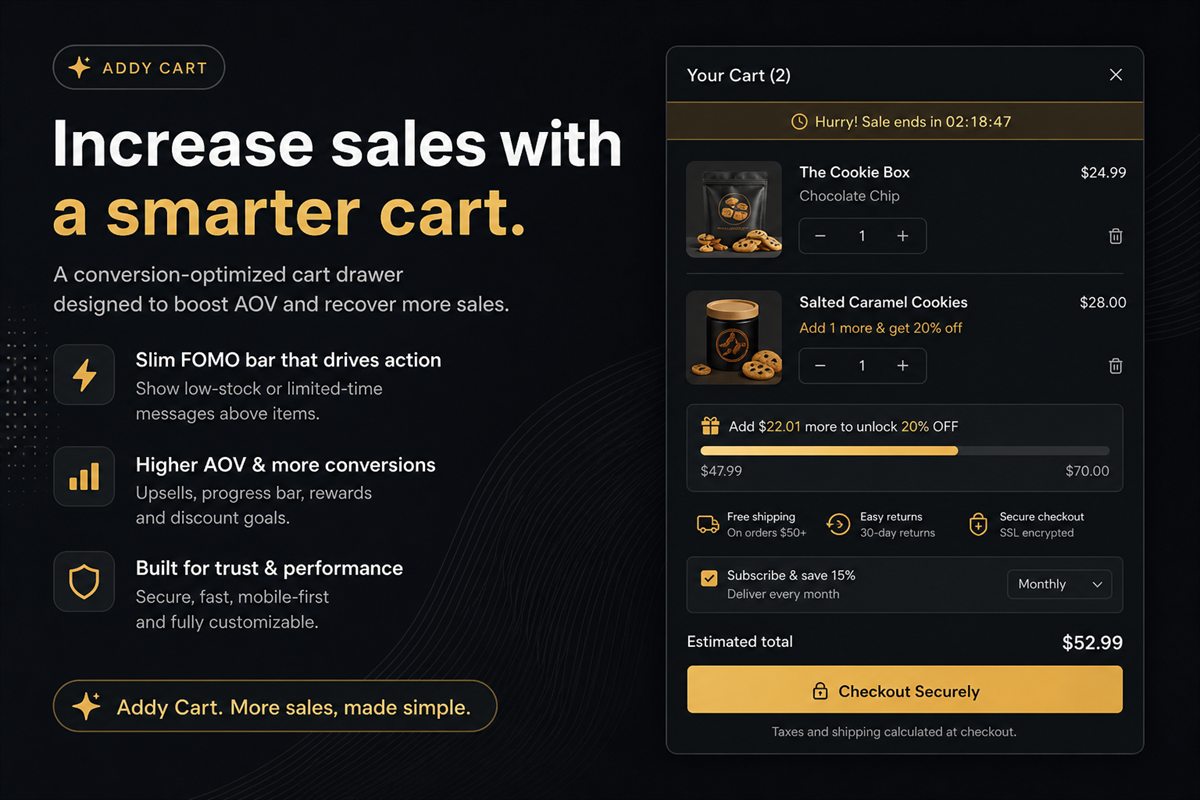
Key takeaways
- One true urgency signal beats three fake ones. "12 sold in the last 24 hours" only works if the number is real.
- Countdown timers that reset on refresh are a trust leak. If you cannot honour the deadline, do not show a clock.
- Put FOMO above the line items or on a single announcement bar — not on every product card.
- Social proof in the cart should be about this order (stock, delivery, recent sales), not about the brand in general.
- If you cannot write a specific, true line, you do not have a FOMO feature. You have a copy box.
Fear of missing out belongs in the Shopify cart only when the claim is true. The shopper is already committed enough to have added something, and a real constraint — stock, a sale end, a dispatch cut-off — can finish the job. A fake timer belongs in the bin, because this is the last moment of trust before payment.
FOMO is not a design style. It is a claim about the world. Write the true version or show nothing.
What FOMO in the cart actually is
In a cart drawer, FOMO is a short line that states a real limit on this order: inventory at the variant they added, a promotion that actually ends, or a warehouse cut-off you will keep. It is not brand-level social proof ("thousands of happy customers") and it is not a clock that restarts when they refresh.
The cart drawer is a small surface. One true signal is plenty. Three signals is nagging.
The only FOMO that belongs in a cart
Three categories earn their pixel:
- Real inventory. Variant-level stock, updated, not a theme setting of "3".
- Real promotions. A sale that actually ends at a timestamp you will not quietly extend.
- Real delivery constraints. Cut-off times for next-day dispatch that your warehouse actually keeps.
Everything else — "27 people are looking at this", "in high demand", a timer that restarts at 15:00 every time you open the tab — is theatre. Theatre converts once and then trains your regulars to ignore you.
An estimated delivery date that names a cut-off is often stronger than a countdown, because it is a promise the warehouse can keep rather than a clock the marketing team invented.
One bar, not a stack
Announcement bars compound badly. A free-shipping progress bar is a goal. A countdown is a deadline. A stock warning is a constraint. Pick the one that is actually true for this basket and silence the others.
A useful default:
- Progress bar if they are under a threshold you care about.
- Delivery cut-off if they are over the threshold and you can still make a same-day dispatch.
- Stock only on the line item that is actually scarce, not as a global banner.
Put the bar above the line items. It frames the basket. Below an upsell it reads as a caption on an offer, which is a different and weaker job. Do not repeat the same urgency on every product card in the drawer.
How to write the line
Specific and boring beats vague and exciting.
- Bad: "Hurry, selling fast!"
- Good: "Order in the next 2 hours for dispatch today."
- Bad: "Limited stock."
- Good: "Only 2 left in Navy / M."
- Bad: "Sale ends soon."
- Good: "Member price ends Sunday at midnight."
If you cannot write the good version because the data is not there, you do not have a FOMO feature. You have a copy box.
Name the variant, the hour, or the date. Do not name a feeling. "Selling fast" is a feeling. "Only 2 left in Navy / M" is a fact.
How to set a true bar on Shopify
- Decide which one claim is true for most baskets this week: stock, sale end, or dispatch cut-off.
- Wire the bar to live data. Inventory at variant level, the promotion end timestamp, or the warehouse cut-off you actually pick against.
- Place one bar at the top of the cart drawer. Remove duplicate urgency from product cards and from a second announcement app.
- Preview a basket that is under the free-shipping threshold and a basket that is over it. Only one message should win.
- Reload the page. If a timer resets, turn the timer off.
Do not use a theme setting of "show low stock at 3" on a SKU with hundreds of units. Inventory theatre is worse than silence.
When not to use urgency
Skip FOMO in the cart when:
- You cannot honour the deadline (the sale will be extended, the cut-off is decorative)
- Stock numbers are cached or rounded into theatre
- You already have a progress bar that is doing the job of "one more item"
- The store has used fake timers before and regulars have learned to ignore them
Trust is an AOV feature. Shoppers who believe your cart will believe an in-cart upsell. Shoppers who have been burned by a fake timer will not. The quietest stores often have the highest take rates on in-cart offers, because nothing in the drawer has given them a reason to doubt the next sentence.
How to measure a FOMO bar
Watch add-to-cart-to-checkout rate and attach rate on whatever sits next to the bar, not clicks on the bar itself. A bar is not a campaign. If checkout starts fall after you add a timer, you have added anxiety without a true constraint. If they hold and attach on the upsell rises, the bar is doing its job: finishing a decision the shopper had already started.
Frequently asked questions
Do countdown timers increase conversions in the cart?
Real ones can, for genuine promotions with a real end time. Timers that reset when you reload the page train shoppers to distrust every other claim in the store, including the ones that are true.
How many FOMO blocks should a cart have?
One. A bar or a single line of stock/sales proof. A drawer that shouts in three places is a drawer shoppers learn to skim.
Is "only 3 left" okay if it is true?
Yes, if it is true at the variant level and updates. Inventory theatre ("only 3 left" on a SKU with 400 units) is worse than silence.
Should FOMO sit above or below the upsell?
Above the line items. It frames the basket. Below the upsell it reads as a caption on an offer, which is a different and weaker job.
Does Shopify show low stock in the cart by default?
Not as a cart announcement bar. Inventory can appear on the product page depending on the theme, but a true variant-level line in the cart drawer usually needs an app or a custom block that reads live inventory. If you cannot update the number, do not show it.
What if my free-shipping bar and a countdown both want the top slot?
Pick the one that is actually true for this basket. A progress bar if they are under a threshold you care about. A delivery cut-off if they are over it and you can still make a same-day dispatch. Do not stack both plus a stock warning.