 Addy
Addy  Addly
Addly  Goalify
  Monet
Monet  Reviso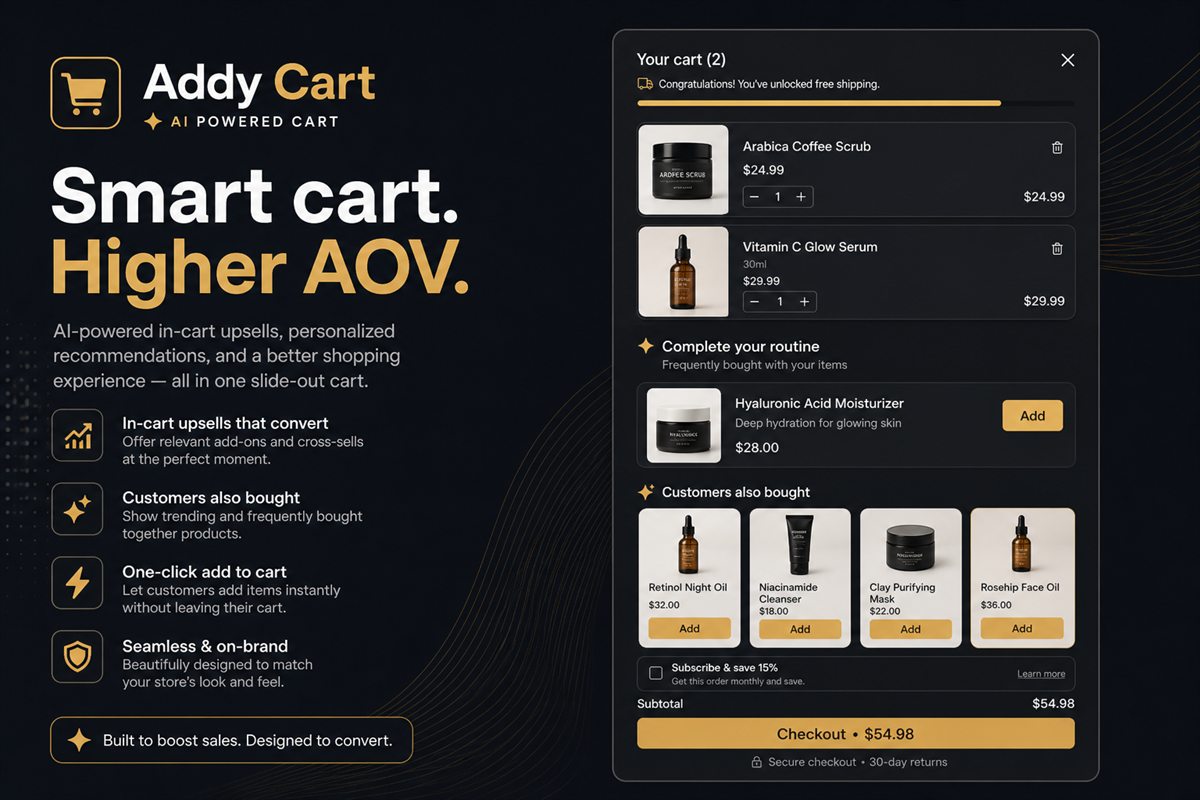
Key takeaways
- The cart is a confirmation surface. Offers that ask a shopper to reconsider a decision they already made will always underperform offers that simply add to it.
- Price the upsell at 15 to 40 percent of the anchor product. Above that ratio it becomes a second purchase decision and gets deferred.
- Two offers is the practical ceiling in a cart drawer. A third measurably lowers the take rate of the first two.
- Take rate matters more than revenue in early testing, because it tells you whether the offer is relevant before volume tells you whether it is profitable.
An in-cart upsell is the easiest offer in ecommerce to get slightly wrong. The shopper has committed, the mechanics are simple, and every app makes it a two-click setup — which is exactly why so many stores end up with a cart full of offers that nobody takes.
The difference between an offer that converts and one that gets ignored is almost never the design. It is the relationship between the offer and what is already in the basket.
The rule underneath everything
A shopper looking at their cart has finished deciding. They are in confirmation mode, not evaluation mode.
That single fact predicts which offers work:
- Additive offers — "would you also like…" — cost the shopper nothing cognitively. They can say no in a quarter of a second and lose nothing.
- Substitutive offers — "actually, consider this instead" — reopen a closed decision. Even when the shopper declines, you have introduced doubt into a cart that had none.
Every recommendation in this article follows from that distinction.
The nine that work
1. The complementary accessory
The default, and still the best. A case with a device, a filter with a machine, socks with boots.
Price ratio is the variable that matters most. Somewhere between 15% and 40% of the anchor product's price is the zone where an accessory reads as "obviously, yes" rather than "let me think about that". At 60%+ you are asking for a second purchase decision, and the shopper defers it — usually forever.
2. The quantity upgrade
"Add one more and save 10%." The shopper does not evaluate a new product at all; they evaluate a better price on something already chosen. Take rates on this are consistently the highest of any cart offer because the decision cost is close to zero.
Works on consumables and anything with a replenishment cycle. Does not work on considered single purchases.
3. The threshold gift
Not strictly an upsell — a reward. "Spend $22 more and get the travel size free."
What makes this work is that the shopper is choosing to earn something rather than to buy something, which is a materially different psychological transaction. The gift should be genuinely desirable and genuinely small in cost. A gift nobody wants is worse than no gift, because it reveals the mechanic.
4. Shipping protection
Near-zero cost of goods, real perceived value, and a legitimate service. Take rates are often surprisingly high.
The one non-negotiable: it must be unticked by default. Pre-ticked opt-outs are illegal in the EU under the Consumer Rights Directive, generate chargebacks everywhere else, and are the fastest way to end up in a review that mentions the word "sneaky".
5. Gift wrap and personalisation
Seasonal, high-margin, and it makes the order feel considered. Particularly strong in Q4, and worth turning off in February rather than leaving it running as permanent clutter.
6. The replenishment nudge
For repeat customers only: "You last ordered this 47 days ago." No discount, no persuasion — just information the shopper actually wants. It converts because it is useful rather than because it is an offer.
7. The bundle completion
The shopper has two of the three items in a known set. Offering the third at a small discount completes a pattern, and pattern completion is unusually motivating.
Requires that the set is real and obvious to the customer. Manufactured sets do not work.
8. The sample or trial size
Low price, low risk, high information value for the shopper, and an excellent way to seed a future full-size purchase. Effectively a paid product trial that improves your AOV instead of costing you CAC.
9. The warranty or service add-on
Best on higher-priced items where the shopper is already thinking about protecting the purchase. Margin is usually excellent. Be precise about what it covers — vague warranties generate support load that erases the margin.
The four that annoy
1. The substitute product
"Customers also viewed…" belongs on a product page, not in a cart. Showing an alternative to something already in the basket does one of two things: nothing, or it makes the shopper wonder whether they picked the wrong item. Neither outcome is worth the slot.
2. The unrelated bestseller
Filling the upsell block with your top seller regardless of cart contents is the recommendation equivalent of shrugging. It trains shoppers to ignore that region of the drawer, which then poisons the well for the relevant offers you show later.
3. Email capture in the cart
You are roughly ninety seconds from getting their email address at checkout. Asking for it here trades a guaranteed acquisition for an interruption.
4. The third, fourth and fifth offer
Every additional offer reduces the take rate of the ones above it. Two is the practical ceiling in a drawer. If you genuinely have three things worth suggesting, your recommendation logic needs to be more selective — not your cart taller.
Picking the pairs
Almost all of the performance difference between two stores running the same upsell app comes down to which products get suggested.
The method that works:
- Export the last 90 days of orders with line items.
- For each product, count how often each other product appears in the same order.
- Filter to pairs where the co-occurrence is materially above what random chance would produce.
- Remove anything in the same substitutable category as the anchor.
- Of what remains, prefer the item closest to 25% of the anchor price.
That produces a better pairing list than any category rule, and it takes an afternoon. If your order volume is high enough, a system that recalculates this continuously will beat a static list, because your catalogue and your seasons move and a hand-built list does not.
Measuring properly
Four numbers, in this order of usefulness:
| Metric | What it tells you | When to look |
|---|---|---|
| Take rate (accepts ÷ impressions) | Whether the offer is relevant | Immediately — needs low volume |
| Attach revenue per cart | Whether it is worth the slot | After ~200 impressions |
| Cart-to-checkout rate | Whether you added friction | Continuously, as a guardrail |
| Gross profit per session | Whether the whole thing is profitable | Monthly |
Take rate is the fastest signal, because relevance shows up long before revenue does. An offer with a take rate near zero is not underpriced — it is irrelevant, and no discount will fix that.
The guardrail metric is cart-to-checkout rate. If it moves down while AOV moves up, you have traded conversions for basket size. Sometimes that is profitable. Run the third number before you decide.
A sensible starting configuration
For a store that has never run cart upsells:
- One complementary accessory block, pairs from real order data, priced at 15–40% of the anchor.
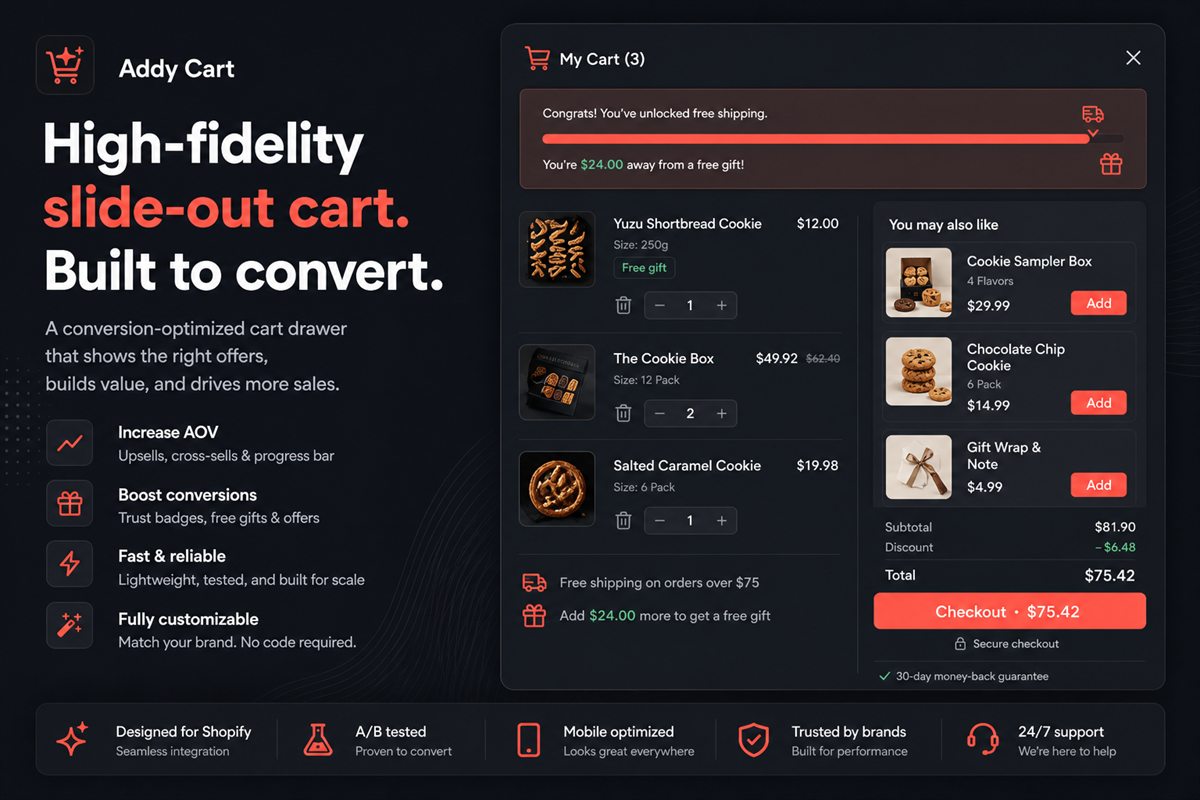
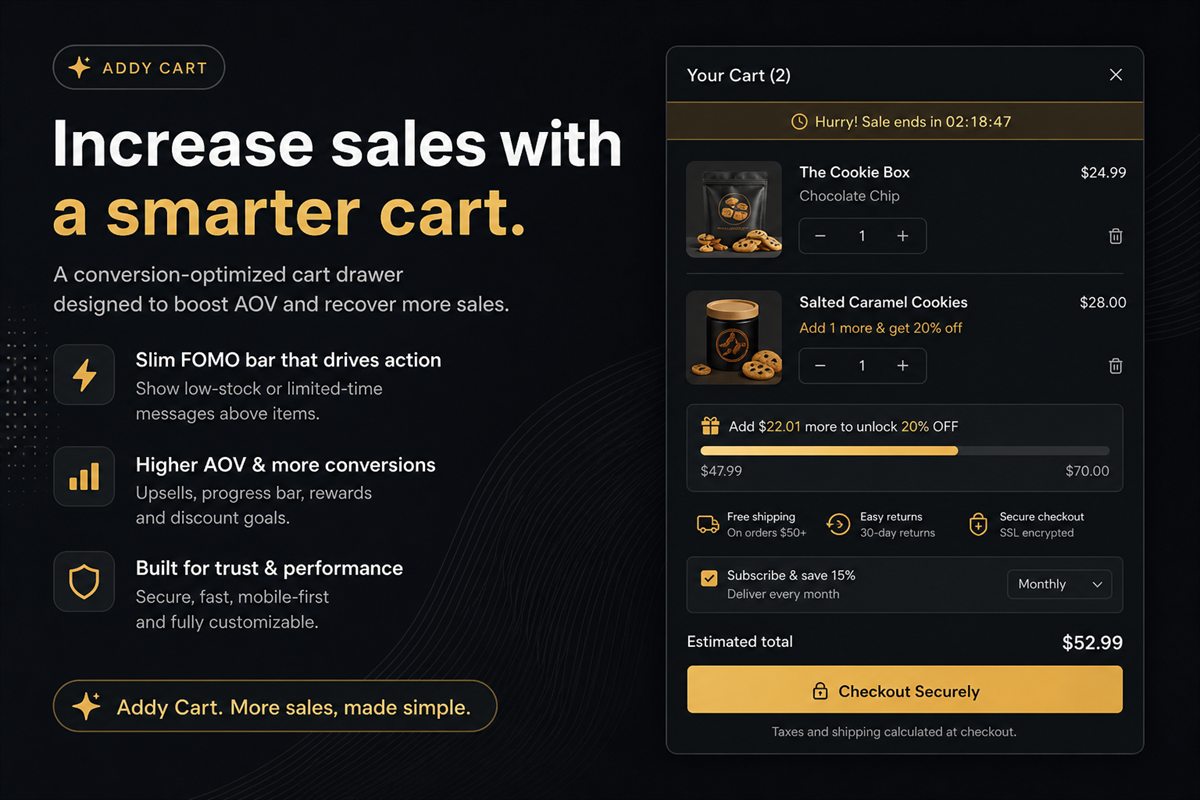
- One free shipping progress bar above the line items.
- Shipping protection as an unticked add-on, if you can service the claims.
- Nothing else, for at least three weeks.
Then add the second offer, and measure whether the first one's take rate dropped. If it did by more than a little, you have found your ceiling.
Frequently asked questions
What is a good in-cart upsell take rate?
For a relevant complementary accessory shown to every cart, single-digit percentages are normal and anything consistently above ten percent is strong. Quantity upgrades on an item already in the cart run much higher because they require no new decision. Compare each offer against your own baseline rather than against a published benchmark, since take rate depends heavily on category and price point.
Should cart upsells be discounted?
Not always. A discount helps when the shopper needs a reason to decide now, and hurts when it trains customers to expect the accessory to be cheap. Test the same offer with and without a discount before assuming the discount is what makes it work.
Where should the upsell block sit in the cart drawer?
Below the line items and above the trust and checkout blocks. Placing it above the line items competes with the progress bar for the top slot and makes the cart feel like an ad unit before it feels like a cart.
Do cart upsells hurt conversion rate?
Additive offers placed after commitment rarely do. What hurts is anything that asks the shopper to re-open a settled decision, anything that pushes the checkout button below the fold, and anything that adds a required step. Keep the checkout path a single unobstructed click and the risk is minimal.
How do I choose which product to upsell?
Use your own order data. Find the products that most frequently appear in the same order as the anchor product, filter for ones priced well below it, and exclude anything in the same substitutable category. Category-based logic produces the classic failure of recommending a second pair of the same shoes.