 Addy
Addy  Addly
Addly  Goalify
  Monet
Monet  Reviso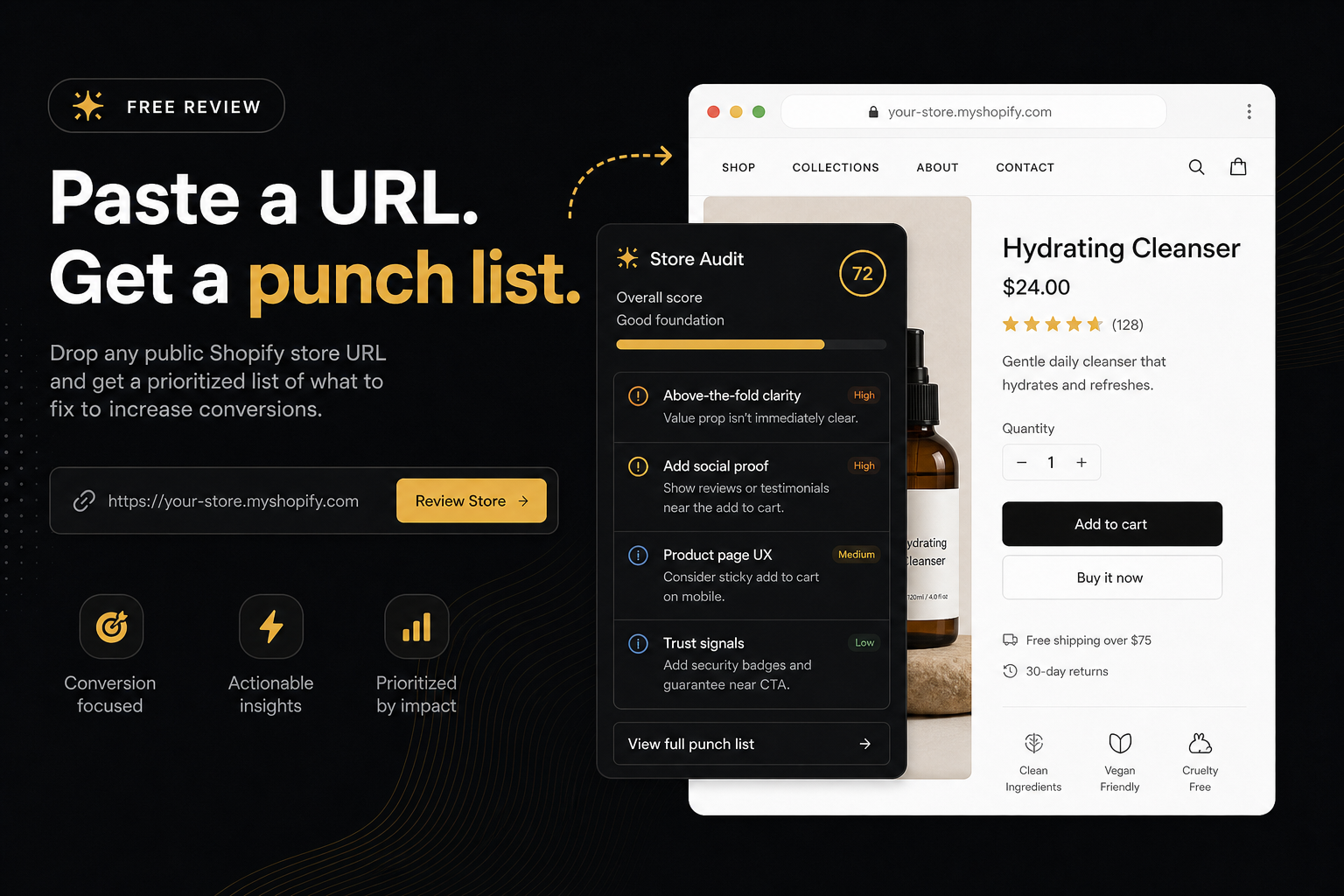
Key takeaways
- Free is useful only if it is public, fast, and ranked. A login wall is a lead form, not a review.
- Paste the domain. https:// is optional. Homepages resolve to a bestseller unless you send a /products/ URL.
- You get health plus a short punch list. Constraints first. App names only where an app owns the leak.
- Reports last about 90 days. The share link does not recrawl. Use Audit again after a theme change.
“Free Shopify store review” is a crowded promise. Half the results are a form that sells a call. Half are a PageSpeed number with a Lighthouse screenshot. Neither answers review my Shopify store in the sense a founder means it: what is broken on the page that takes money, and what do I do this afternoon.
A free review earns the word if it is public, ranked, and done in one paste.
Free that is not a review
Lead magnets that ask for collaborator access, a Calendly, and “we will send a Loom.” That can be a good paid engagement. It is not free, and it is not instant.
Chrome extensions that score your meta titles. Useful for SEO. Wrong funnel if ads land on a PDP with no add-to-cart.
AI chat that “reviews” a URL from memory. It has not fetched this theme this morning. It will invent a bundle widget you uninstalled last week.
If the tool cannot show you the HTML it read, it is an opinion.
What free should include
The CRO Audit for Shopify stores is built as the first review, not the last:
- No account.
- Bare domain allowed.
- A product page, not “the brand.”
- A health number you can recrawl after a fix.
- A punch list capped so you are not handed forty SEO rows.
When Chromium is available, it hydrates the page, clicks add-to-cart, and waits so drawers and popups that only exist after add can be scored. That is the difference between a source-code grep and a shopper.
How to run it without a developer
- Open the CRO Audit for Shopify stores.
- Paste
yourstore.comor the product in the ad. - Wait for “Finding a product” if you sent a store, then “Auditing {title}.”
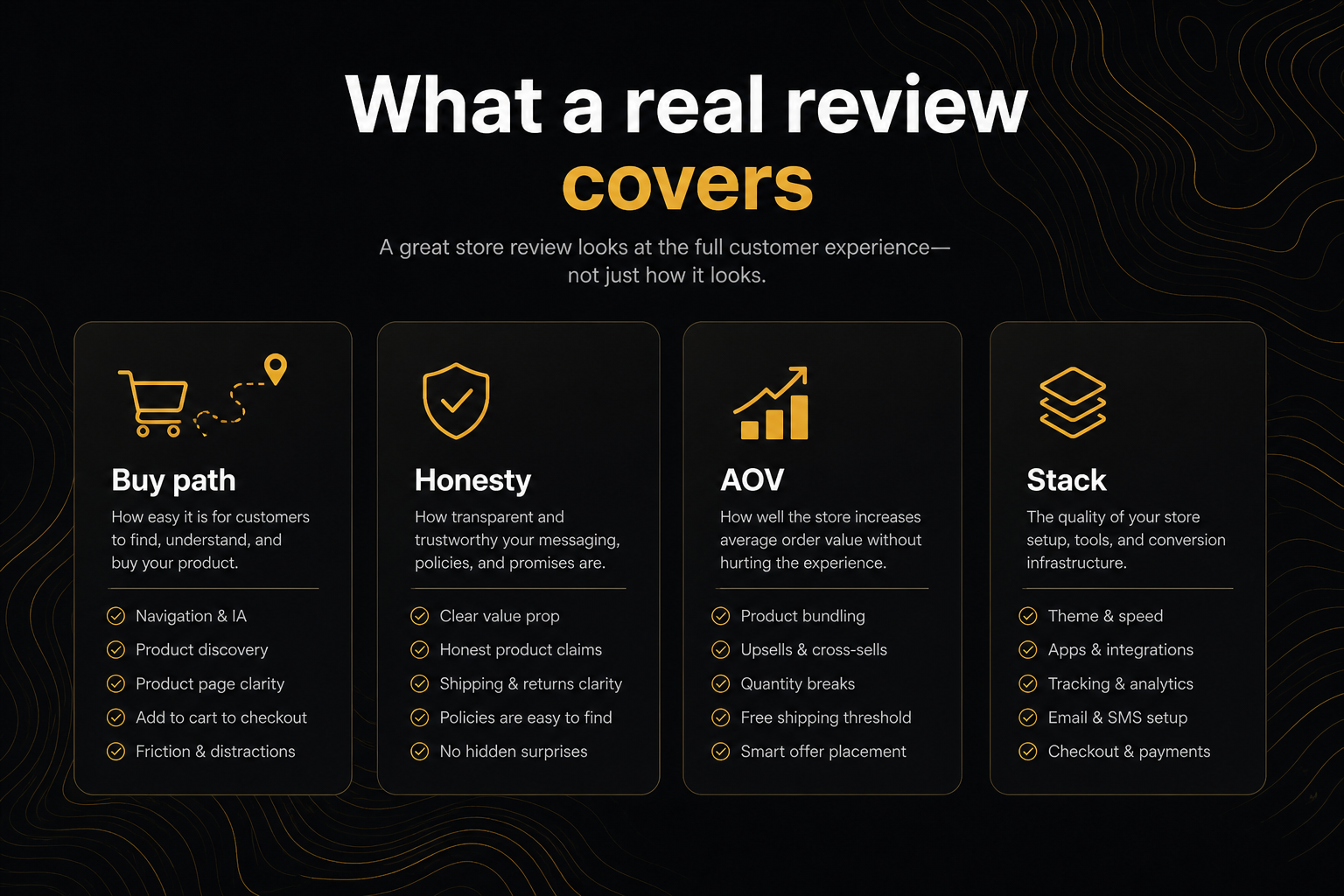
- Read Can they buy? before you scroll to apps.
If the product is wrong, that is the bestseller heuristic doing its job. Paste the exact /products/ URL. Do not argue with the homepage pick — replace it.
Same product twice within about ten minutes may return a cache. Use Audit again after you change the theme.
How to read a free score without lying to yourself
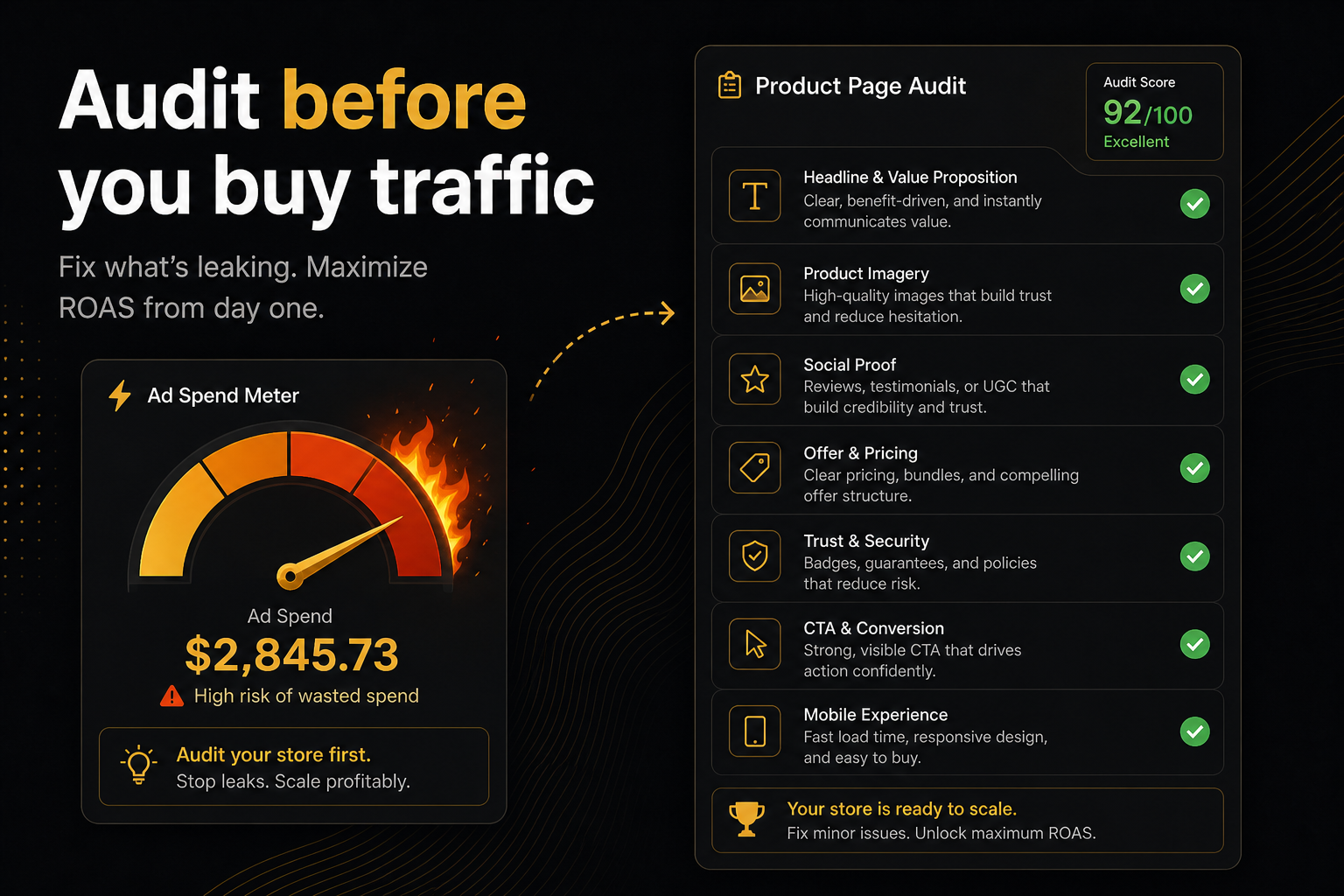
Health starts at 100 on a clean scored sheet. Misses bring it down; buy-path misses weigh more than AOV or hygiene. Skipped rows (unread HTML) and Next rows (post-purchase) do not.
Solid / Strong (85+) means the page scored well enough to be proud of. Still read the punch list.
Uneven / Patchy (70–84) means they can buy. It is not a flex. Work the list.
Thin (62–69) means a working page with real gaps. 65 is not a good score.
Friction / Leaky / Drop-off (under 62) means conversion is taking a hit. That is the week’s work, even if AOV is also thin.
Partial means the theme was not readable. Do not celebrate a 100 you did not earn.
A free review that only prints a big number is a trophy. Demand the rows.
Theme vs app on a free punch list
If the miss is “no add-to-cart,” that is Dawn, a custom product-form, or an app that replaced the form and then broke. It is not “install a popup.”
If the miss is “no frequently-bought,” the owner is an offer app (Addly on this site). You can ignore the logo and still use the diagnosis.
If the miss is “add dumped to /cart,” you need a drawer that actually opens, not a script that mentions a drawer.
Free reviews that score every miss as “buy our suite” are ads. This one names theme when it is theme.
What to do with the artefact
- Report URL
?r=— send to a developer. Snapshot. No surprise recrawl in the morning. - PDF — the punch list for someone who will edit Liquid or the theme editor.
- Badge — a slide. Caption it with the product URL and the date. Do not crop the QR if you are claiming the number is real.
Reports live about 90 days. Re-run if you need a fresh artefact.
When free is not enough
You still need analytics for “where did they drop.” You still need a photographer if media is the constraint. You still need a merchant of record conversation for Markets. You still need a human if the question is positioning.
Run the free review before you buy those. Otherwise you will pay a strategist to discover that name="add" is missing.
Free vs “free consult”
A consult that starts with your revenue, team size, and a 30-minute Loom is a sales call. It can be a good sales call. It is not a store review.
A free review shows you the rows before anyone asks for a card. You should be able to leave with a PDF. If you cannot leave, it was not free.
What “ranked” saves you from
Unranked free tools dump twenty Lighthouse opportunities and a mixed SEO crawl. You will fix alt text on a collection image while the product form is missing.
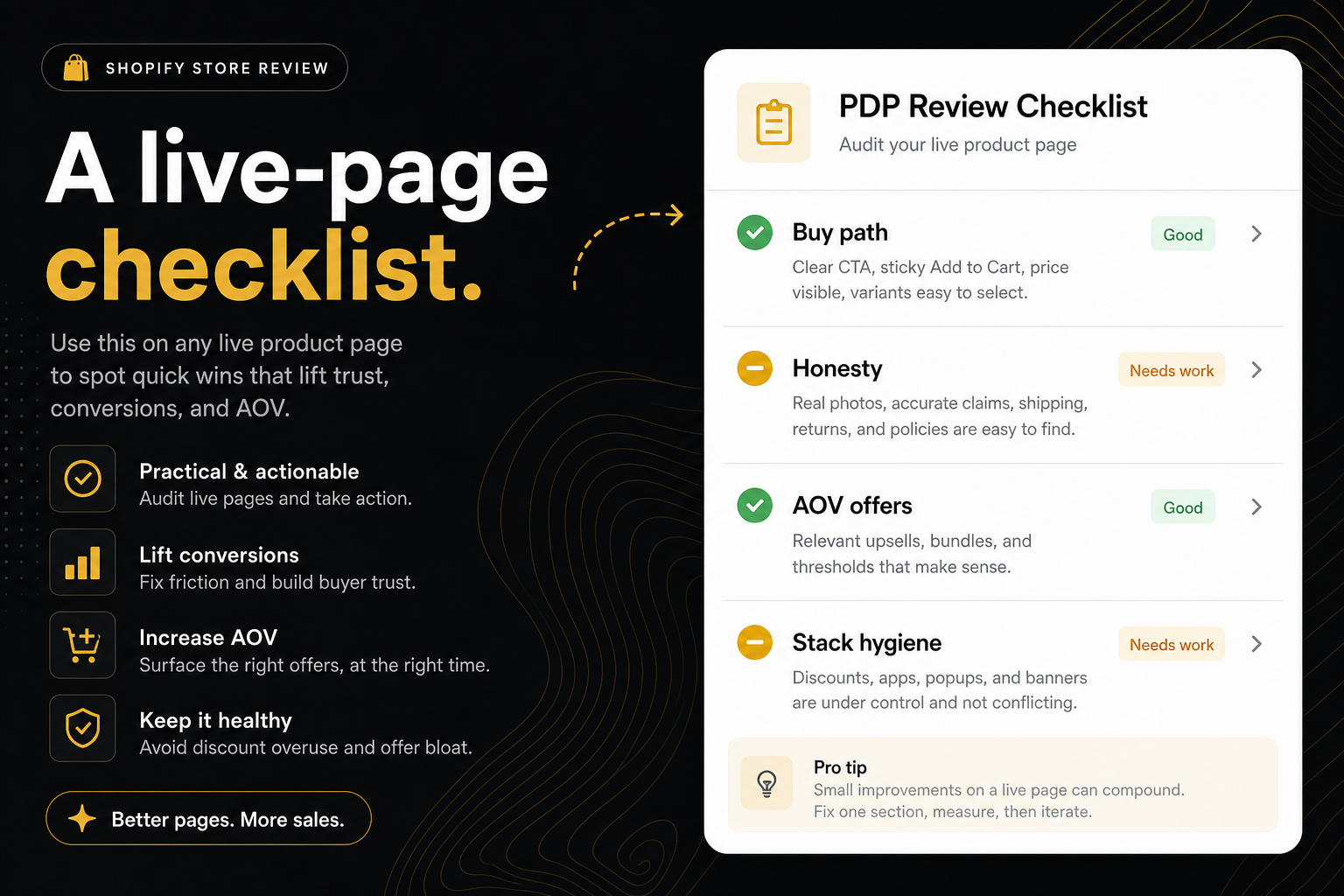
Ranked means: constraints that stop the sale, then missed AOV, capped so you can finish. Hygiene (competing primaries, app pile) sits after that. Post-purchase is Next, not a fake fail.
If the free artefact cannot tell you which row is this afternoon, it is a report, not a review.
Sharing without oversharing
The snapshot is public-to-anyone-with-the-link. Do not put staff-only copy in the theme and then paste the report in a Facebook group.
The audit stores the punch list and optional screenshots for about 90 days. Privacy policy lists the rest. Competitors can open a link you tweet. That is the trade for a QR that teachers can scan.
A note on opt-out
Merchants can block public audits with a meta tag in theme.liquid. If you are reviewing a client who opted out, you cannot complete the assignment on that shop from the outside. Use a development storefront that is public, or ask them to remove the tag for a day.
That is the whole free product: paste, rank, fix, recrawl. If you came here because you searched review my Shopify store and you wanted it to cost nothing, that sequence is the review.
Frequently asked questions
What is this score based on?
Ninety9’s product-page rubric — defaults we apply the same way on every public Shopify PDP. It is not a conversion-rate prediction, and it will not fit every store or situation. How we score.
Is there a truly free Shopify store review?
Yes, if it reads the public storefront and does not require Shopify admin. The Ninety9 CRO audit is that shape — no login, no card, rate-limited so one shop cannot knock over the queue.
What does a free review see?
Product HTML, public product details, the cart page, and when we can render the page a real add-to-cart with a short wait for drawers and popups. Not checkout. Not customers. Not your Shopify login. Password-protected stores work too — paste the store password if we ask. We do not keep it.
Will a free review tell me to install your apps?
It names the owner of each miss. Theme problems stay on the theme. You can leave after the list. That is still a review, not a demo.
Can I use a free review for a class or a client pitch?
Yes. Download the badge and the PDF. The QR opens the saved snapshot. Do not present the badge as a full diagnosis.
Why would a free review fail?
Custom stores we cannot open like a normal Shopify shop, private IPs, and merchants who added the opt-out tag. Password-protected stores are not a fail — paste the store password from Online Store → Preferences if we ask.