 Addy
Addy  Addly
Addly  Goalify
  Monet
Monet  Reviso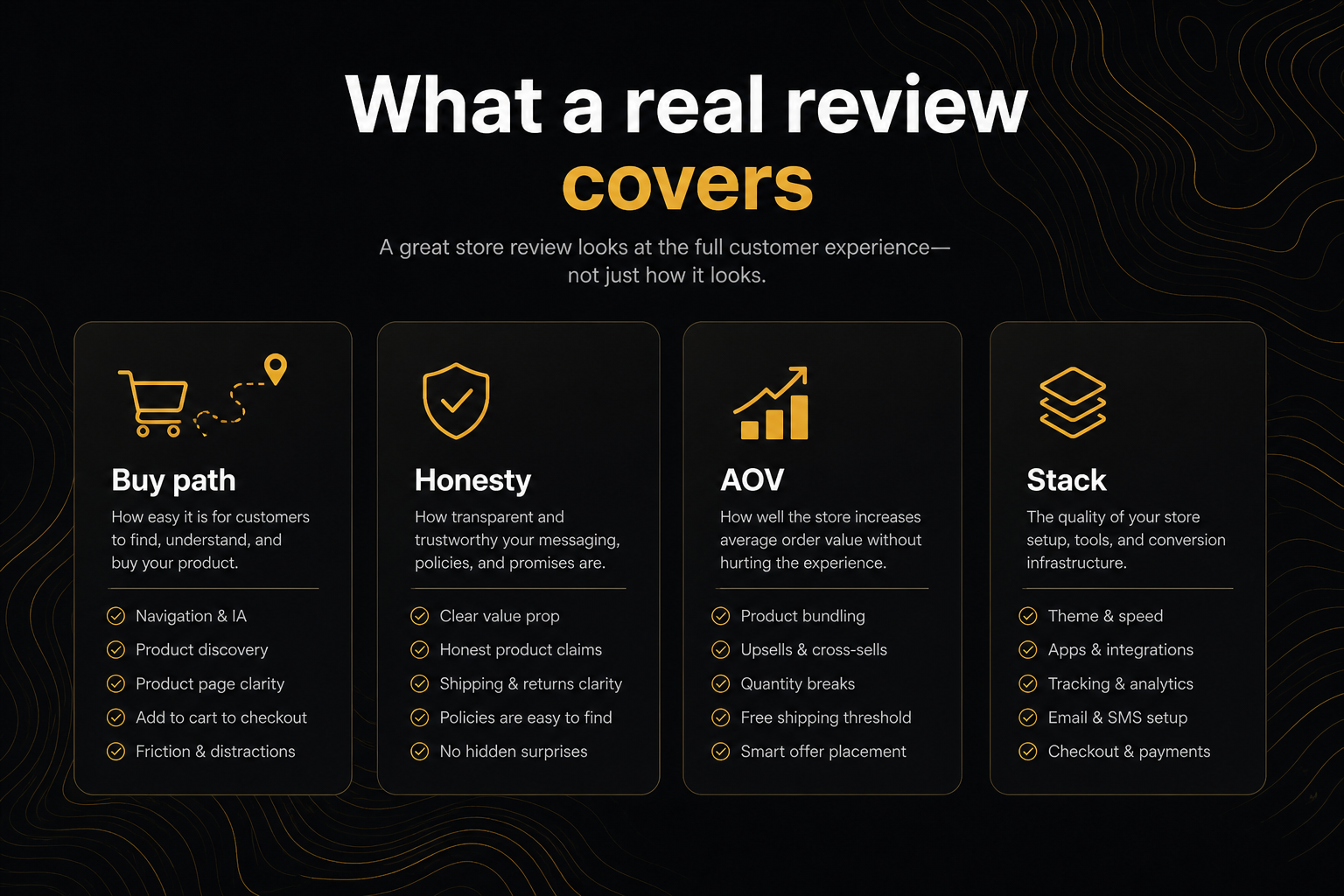
Key takeaways
- Include buy-path, price/stock honesty, media, one primary CTA, then AOV modules, then cart behaviour after add.
- Exclude checkout internals, customer lists, and “brand vibes” from the first artefact unless that is the paid brief.
- Name the owner of each miss: theme vs a specific job (bundle, drawer, goal, popup, post-purchase).
- Cap the list. A review that cannot be finished this week is a catalogue, not a review.
Scope is the difference between a store review and a pile of opinions. People who type review my Shopify store are asking for a diagnosis with an edge. This is the edge.
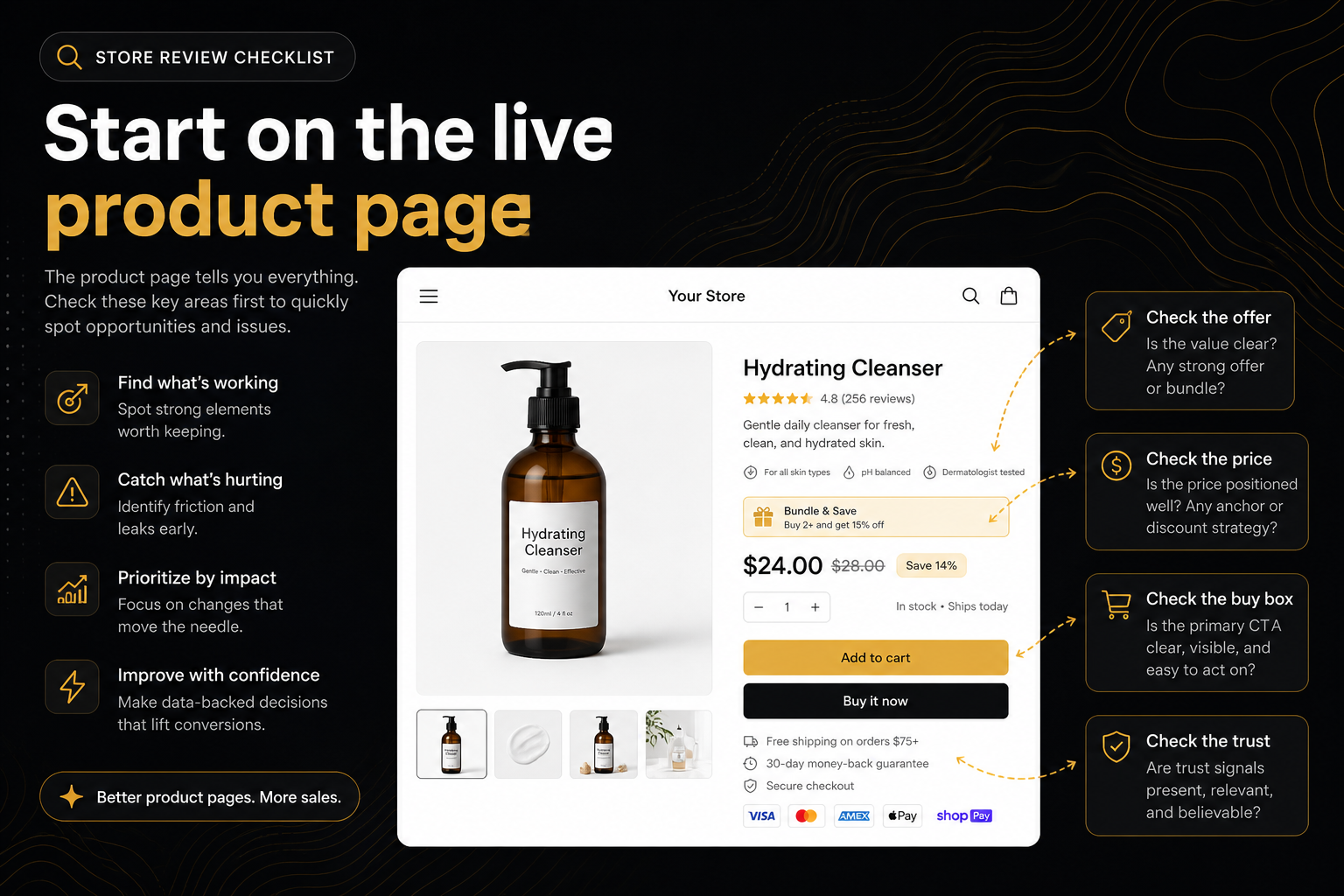
In scope: the shopper’s product page
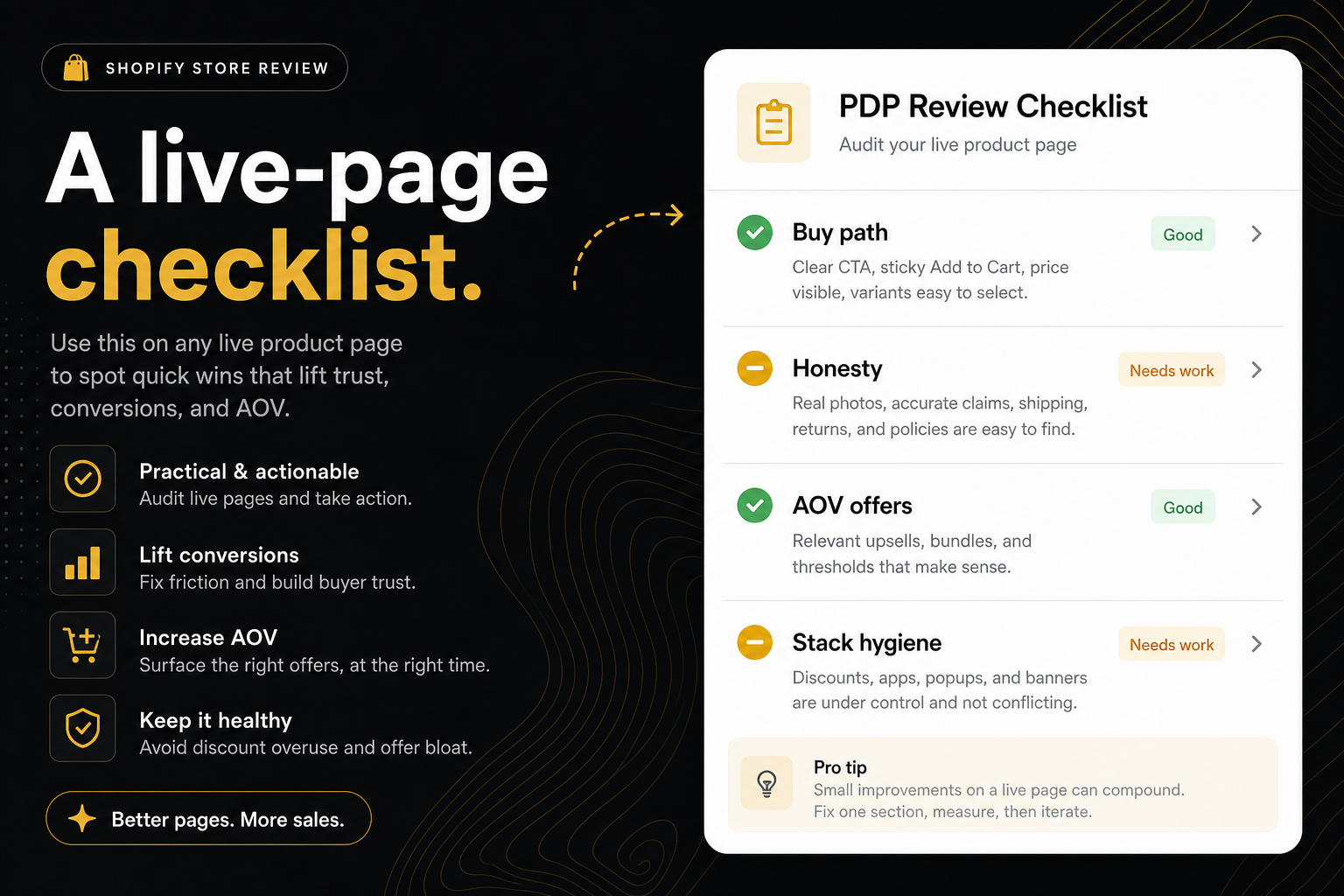
Buy-path
Add-to-cart or Shop Pay. Variant pickers. Sticky buy or a drawer so mobile still has a button. Pre-order when you are selling empty inventory. These are constraints. They go first.
Honesty
Price next to the button. Compare-at that is actually a sale. Stock that matches what the button says. Schema that does not contradict the catalogue. A size option with a chart if you sell apparel.
Honesty fails are often theme bugs. They are also the ones that get you in trouble with shopping ads.
Media
Enough stills. Copy that is not a spec dump or a poem. Video when the product needs motion. This is judgement. A machine can count images and words. A human decides if the third photo is a crop of the first.
One primary action
Filled ATC in the buy box. Express and bundle as secondaries. This is CRO hygiene, not branding.
AOV modules
Frequently-bought, quantity breaks, cart goal, delivery estimate. Missing is a leak, not a moral failure. The review should say which job is empty, not “you need more apps.”
Behaviour after add
Drawer vs /cart. Popup vs nothing. Protection at cart intent. You need a click — yours or Chromium’s.
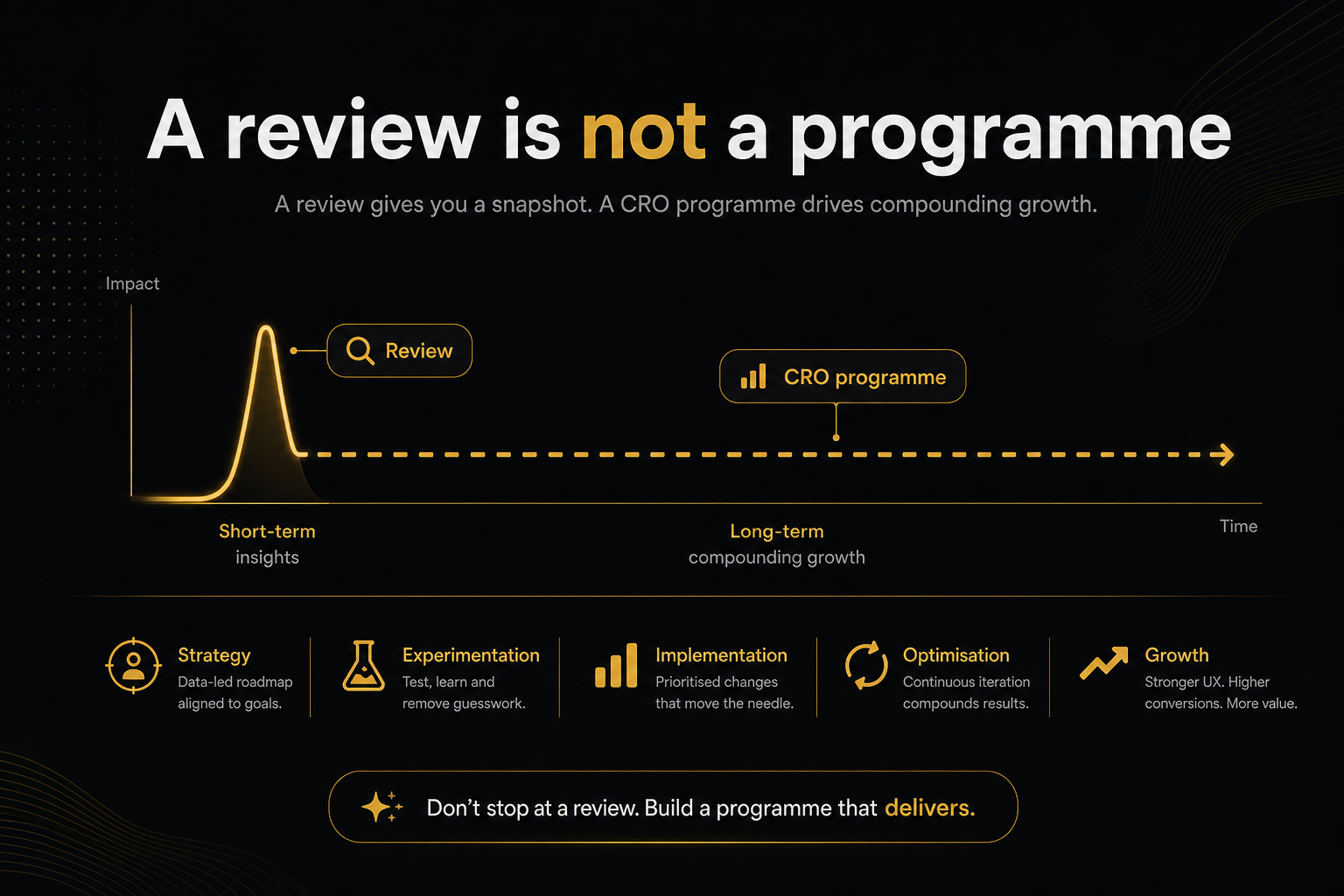
The CRO Audit for Shopify stores is this scope, automated, with a cap on ranked fails so the document stays a punch list.
Out of scope (unless the contract says otherwise)
Checkout. Shopify-hosted. Payment apps, Shop Pay split, address validation — different tools, usually a login.
Admin. Inventory policies, markets, discounts, customer segments. A public review that claims to have seen them is lying.
Email Klaviyo flows. Not on the PDP.
Creative. UGC quality, hook rate, brand world. Adjacent, not the same PDF.
Full IA. Collection taxonomy for 2,000 SKUs is a merchandising project.
Legal. GDPR banners are not CRO. Cookie consent is not a ranked miss unless it blocks the form — then it is a constraint, and you say that plainly.
Write the out-of-scope list on page one. That is how you stop the client adding “also SEO, also email, also the app store” in week two.
Owners, not vibes
Every miss needs an owner:
| Miss | Typical owner |
|---|---|
| No ATC / broken picker / fake sale | Theme |
| No FBT / quantity break | Offer app (Addly here) |
| No goal bar | Goalify or equivalent |
| No drawer / dump to cart | Cart app (Addy) |
| No add or exit popup | Monet or equivalent |
| No protection in cart | Cart app |
| Post-purchase edit / second sale | Reviso or equivalent |
If you cannot name an owner, it is not a finding yet. It is a feeling.
Evidence
A review without evidence is a tweet.
- Product URL.
- Timestamp.
- Screenshot of buy box and of after-add (if you have Chromium).
- Report id for the snapshot.
- Exact copy you searched for (“Add to cart”, “Notify me”, “Get the bundle”).
Do not screenshot the homepage and caption it “store review.”
Length and ranking
Constraints first. Then opportunities. Then hygiene (stack pile, competing primaries). Then Next.
Cap the ranked list. Seven plus a post-purchase note is enough to work. The rest can live in an appendix the client will not read.
Health score is optional on the cover. It is a coverage metric. A high score with a red constraint is still a red week.
How this differs from an SEO audit
An SEO audit wants indexation, titles, internal links, schema completeness. A store review wants the sale.
JSON-LD belongs in both when price or availability is wrong. Keyword maps belong in SEO. If your “store review” is 80% titles, you answered the wrong query.
See also CRO audit vs SEO audit if you are writing both documents. Keep the files separate.
A template outline you can steal
- URL, date, device, how you crawled (paste vs Chromium).
- Verdict in one line (Solid / Strong / Uneven / Patchy / Thin / Friction / Leaky / Drop-off / Partial) — a score band, not a failed-audit stamp.
- Ranked misses with owner and fix.
- What you did not see.
- Recrawl plan (same
/products/URL).
That outline is what a Shopify store review should include. Everything else is optional paid work.
If you still just want to review my Shopify store this morning, paste it, export the PDF, and fill section 4 by hand.
Frequently asked questions
What is this score based on?
Ninety9’s product-page rubric — defaults we apply the same way on every public Shopify PDP. It is not a conversion-rate prediction, and it will not fit every store or situation. How we score.
What should be in a Shopify store review?
Whether a stranger can buy on a real product page, whether the page asks for a larger basket, whether widgets fight, and a short out-of-scope list (checkout, admin, creative).
Is SEO part of a store review?
Only where it lies to the shopper — JSON-LD vs catalogue price or stock. Keyword research is a different deliverable.
How long should the document be?
A punch list plus evidence (screenshots, report id). If it needs a table of contents with twelve chapters, you built a newspaper.
Do I include every app on the shop?
Fingerprint what is competing. Do not write a paragraph on each. “Four offer apps on one PDP” is the finding.
Where does post-purchase go?
In a Next section. A PDP review cannot score thank-you. Pretending it can is how reviews lose trust.