 Addy
Addy  Addly
Addly  Goalify
  Monet
Monet  Reviso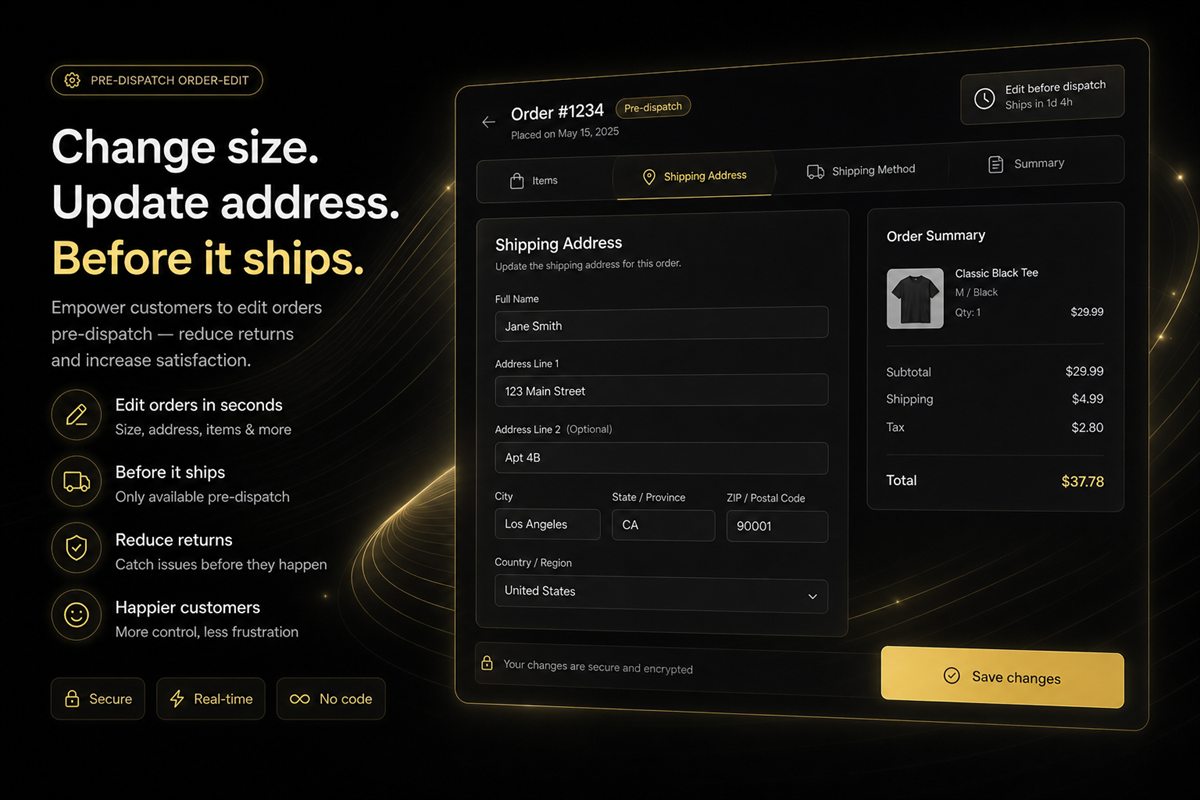
Key takeaways
- Returns divide into avoidable and unavoidable. Avoidable ones - wrong size, wrong item, wrong address, changed mind before dispatch - are the only ones worth engineering against.
- A return costs roughly twice the shipping plus handling plus the refunded margin, and often the customer. Preventing one is worth several times more than the discount you would spend acquiring a replacement sale.
- The cheapest intervention point is before dispatch, because a change there costs a database write instead of two shipping legs.
- Return reasons are diagnostic. Clustering by product almost always points at a product page problem rather than a product problem.
A return is a sale that reverses, plus two shipping legs, plus labour, plus a customer who may not come back. It is one of the few metrics in ecommerce where the cost of the event substantially exceeds the value of the transaction that caused it.
The instinct is to optimise the returns process — faster labels, better portals, quicker refunds. Worth doing, but it is treating the symptom. The interesting question is which returns did not have to happen, and where the cheapest place to intervene is.
Avoidable versus unavoidable
Split your return reasons into two lists.
Unavoidable at the point of sale:
- Product defect
- Damage in transit
- Genuine dissatisfaction with quality
- Gift recipient did not want it
These are real problems and worth fixing — but they are fixed in sourcing, QA and packaging, not in the checkout flow.
Avoidable:
- Wrong size or fit
- Wrong colour or variant ordered
- Wrong item ordered entirely
- Duplicate order
- Wrong address, resulting in a failed delivery
- Changed mind before the parcel shipped
- Did not match expectations set by the product page
In most stores the avoidable list is a substantial share of total volume, and in apparel it dominates. That list is where the leverage is.
What a return costs
Worth building the number for your own store, because it is usually larger than people assume.
outbound shipping            (already spent)
+ return shipping            (usually yours to pay)
+ inspection and restocking  (labour, minutes per unit)
+ repackaging                (if resold as new)
+ payment processing         (often not fully refunded)
+ writedown                  (if the item cannot be resold at full price)
= cost of the return
Then add the opportunity side: the margin you booked and gave back, and the probability that the customer does not return. On lower-priced items the total frequently exceeds the gross profit on the original order, meaning the return does not just erase the sale — it costs you money to have made it.
Where to intervene, cheapest first
Before the order: set expectations accurately
The highest-leverage work, and the slowest.
- Sizing. Real measurements, not just S/M/L. Model height and worn size. Fit notes ("runs small", "size up if between sizes") drawn from actual return reasons.
- Photography. Colour accuracy, scale reference, the product in use rather than only on white.
- Materials and dimensions stated explicitly rather than implied.
- Reviews with attributes. Reviews that record the reviewer's size and the fit outcome do more for return rate than any other single addition to a product page.
At checkout: prevent the mechanical errors
- Address validation and autocomplete. Catches the missing unit number, which is the leading cause of failed delivery.
- Clear variant selection. A variant selector that does not make the current choice obvious produces wrong-variant orders at a surprising rate.
- Order summary that shows variants in words, not just a thumbnail. "Blue / Large", not a colour swatch the customer has to interpret.
Before dispatch: the cheapest fix of all
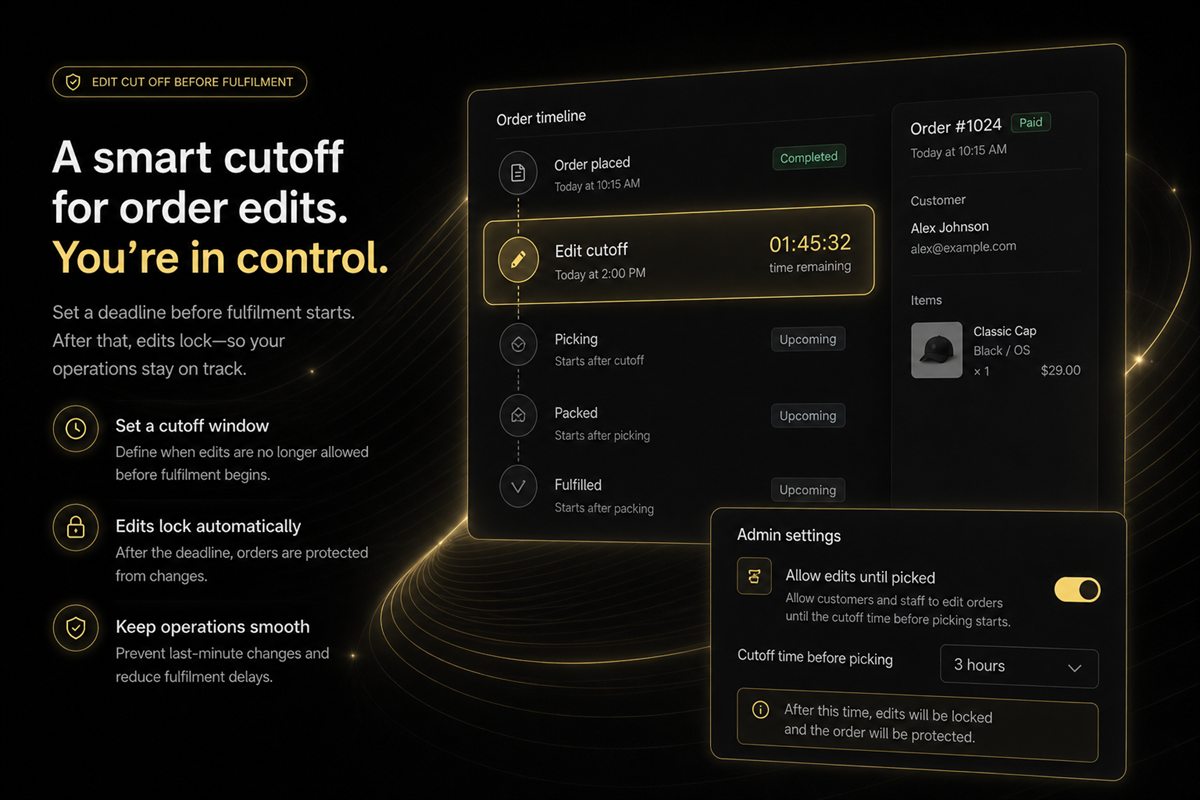
This is the window most stores ignore, and it is the one where a correction costs nothing.
A customer who realises within an hour of ordering that they picked the wrong size has three possible paths:
- They email support. Support may or may not catch it before dispatch. Costs staff time; sometimes works.
- They do nothing and return it. Costs both shipping legs, restocking, refund and the margin.
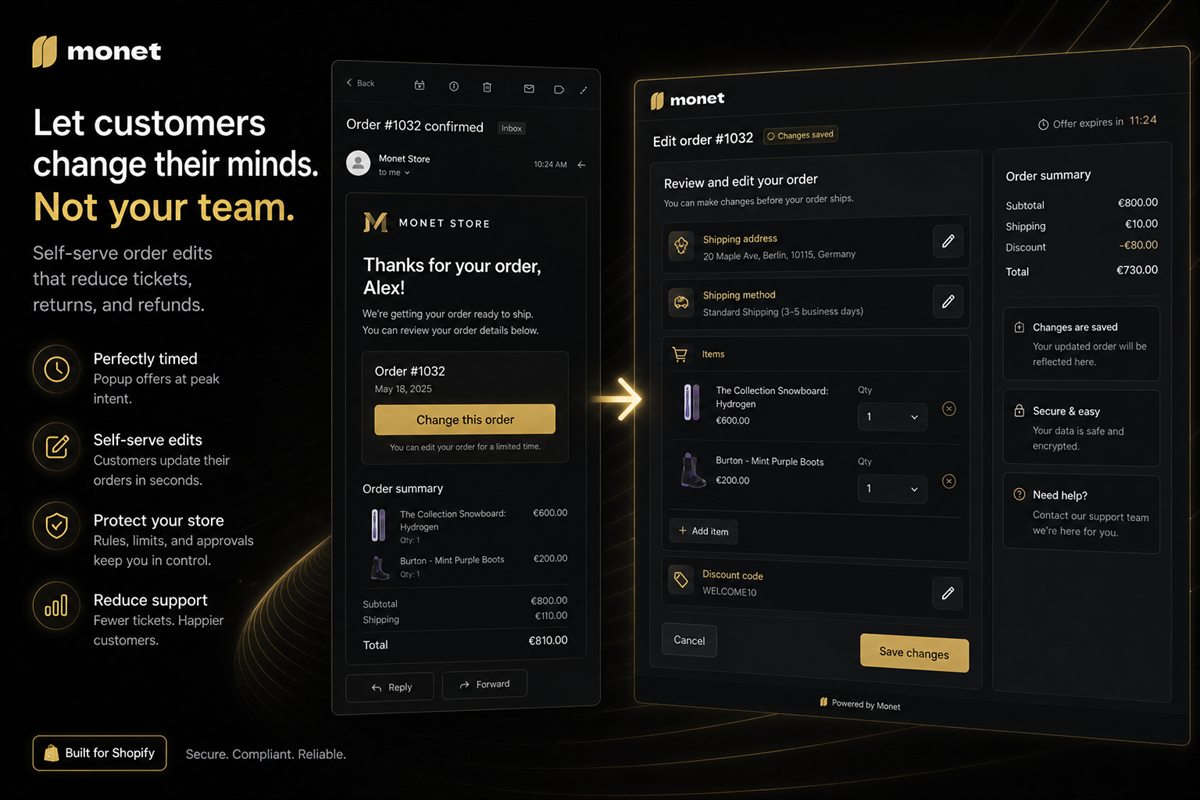
- They fix it themselves in an edit flow. Costs a database write and a stock movement.
Path three is available for essentially every mistake in the avoidable list, and it is the difference between a return and a non-event.
After dispatch: exchange before refund
Once the parcel is out, the goal shifts from prevention to preserving the sale.
An exchange keeps the revenue; a refund does not. Offering the exchange path first — with the correct size pre-selected based on the stated return reason — converts a meaningful share of what would have been refunds.
Store credit sits between the two: better than a refund for you, and often acceptable to the customer if there is a small bonus attached.
Return reasons as a diagnostic
Requiring a reason on every return produces one of the most useful datasets in the business, provided the categories are specific enough to be actionable.
Bad categories: "not as expected", "other", "changed my mind".
Useful categories: "too small", "too large", "colour different from photos", "material felt different", "arrived damaged", "wrong item sent", "ordered wrong item", "arrived too late", "found better price".
Read them by product:
- One product with a high "too small" rate → a sizing note on that product page fixes it, not a policy change.
- One product with a high "colour different" rate → reshoot it.
- A category with a high "material" rate → the description is under-specifying.
- "Ordered wrong item" across the catalogue → a variant selection UI problem, not a product problem.
- "Arrived too late" → a fulfilment or expectation-setting problem that will also be showing up in your cancellation reasons.
Almost every clustered return reason points at a fix that is cheap and permanent. Unclustered reasons spread evenly across the catalogue usually point at a checkout or expectation problem instead.
The policy question
Restricting returns to lower the return rate is almost always a false economy. A restrictive policy lowers return rate and conversion rate together, and the conversion loss is generally larger.
The better levers:
- Free returns, but exchanges are faster. Steer to exchange through convenience rather than penalty.
- A longer window than the industry norm. Counter-intuitively, longer windows tend to reduce return rate, because the urgency to decide disappears and endowment sets in.
- Instant exchange. Ship the replacement before the original comes back, for customers who pass a trust check.
- Charge for returns only on repeat offenders. A small share of customers generate a disproportionate share of returns. Rules targeting them do not damage everyone else's experience.
Rollout
- Add return reason capture with specific categories, if you do not have it. Everything else depends on this data.
- Fix the top three products by avoidable return volume — sizing notes, photography, description.
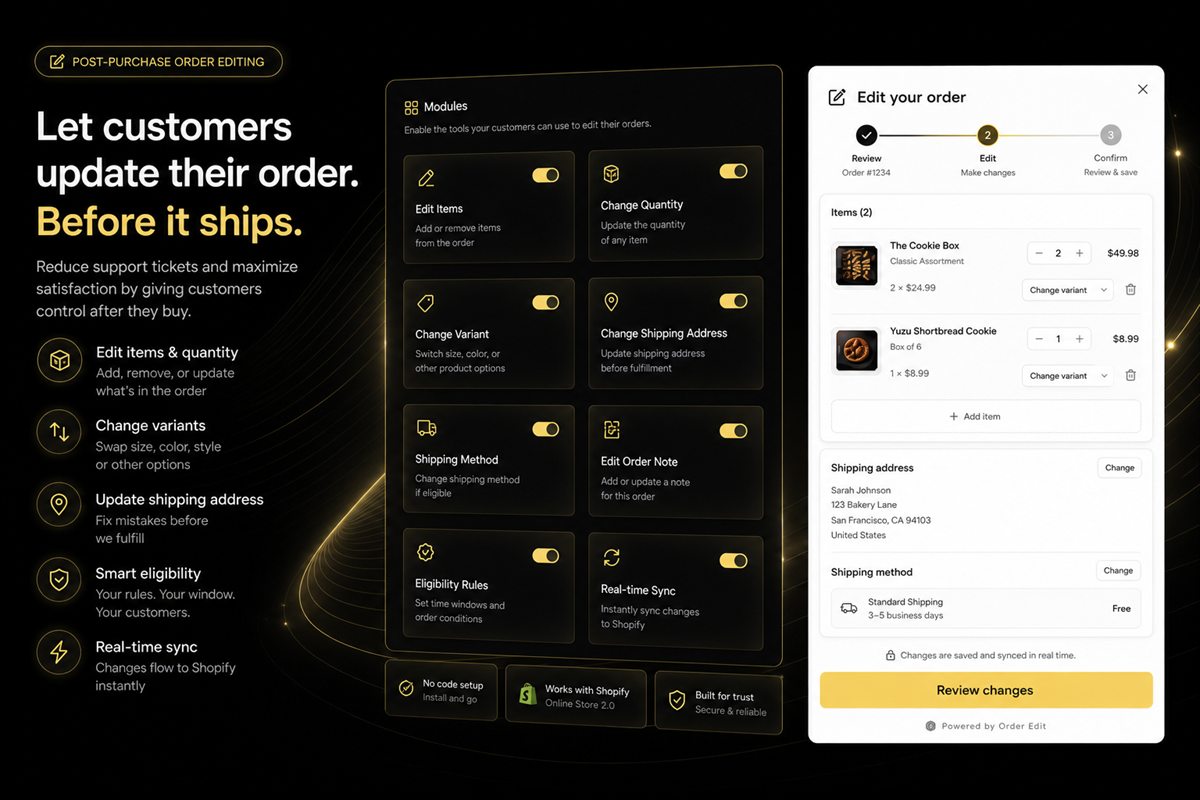
- Enable pre-dispatch self-service editing for variant swaps and addresses. This is the fastest-acting intervention.
- Add address validation at checkout if it is not there.
- Make exchange the default path in the returns flow, with refund available but secondary.
- Review reason clustering monthly and treat it as a product page backlog.
Measuring it
- Return rate overall, and split by avoidable versus unavoidable. The split matters more than the total.
- Return reason distribution, tracked by product and by category.
- Pre-dispatch edit rate — the leading indicator that prevention is working.
- Exchange-to-refund ratio in the returns flow.
- Cost per return, calculated properly and reviewed quarterly.
- Repeat purchase rate of customers who returned. A well-handled return can produce a more loyal customer than a smooth first order; a badly handled one ends the relationship.
Frequently asked questions
What is a normal ecommerce return rate?
It varies enormously by category. Apparel and footwear run far higher than most other categories because of sizing, while consumables and electronics accessories run much lower. The useful comparison is against your own trend and against the avoidable portion, not against a cross-industry average.
What does a return actually cost?
Outbound shipping, return shipping, inspection and restocking labour, payment processing that is often not fully refunded, and the lost margin. For lower-priced items the total frequently exceeds the profit on the original sale, which is why prevention beats process.
Which returns are actually preventable?
Wrong size, wrong variant, wrong address, duplicate orders and changed-mind returns caught before dispatch. Product defects, damage in transit and genuine dissatisfaction are not preventable through the checkout and post-purchase flow, though they are worth fixing at source.
Does a generous returns policy increase returns?
It increases return rate modestly and increases conversion rate and repeat purchase substantially. For most stores the trade is favourable. Restricting returns to lower the rate usually costs more in lost sales than it saves in logistics.
How does order editing reduce returns?
It converts a return into an edit. A customer who ordered the wrong size and can change it before dispatch never generates a return, which removes both shipping legs, the restocking cost and the refund - and keeps the sale.