 Addy
Addy  Addly
Addly  Goalify
  Monet
Monet  Reviso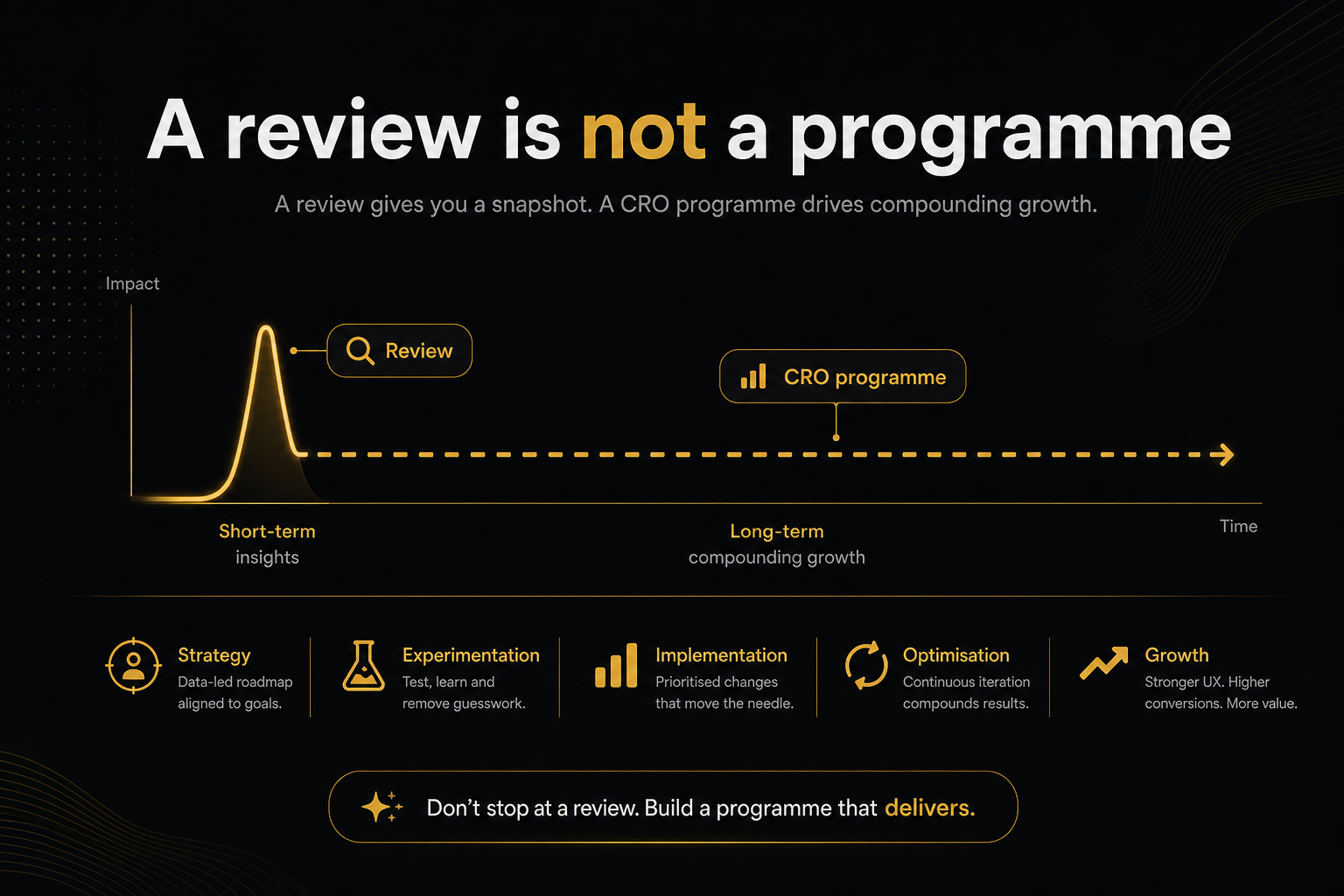
Key takeaways
- A store review answers “what is wrong on this product page, in order.” A programme answers “what should we test for the next quarter.”
- You can start a programme without a review, but you will pay to rediscover add-to-cart.
- Analytics, heatmaps, and interviews belong in the programme. They are not required to fail a missing product form.
- Recrawl is the review’s feedback loop. A test backlog is the programme’s.
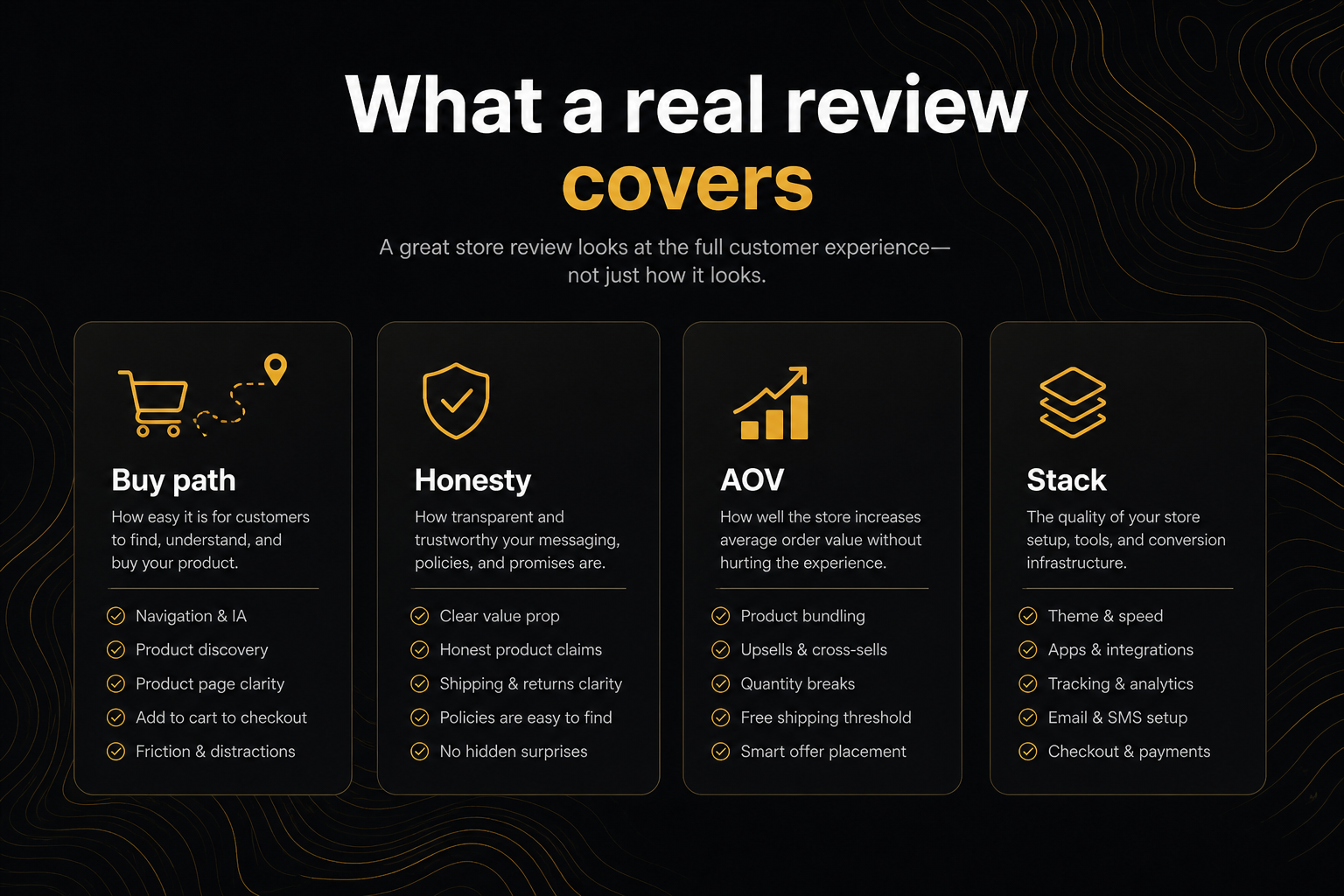
Vendors blur language on purpose. “CRO audit,” “store review,” “growth programme,” “partnership.” If you typed review my Shopify store, you probably wanted a list. You are being sold a calendar.
Separate the products so you do not pay retainer rates for a paste.
A store review (hours)
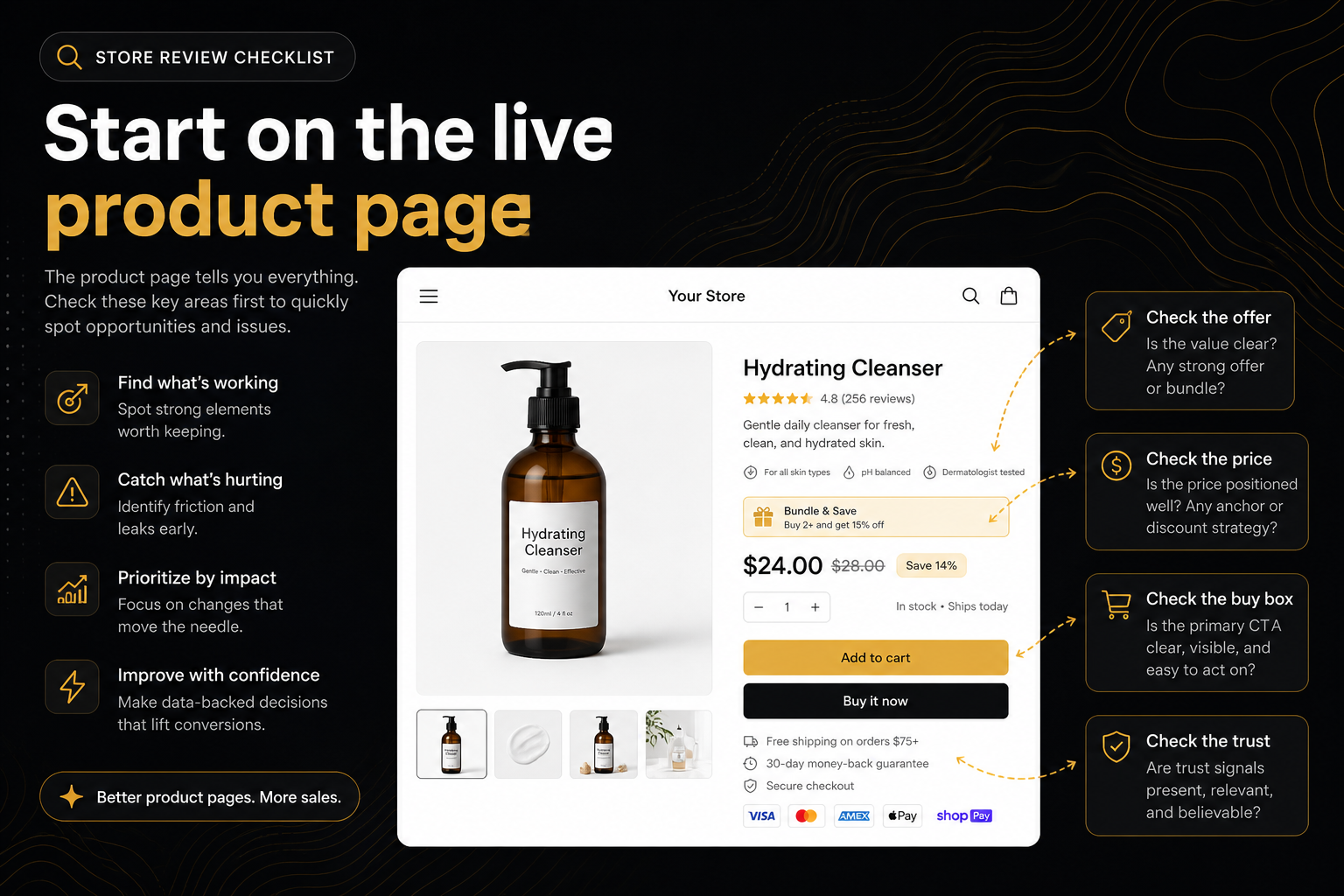
Question: Can they buy on this URL, and is the basket leaving money on the table?
Inputs: Public product page, catalogue JSON, cart, a click if possible.
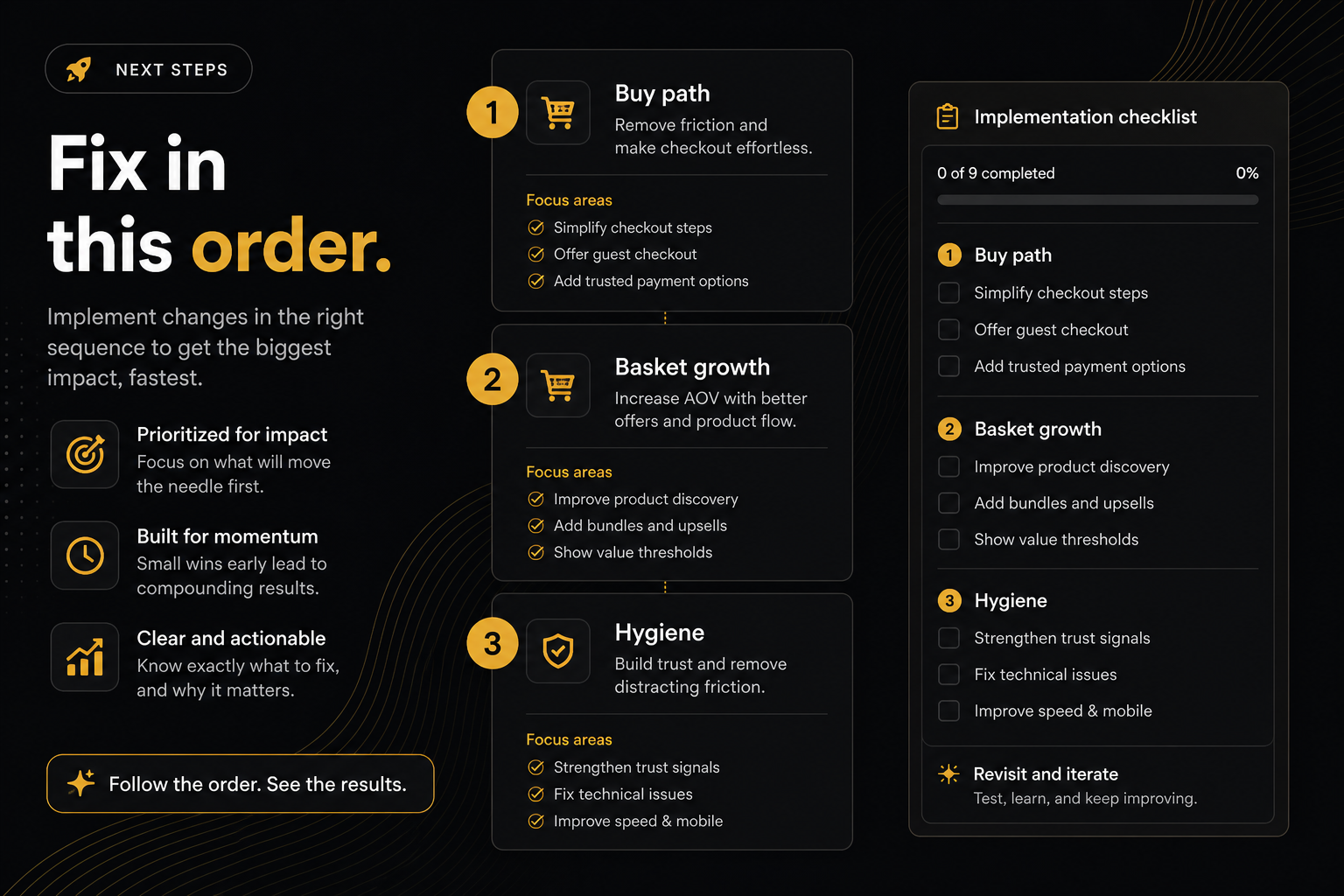
Output: Ranked misses with owners. Health as a before/after on that URL. A status for the score (Solid, Strong, Uneven, Patchy, Thin, and so on) plus a line such as Fail in Rubric A. Out-of-scope list. Recrawl plan.
Done when: You know the next theme change and the next optional install.
The CRO Audit for Shopify stores is this product, automated.
A CRO programme (weeks)
Question: Given traffic, what should we change, how do we know it worked, and who ships it?
Inputs: The review, plus analytics, recordings, margins, supply, campaigns, maybe checkout.
Output: A backlog with hypotheses, sample sizes or kill-by dates, and implementation.
Done when: Never, if it is healthy. It is a loop. That is the point.
If there is no loop, it was a review with nicer slides.
Why the review has to go first
Programmes love workshops. Workshops love homepages. Homepages are not where shopping ads land.
If add-to-cart is missing, the first “test” is not a test. It is a repair. Treating repairs as experiments wastes calendar and pollutes your story (“we ran six tests” — five were installing the form).
Do the review. Repair. Recrawl. Then you have a baseline a programme can use.
What each artefact should contain
| Review | Programme | |
|---|---|---|
| URL | Required | Required |
| Ranked PDP misses | Required | Intake |
| Heatmaps | Optional | Usual |
| Test design | No | Yes |
| Checkout | Out of scope unless stated | Often in scope |
| Admin | No | When needed |
| Recrawl | Same SKU | Plus experiment readouts |
If a proposal has the left column only, pay review money. If it has the right, pay programme money and demand the left column on day one anyway.
Analytics without a review
GA4 will tell you product-page exits. It will not tell you the button was display:none below 900px until you look.
Use analytics to pick which SKU to review when you have many. Use the review to see why.
A programme that starts in Looker and never opens the PDP is a reporting retainer.
Reviews that pretend to be programmes
Red flags:
- Twelve-week timeline before anyone clicks add to cart.
- Deliverable is “opportunities” with no owners.
- You are not allowed to recrawl yourself.
- Every miss maps to their app, including missing product-form.
- No mention of theme.
Walk. Run the public audit. Hire a developer for the constraint. Re-open the conversation when the buy path is clear and AOV is still thin.
Programmes that pretend to be reviews
Red flags:
- “We’ll hop on a call and look together” with no URL prep.
- One PDF, no backlog, no recrawl.
- Lighthouse as the cover.
That is a review. Price it like one.
How to use both without politics
Week 0: public review, two SKUs (campaign + bestseller).
Week 1: theme constraints. Recrawl.
Week 2: one AOV install. Recrawl.
Week 3+: programme if traffic exists and the question is now “which offer,” not “is there a form.”
Internal story for the founder: the review is the X-ray. The programme is physiotherapy. Buying physiotherapy because you refused the X-ray is how you stretch a broken bone.
Language to steal for a brief
We need a store review of {product URL} this week: buy-path and AOV on the PDP, public only. Separately we may want a CRO programme next month: tests on offers and cart, using analytics. Do not bundle them into one vague “CRO” line item.
If they cannot split the SKU, they cannot split the work.
When you are done splitting, the review is still a paste. That is allowed to be unglamorous. Unglamorous is how review my Shopify store gets a real answer.
Who sits in which meeting
Review readout: founder, whoever owns the theme, whoever can install one app. Thirty minutes.
Programme standup: plus media, plus whoever reads GA4, plus whoever can say no to a test. That group should not assemble to learn that ATC was missing. They should assemble after recrawl is green on buy-path.
If the same meeting is used for both, the programme will eat the repair and nobody will recrawl.
Frequently asked questions
What is this score based on?
Ninety9’s product-page rubric — defaults we apply the same way on every public Shopify PDP. It is not a conversion-rate prediction, and it will not fit every store or situation. How we score.
Is a Shopify store review the same as CRO?
No. The review is the diagnosis on a public PDP. CRO is the habit of testing after the diagnosis. You need the first to spend the second well.
Do I need GA4 before I review my Shopify store?
No. You need a URL. Analytics tell you where volume dies. The review tells you whether the page can take money at all.
How long is a real CRO programme?
Weeks to months, with a backlog and kill criteria. A review is an afternoon. If a vendor sells a “programme” that is one PDF, it is a review at programme prices.
Can the free audit replace a CRO retainer?
It can replace the discovery PDF. It cannot replace tests, creative, or checkout work.
What should I buy first?
The review (free). Then theme fixes. Then one AOV install. Then, if you are still stuck with traffic, a programme.