 Addy
Addy  Addly
Addly  Goalify
  Monet
Monet  Reviso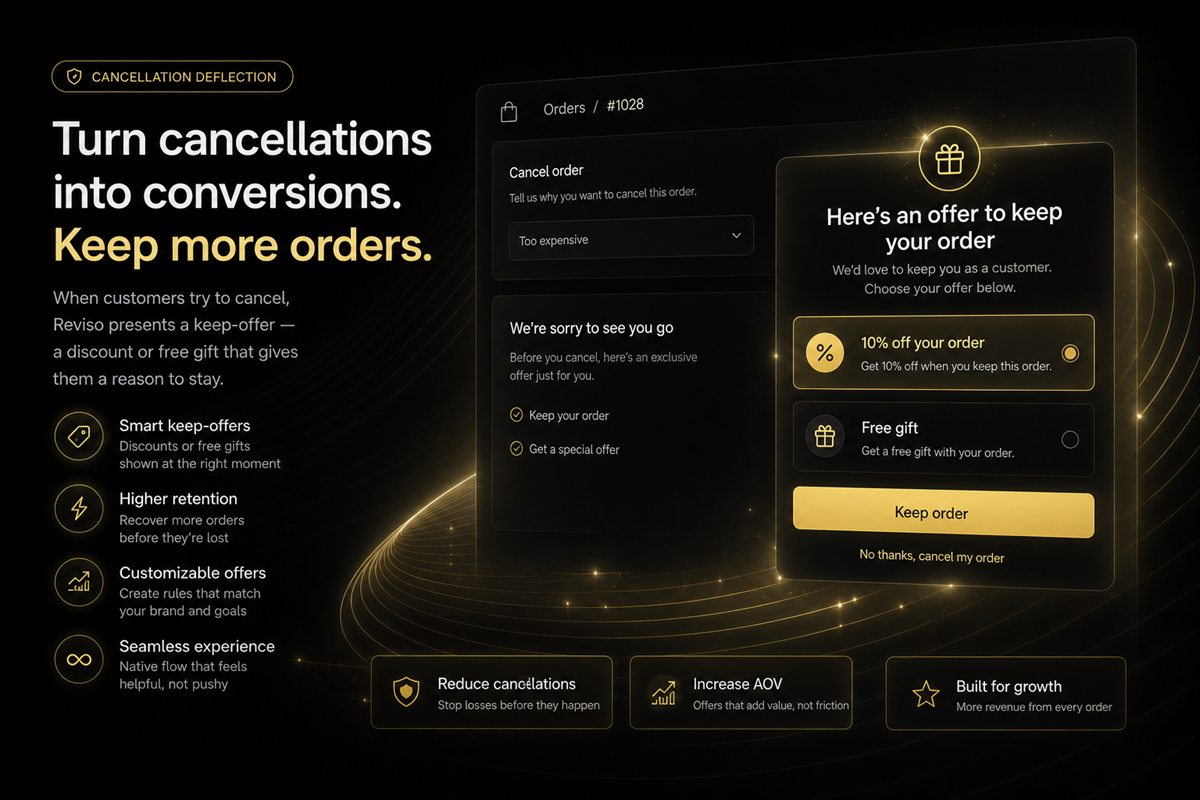
Key takeaways
- Most cancellations are not rejections of the product. They are corrections of a mistake or reactions to uncertainty, and both are addressable.
- Capture the reason before offering anything. A deflection offer that ignores why someone is leaving usually fails and always annoys.
- The best deflection for "wrong item" is an edit flow, not a discount. Fixing the problem beats paying someone to tolerate it.
- A cancellation flow that traps people produces chargebacks and one-star reviews, which cost far more than the order was worth.
A cancellation looks like a lost sale, which is why most stores treat it as a customer service problem to be minimised rather than a signal to be read.
That framing misses the interesting part. Very few cancellations are a rejection of the product. Most are the correction of a mistake, or a reaction to something the store told them after checkout that it should have told them before. Both are addressable, and reading the reasons tells you where.
The five reasons, and what each one means
1. "I made a mistake"
Wrong size, wrong colour, wrong quantity, wrong address, duplicate order. Almost always the largest single category.
What it means: the customer still wants to buy from you. They just want a different version of what they ordered.
The fix: an edit flow. Cancelling is a workaround for the absence of one. Offer the edit and most of these disappear entirely.
2. "It's taking too long"
The customer has not received a dispatch notification within the timeframe they imagined, and their imagination was calibrated by a marketplace that ships same day.
What it means: an expectation was never explicitly set, so the customer invented one.
The fix: show the actual delivery estimate — in the cart before purchase, on the confirmation, and again in the cancellation flow. A large share of "taking too long" cancellations arrive before the promised window has even passed.
3. "I found it cheaper"
Price comparison after purchase, which is more common than most merchants assume.
What it means: the purchase was price-led rather than brand-led. That is worth knowing.
The fix: a price match, or an incentive to keep the order. This is one of the few cases where a discount is genuinely the right instrument. Whether it is worth it depends on your margin and whether this customer has repeat potential.
4. "I changed my mind"
Genuine reconsideration. Buyer's remorse, budget change, or the purchase was impulsive.
What it means: usually nothing actionable at the individual level, but a rising share here can indicate that a promotion is driving low-quality demand.
The fix: limited. A modest incentive recovers some. Do not fight hard for these.
5. "Something unexpected"
Payment issue, duplicate charge, a family member already bought it, an address that turned out to be wrong.
The fix: make the process painless and make sure the refund is fast. The goal here is that the customer comes back, not that they stay.
Designing the deflection flow
The sequence that works, in four steps.
Step 1: Make the intent easy to express
The cancellation link should be findable in the order confirmation email and in the customer account. Hiding it does not prevent cancellations; it converts them into support tickets and chargebacks.
Step 2: Ask why, with a short list
Five or six options, plus a free-text field. Keep it to one screen. The list should map to the categories above, in your customers' language rather than yours.
This step alone is worth building even if you never offer a deflection, because the data is genuinely valuable.
Step 3: Respond to the specific reason
| Reason | Best response | Why |
|---|---|---|
| Wrong item or size | Open the edit flow | Fixes the actual problem |
| Wrong address | Open the address edit | Same |
| Taking too long | Show the real delivery estimate | Usually resolves it outright |
| Found it cheaper | Price match or incentive | Only case where discount is first choice |
| Changed my mind | Small incentive, or let go | Limited upside |
| Ordered by mistake | Cancel immediately, no friction | Fighting this damages the relationship |
Note how few rows call for a discount. The reflex is to offer money; the better answer is usually to fix the thing.
Step 4: If they still want to cancel, let them
One offer, then the cancel button works. A flow that requires three dismissals produces chargebacks and reviews, both of which cost multiples of the order value.
What to offer, and what it should cost
If an incentive is the right response, size it against the true value of the saved order — not the order total.
The value of a saved order is roughly:
gross profit on the order
+ avoided refund processing cost
+ avoided restocking cost (if fulfilled)
+ probability-weighted lifetime value of the retained customer
For a first-time customer on a $70 order at 55% margin, gross profit alone is $38.50. Spending $7 to save it is clearly worthwhile. Spending $25 probably is not, unless your repeat rate is high enough that the lifetime value term dominates.
Options ranked by cost to you:
- Fix the problem (free) — edit the order, correct the address, swap the variant.
- Provide information (free) — the real delivery date, the returns policy, stock status.
- Add value (low cost) — a free gift, expedited shipping, an extended returns window.
- Discount the current order (direct cost) — a partial refund or credit.
- Store credit (deferred cost) — often better received than a discount and it keeps the customer.
Start at the top. Most stores start at four.
Cancellations before fulfilment vs after
Two different problems.
Before fulfilment, a cancellation is a database change. It should be self-service, immediate, and free of friction. There is no operational reason to involve a human.
After fulfilment, it is a return in disguise. The parcel exists. Handle it as a return, be explicit that the item needs to come back, and consider whether a carrier intercept is cheaper than a return journey.
Blurring these two is a common source of customer frustration, because a customer told "cancelled" who then receives a parcel has been given wrong information at the worst moment.
Reading the reason data
After a few months, the reason distribution becomes one of the more useful reports in the business.
- Rising "wrong size" → your size guide or product photography is unclear. Fix the product page, not the cancellation flow.
- Rising "taking too long" → either fulfilment has slowed or your pre-purchase delivery messaging is absent. Check which.
- Rising "found it cheaper" → you are competing on price in a channel where you should not be, or a competitor has moved.
- Rising "changed my mind" → often correlates with a promotion driving low-intent traffic. Check the source.
- Clustering by product → that product page is over-promising.
- Clustering by country → that market's delivery expectations or duty treatment is not being communicated.
Each of those points at a fix somewhere earlier in the funnel, which is where cancellations are actually prevented. The deflection flow catches what leaks through; the product page and the delivery promise are what stop the leak.
Measuring it
- Cancellation rate as a percentage of orders, tracked weekly.
- Reason distribution, and its trend.
- Deflection rate — cancellations started but not completed ÷ cancellations started.
- Deflection cost per saved order. Total incentive value ÷ orders saved.
- Chargeback rate. The guardrail. If deflection rate rises and chargebacks rise with it, the flow has become too aggressive.
- Repeat purchase rate of customers who cancelled. The long guardrail — a customer who cancelled easily and came back is a better outcome than one who was talked out of it and never returned.
Frequently asked questions
What is a normal order cancellation rate?
It varies widely by category and fulfilment speed, but for most direct-to-consumer stores it sits in the low single digits as a percentage of orders. What matters more than the absolute figure is the reason distribution, because that tells you which cancellations were preventable.
Should I make cancelling difficult?
No. A difficult cancellation converts into a chargeback, a negative review, or a customer who never returns - each of which costs more than the order. Make cancelling easy, and put a genuinely useful alternative in front of it.
What is the best cancellation deflection offer?
It depends on the reason. For a wrong item or wrong address, offer the edit rather than an incentive. For delivery concerns, show the real delivery estimate. Discounts are the most expensive option and should be reserved for reasons that have no operational fix.
When should customers be able to cancel themselves?
Up to fulfilment. Before a label is printed a cancellation is a database change; after it, it becomes a warehouse operation and often a carrier intercept. Automatic self-service cancellation before fulfilment and a support route after is the right split.
Does capturing a cancellation reason actually help?
It is one of the highest-value datasets a store can collect. Over a few months the reason distribution shows you exactly where the funnel is over-promising, which product pages are unclear, and which fulfilment lanes are too slow.