 Addy
Addy  Addly
Addly  Goalify
  Monet
Monet  Reviso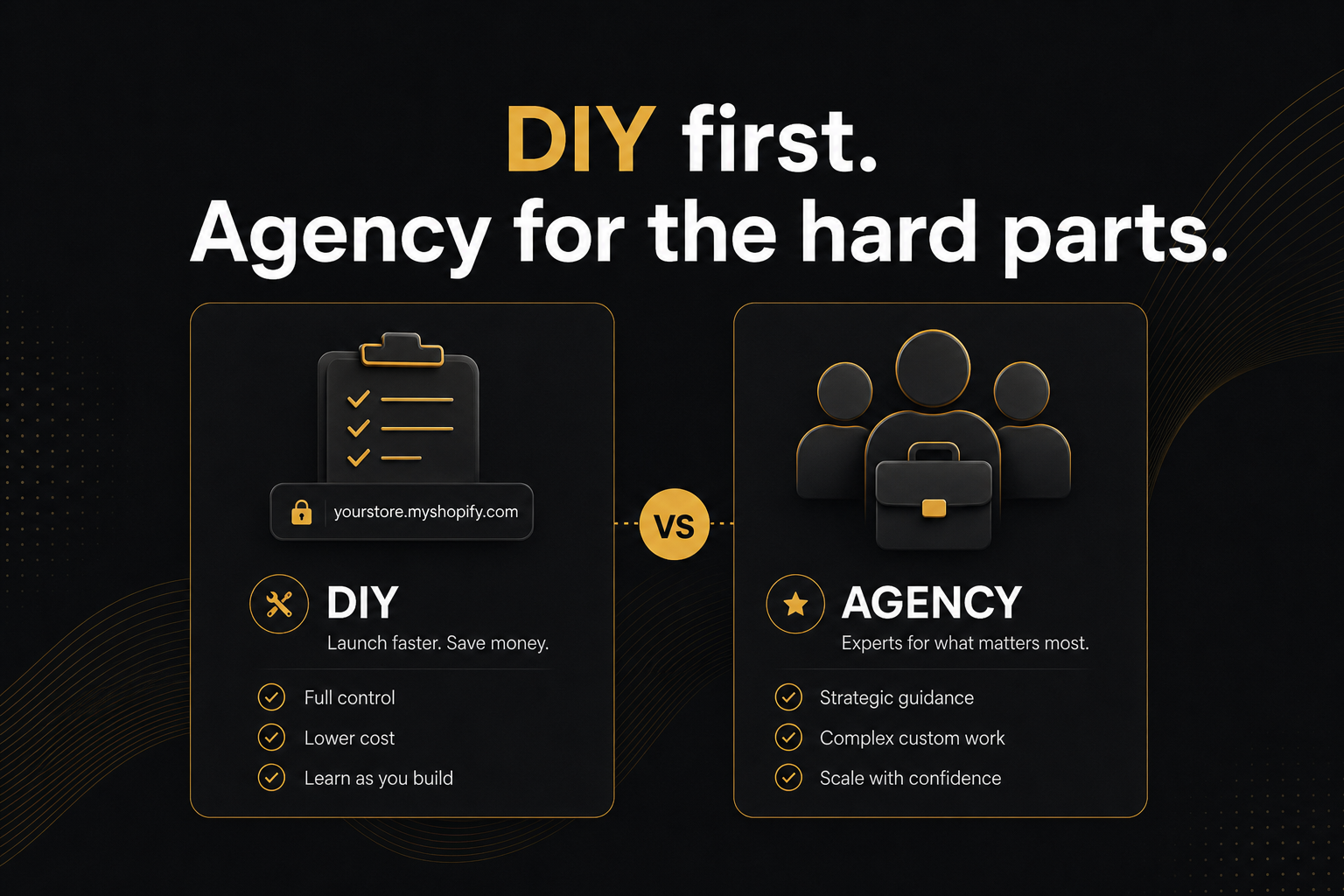
Key takeaways
- A pasteable public audit is the DIY store review. It is not a strategy engagement.
- Pay an agency for research, information architecture, and implementation you will not do this week.
- Bring the report URL to the kickoff. Agencies that ignore it will charge you to rediscover the punch list.
- Students and operators can produce a real artefact (badge + PDF) without pretending it is a 40-hour audit.
The search review my Shopify store splits into two buyers. One wants a punch list before lunch. One wants a partner. Mixing them up is how you pay $8,000 to hear that the product form is broken.
Do the cheap review first. Hire for what the cheap review cannot see.
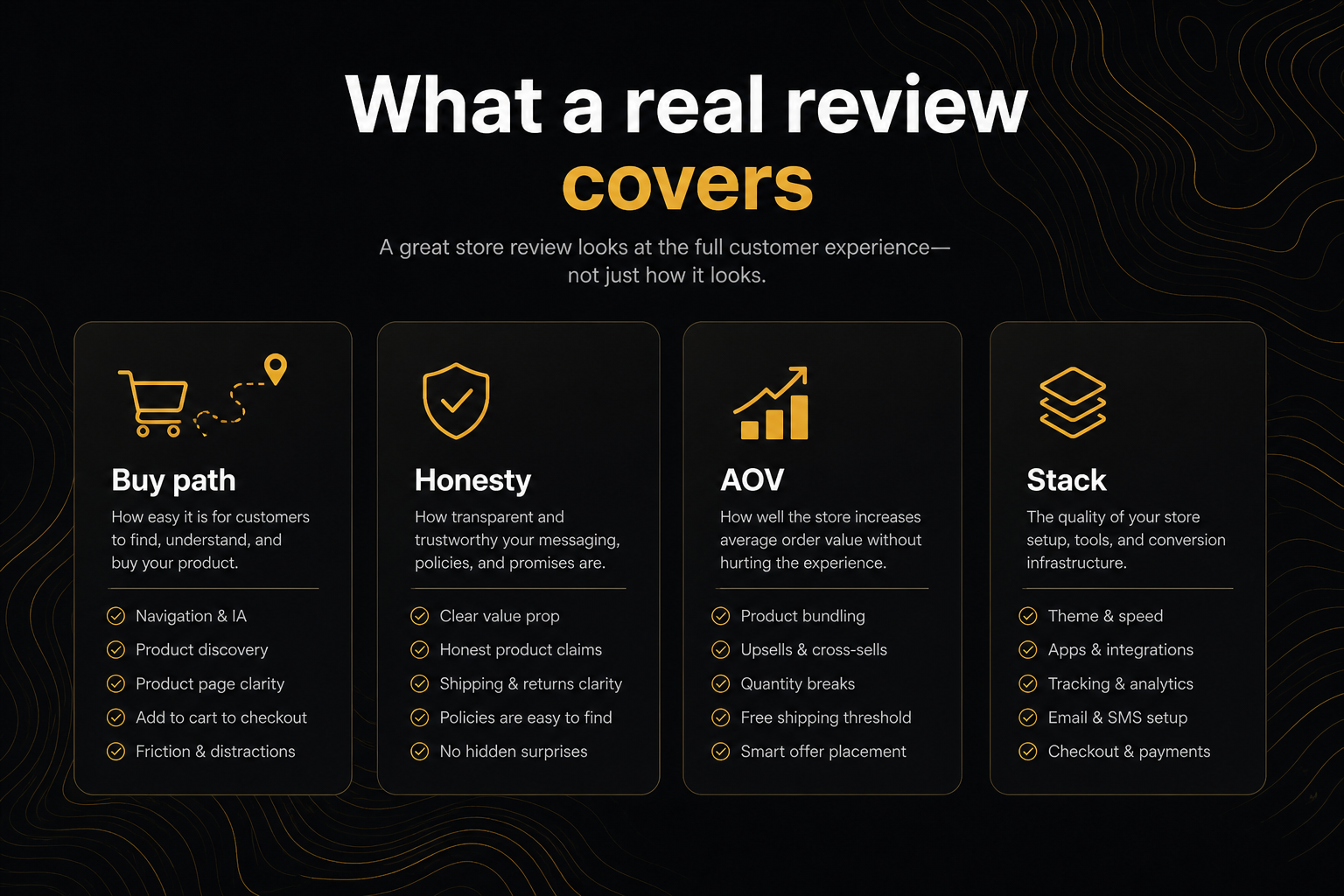
What DIY can honestly cover
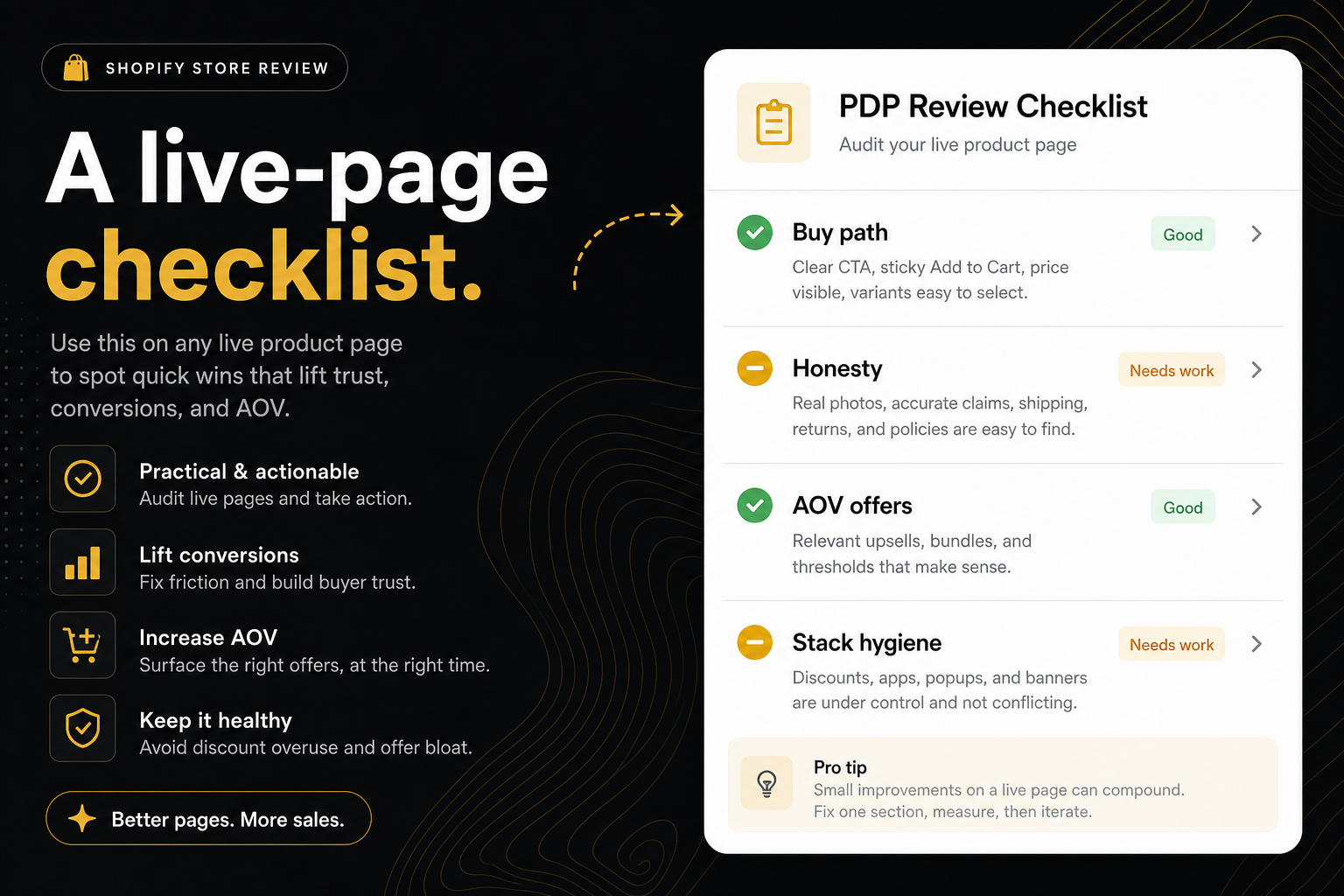
A stranger with a URL can see:
- Whether add-to-cart exists and survives scroll.
- Whether variants are pickable.
- Whether stock and price look honest.
- Whether media can carry a click.
- Whether the buy box has one primary and a pile of secondaries.
- Whether a bundle, goal, drawer, or popup is even present.
- Whether add opens a drawer or dumps to
/cart(if you click, or if an audit with Chromium clicks for you).
That is most of what a junior agency analyst would put on slides one through six. You can generate it with the CRO Audit for Shopify stores in minutes.
DIY cannot honestly cover:
- Why returning customers bounce (needs cohorts).
- Whether the offer should be a bundle or a subscription (needs margin and supply).
- Information architecture across 800 SKUs.
- Checkout extensibility, Shop Pay split, and payment apps.
- Creative fatigue.
- “Does this brand deserve a $180 AOV.”
If you need those, you need a human. If you do not have the punch list yet, you are not ready to brief the human.
What you are paying an agency for
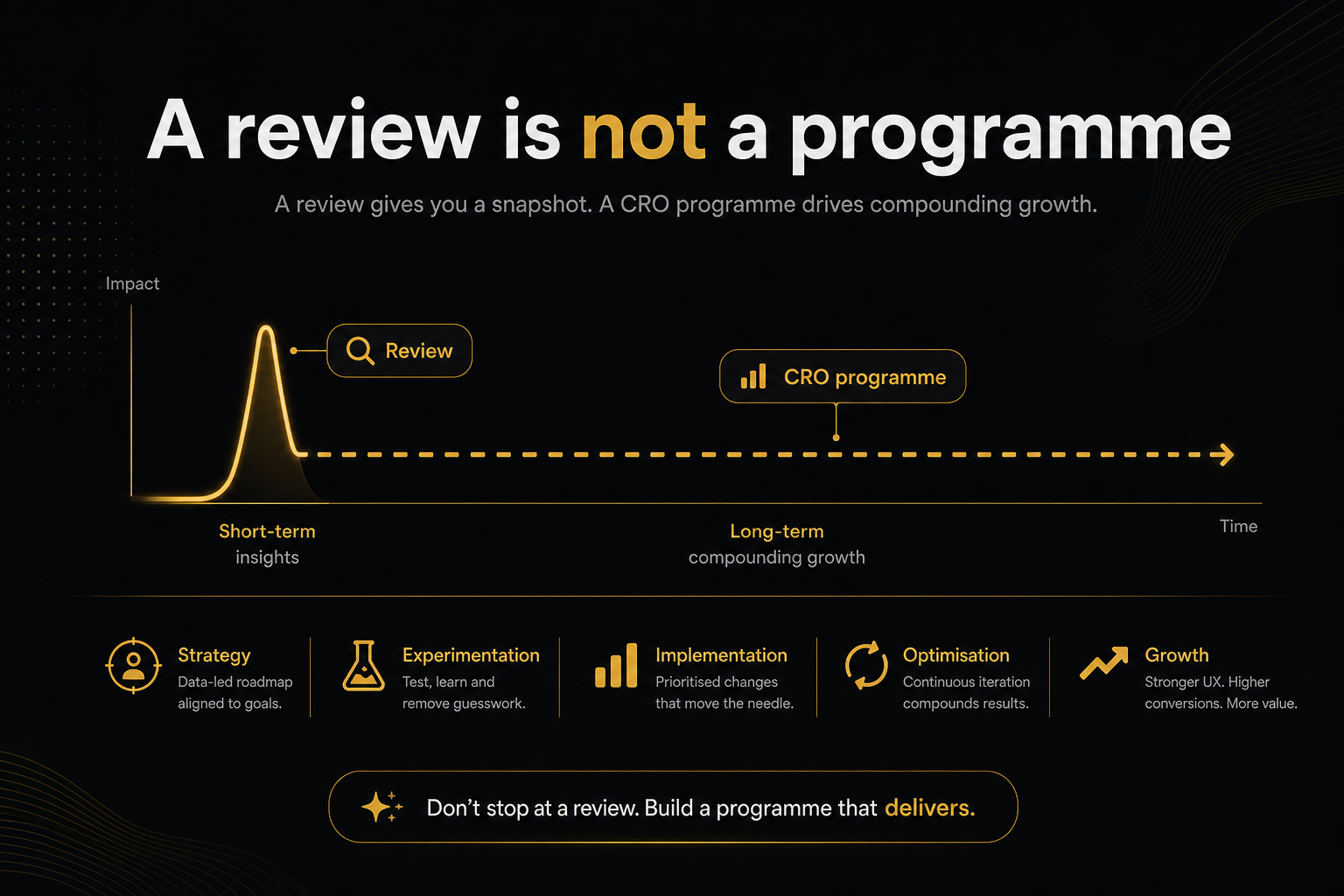
A good Shopify review engagement is mostly decisions and build, not discovery of public HTML.
Pay for:
- Interviews, session recordings, and a test backlog with owners.
- Theme work you will not do — variant UX, size charts, price honesty.
- App stack simplification (killing three offer widgets so one can work).
- Markets, B2B, Hydrogen — things a public crawl will refuse.
- A 90-day experiment cadence.
Do not pay for:
- A Lighthouse reprint.
- A colour workshop while ATC is dead.
- A 40-row SEO file titled “CRO.”
- Proprietary scoring that you are not allowed to recrawl yourself.
How to hire without getting a newspaper
Put this in the RFP:
- Here is the product URL.
- Here is the saved report.
- Top constraint is X. We will fix it in theme / app.
- We want you for Y (research, rebuild, tests) — not to repeat X.
If they start the kickoff by ignoring the report and crawling the homepage, they are running their template. Templates are fine when they add research. They are waste when they redo the public audit.
Ask who owns implementation. A review with no builder is a PDF. You already have a PDF.
How to fire a reviewer without drama
If two weeks in there is still no URL in the deck, end it. You do not owe a full month to a process that will not look at the page.
Pay for hours used. Keep the public audit. Hire a theme person for the constraint.
DIY sequence (one afternoon)
- Audit the landing SKU and the bestseller.
- Fix the constraint on both if it is the same theme bug.
- Pick one AOV miss that matches the business (bundle vs goal vs drawer).
- Recrawl.
- Write three sentences: what you fixed, what you will not touch, what a human would do next.
That write-up is the store review. Attach the badge if a teacher or a founder wants a cover.
Agency sequence (after DIY)
Week 0: read the report, confirm it on device, add analytics questions.
Week 1: one theme constraint and one offer, not a redesign.
Weeks 2–6: tests on the leftover leaks, with a kill list for overlapping apps.
If an agency wants six weeks before touching ATC, they are not reviewing the store. They are staffing a project.
Students, operators, agencies
Students. DIY is the assignment. Do not buy a review. Run the tool, cite the limits (no checkout, no admin), propose the next human step.
Operators. DIY monthly on the money SKU. Agency quarterly if you are stuck after the punch list is green.
Agencies. Use the public audit as intake. Charge for what you add. If your differentiator is “we looked at the HTML,” the client can paste.
When someone in your inbox says review my Shopify store, send them the audit link first. The ones who come back with a report URL are ready to be clients. The ones who want you to “just have a look” will still want that after they have the punch list — and then the look is cheaper, because the look has a brief.
Frequently asked questions
What is this score based on?
Ninety9’s product-page rubric — defaults we apply the same way on every public Shopify PDP. It is not a conversion-rate prediction, and it will not fit every store or situation. How we score.
Can I review my Shopify store myself?
Yes, for public buy-path and obvious AOV gaps. Paste the store, fix the top constraint, recrawl. That is a review. It is not a brand strategy.
When should I hire an agency instead?
When the page can sell and you still cannot explain the drop, when you need qualitative research, when you need a rebuild, or when you need someone to implement across Markets and checkout extensibility.
How much should a Shopify store review cost?
A public machine review is free. A senior audit with interviews and a test plan is a project. Do not pay project rates to be told your ATC is missing if you never pasted the URL.
Will an agency use the free CRO audit?
Good ones will, as a starting artefact. If they refuse any public crawl “because our process is proprietary,” ask what they will look at that a shopper cannot see — and whether that is the first week’s work.
I am a student. Is DIY enough for class?
For a product-page CRO assignment, yes. Submit the PDF and the badge QR. Say what you would hire a human for next. That sentence is the maturity.