 Addy
Addy  Addly
Addly  Goalify
  Monet
Monet  Reviso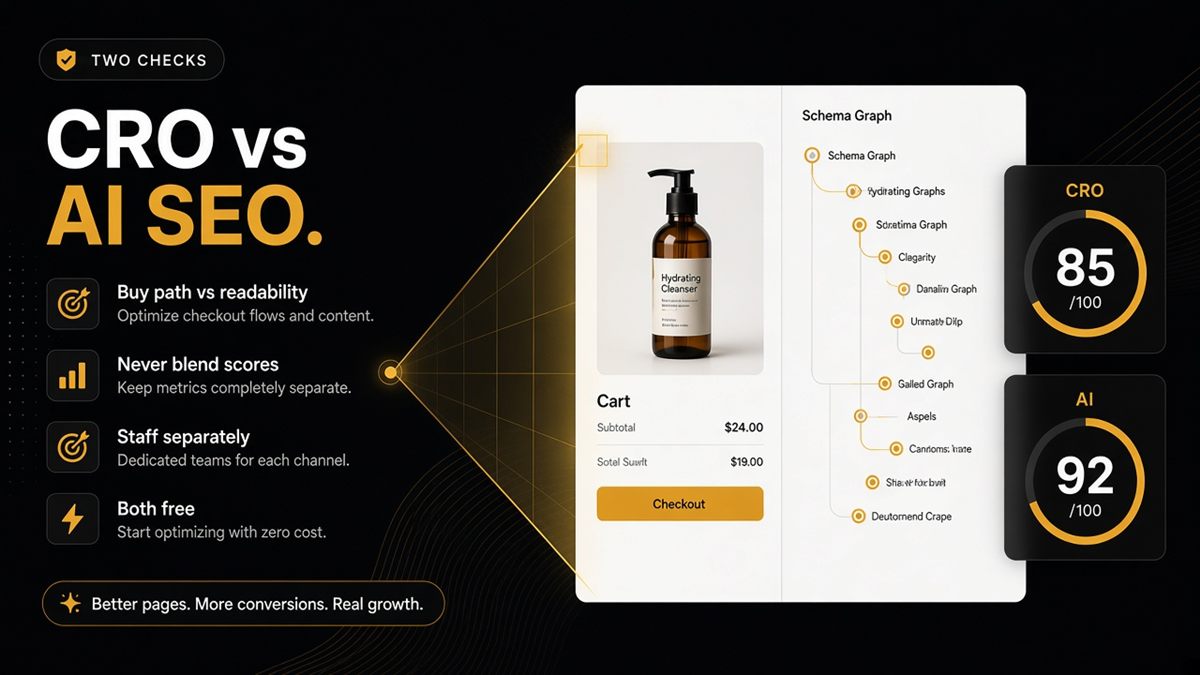
Key takeaways
- CRO asks whether a person can buy and grow the basket; the ChatGPT SEO check asks whether a model can read and quote the URL.
- Never average the two into one “site health” number — a blended score hides the next action.
- If ads are already live, fix CRO constraints first, but still schedule an AI readability pass the same week.
- Ninety9 offers both free tools on separate URLs with separate reports, so keep two punch lists.
- One opt-out meta tag can stop both checks; there is also a readiness-specific opt-out.
A CRO audit and a ChatGPT SEO check answer two different questions about the same Shopify store: the CRO Audit asks whether a shopper who lands on the page can buy easily and is nudged to buy more, while the ChatGPT SEO check asks whether an AI model or search engine can fetch the page and read its facts accurately. Run both, keep the results on separate punch lists, and never average them into one blended grade.
What is a CRO audit?
A conversion rate optimisation audit reviews the buying path a real person walks: is the buy path honest, is the add-to-cart clear, and does the page ask for a larger order? In other words, can a human buy, and does the store grow the basket? The free CRO Audit reads a public page and returns its findings as a separate report from the SEO & AI check.
What is the ChatGPT SEO check?
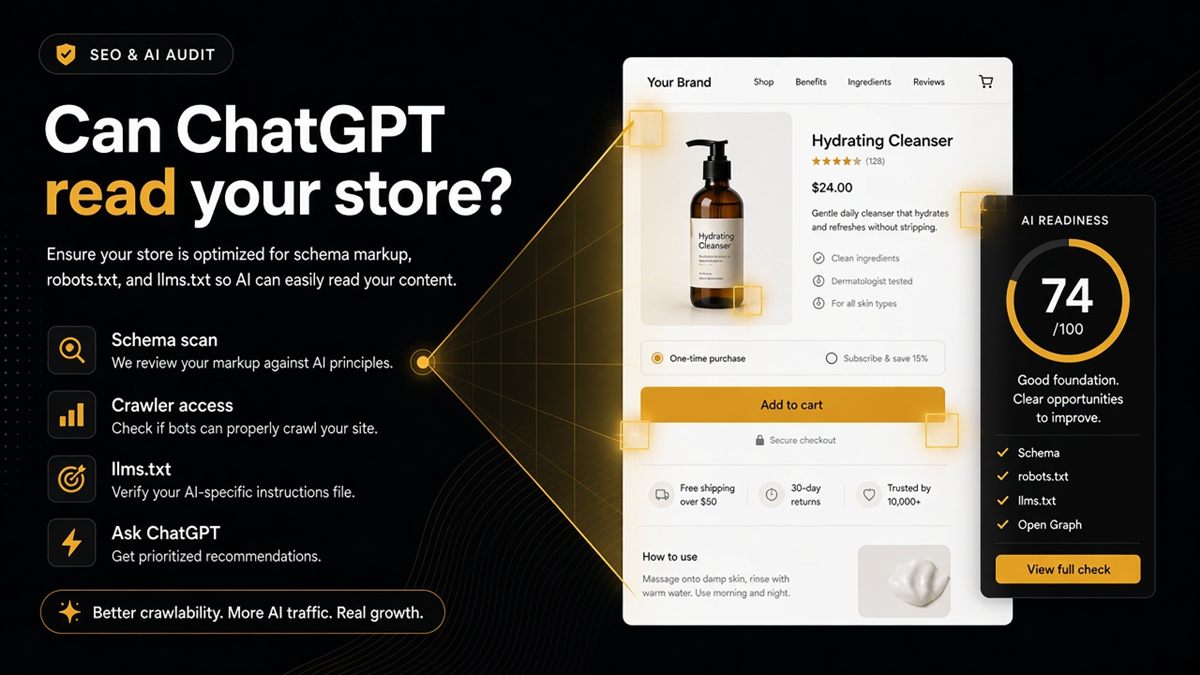
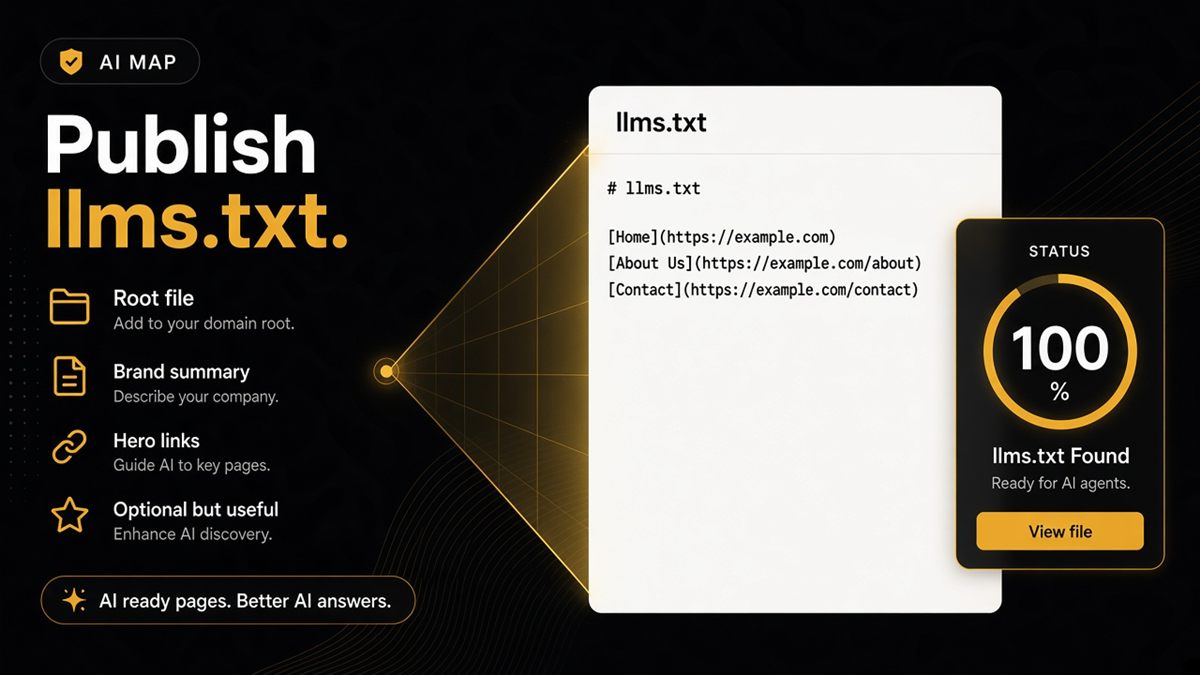
The ChatGPT SEO check for Shopify stores — also called the SEO & AI Audit — reads a public URL and reports whether structured data, robots.txt rules, canonical and preview tags and llms.txt are in shape so that ChatGPT, Perplexity, Claude and Google's AI surfaces are not guessing. It does not care whether the page converts. It cares whether a model can trust the price and the shop's identity.
Why do blended scores fail merchants?
A single "site health: 72" hides the next action. Consider the two extremes:
- A gorgeous schema graph does not revive a missing add-to-cart button. The store is perfectly citable and sells nothing.
- A product page that converts brilliantly but disallows GPTBot in robots.txt still loses every shopper who researched with an assistant first.
Averaging those two into one number produces a mediocre score that points at neither problem. Two separate lists point at both.
CRO Audit vs ChatGPT SEO check at a glance
| Question | CRO Audit | ChatGPT SEO check |
|---|---|---|
| Who is the "reader"? | A shopper with a card in hand | A crawler or AI model fetching HTML |
| What does a fail look like? | A buy path that is not honest, a page that never asks for a larger order | noindex, blocked GPTBot, price missing in markup, no llms.txt |
| Who fixes it? | Merchandiser, designer, app settings | Theme developer, SEO app settings, robots.txt.liquid |
| What does success look like? | Higher conversion and average order value | Accurate answers and citations from assistants |
| Best URL to test | The product page your ads land on | Homepage, that product, and the shipping policy |
How to schedule both in one week
- Monday — CRO on the ad product. Paste the product page that receives paid traffic into the CRO Audit. Log each fail as a ticket for the merchandising or design owner.
- Tuesday — SEO & AI on three URLs. Paste the homepage, the same product and your shipping policy into the ChatGPT SEO check for Shopify stores. Log fails for the theme developer or the SEO app owner.
- Wednesday — tickets. Group theme fixes so they ship in one deploy. Keep copy and offer changes separate.
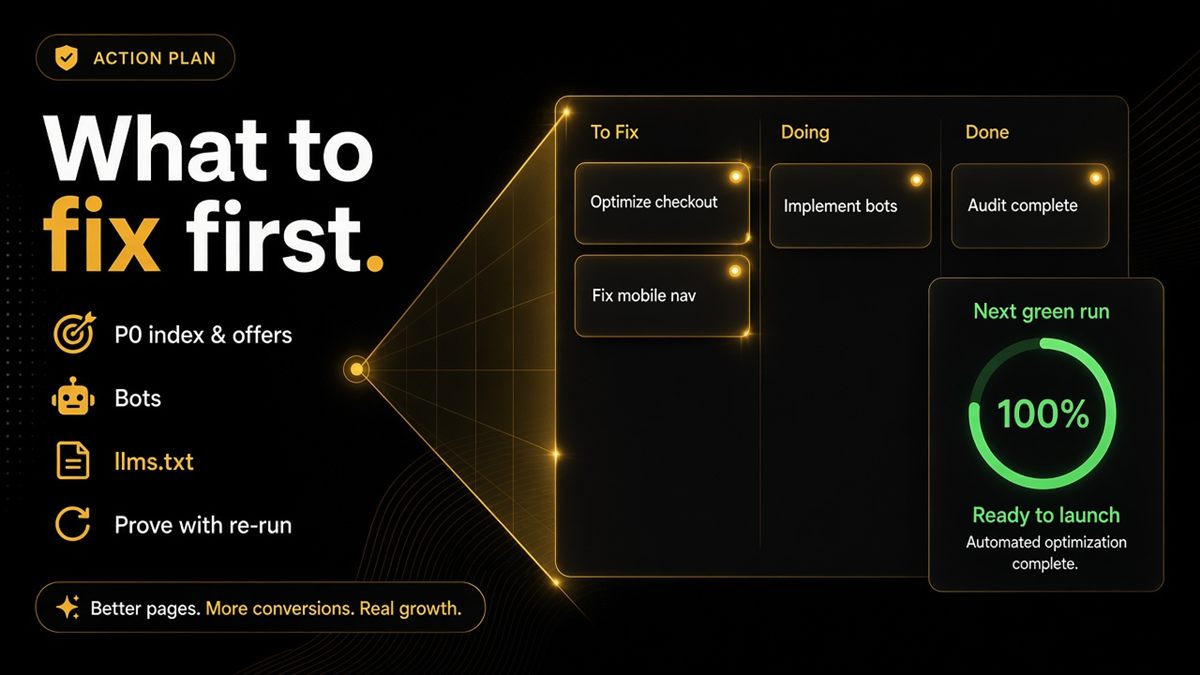
- Thursday — re-checks. Re-run both tools on the same URLs and record which rows flipped.
- Friday — decide. Anything still red gets an owner and a date, or a written decision to leave it.
A worked example
Say you run a skincare store with a £34 hero serum and paid social sending 2,000 visits a week to its product page. Your CRO punch list says the page never asks for a larger order and the buy path is cluttered. The SEO & AI Audit flags GPTBot blocked and no Product price in markup.
Fixing the CRO items could lift orders from the traffic you already pay for this week. Fixing the readability items lets the shoppers who ask an assistant "best serum under £40 that ships to the UK" actually find you next month. Neither fix substitutes for the other, and neither team should wait for the other.
Common mistakes when running both
- Asking the theme developer to "improve conversion" and the merchandiser to "fix schema". Match the fail to the person who owns that layer.
- Reporting one averaged score to a founder or client. Show two slides, two punch lists, no average — the agency version of this advice applies to in-house teams too.
- Expecting structured data to lift conversion, or a new upsell to earn citations.
- Running the tools once and treating the result as permanent. Theme updates and app installs regress both.
- Forgetting that the CRO opt-out meta tag also stops the SEO & AI check when you later want to test.
When to run only one
If your store is deliberately closed to AI crawlers for legal reasons, the SEO & AI Audit will keep showing intentional reds; document the decision and run CRO alone. If you are pre-launch behind a password, the reverse applies — fix readability of templates now and run CRO once real traffic arrives. Everyone else should run both.
How to measure the results separately
Track conversion rate and average order value for the CRO changes, using your Shopify analytics on the specific product. Track the SEO & AI changes by re-running the same URLs and confirming rows flipped from fail to pass, then spot-checking assistant answers against the real page. Do not look for AI citation counts unless you have a repeatable sampling method; otherwise you are measuring anecdotes.
Run both. Staff the reds in the system they belong to.
Frequently asked questions
Which should I run first, the CRO Audit or the ChatGPT SEO check?
If paid traffic already lands on your product pages, start with the CRO Audit because every leak costs money today. If organic or AI-assistant discovery is the goal this quarter, start with the ChatGPT SEO check. In most stores you run both in the same week.
Do the CRO Audit and the SEO & AI Audit share a score?
No. They use separate rubrics on separate pages and produce separate reports. That is deliberate: a conversion problem and a readability problem need different owners and different fixes.
Will fixing schema lift my conversion rate?
Not directly. Structured data helps discovery and lets assistants quote accurate prices and policies. Conversion is still decided by the add-to-cart path, offer design and trust on the page.
Can one meta tag block both checks?
Yes. The CRO Audit opt-out meta tag also stops the SEO & AI Audit. There is also a readiness-specific opt-out if you only want to block the AI readability check.
What is the difference between a CRO audit and an SEO audit on Shopify?
A CRO audit reviews whether a shopper who has already arrived can buy easily and is asked to buy more. An SEO or AI readability audit reviews whether search engines and AI models can fetch and understand the page in the first place.
How often should I run each check?
Run the CRO Audit whenever you change a product template, offer or cart flow. Run the ChatGPT SEO check after any theme update, SEO app install or robots.txt edit. Re-running the same URLs is what makes the results comparable.